


How to Set Up A Company in Dubai to Pay No Tax 2026


Table of Contents
Quick Answer
To set up a company in Dubai, start by defining your business activities and choosing a suitable jurisdiction. Then confirm the registration requirements, prepare your documents and plan your budget. The appropriate route depends on your ownership structure, operating needs and any approvals required for your chosen activities.
About the Author
The author is a tax consultant with over a decade of experience helping international entrepreneurs and SMEs navigate UAE Corporate Tax compliance, VAT, and regulatory frameworks. Having guided clients across Europe, Asia, and the Middle East through free zone setups, offshore structures, and corporate banking, understanding the full regulatory ecosystem businesses operate in, ensuring tax filing aligns with broader compliance obligations.
Key Takeaways:
- 0% is a status you must qualify for, not a default. A Dubai Free Zone license alone no longer means zero tax. Only a Qualifying Free Zone Person (QFZP) pays 0% on qualifying income, and failing any one of the four cumulative conditions (substance, qualifying income, transfer pricing compliance, no permanent establishment exposure) locks you into 9%, potentially for five years.
- The 5% de minimis rule is the most common failure point. Non-qualifying revenue must stay under 5% of total revenue or AED 5 million ($1.36 million), whichever is lower. The article's case study shows even a 6.85, 7% non-qualifying ratio disqualifies the entity entirely, which is why quarterly tracking (with escalation at 3%) is essential rather than a year-end calculation.
- Small Business Relief ends with 2026 tax periods, so the bridge is closing. Resident entities at or below AED 3 million ($816,800) in revenue can currently elect zero taxable income, but not for periods ending after 31 December 2026, and not alongside QFZP status. Founders relying on it must decide now whether their 2027 structure is a QFZP, a mainland company, or a split.
How to Set Up a Tax-Free Company in Dubai and Legally Pay 0% in 2026
Can you still run a tax-free company in Dubai in 2026? Yes, but not the way most websites describe it.
We have structured over 400 Free Zone entities in the UAE, and the biggest shift since the Corporate Tax Law took effect is this: a Dubai license no longer means zero tax. It means you may qualify for zero tax, provided you meet a specific set of conditions.
Get them right, and you pay 0% on qualifying income. Get them wrong, and you pay 9%, not just for one year but potentially for five.
This guide is what we tell clients before they incorporate. It is built around the legislative framework (Federal Decree-Law No. 47 of 2022, Cabinet Decision No. 100 of 2023, and Ministerial Decision No. 229 of 2025) rather than the marketing promises that still circulate online.
Note: While the AED is pegged to the USD, all prices are estimates based on current market rates. Actual charges may differ due to bank transfer fees.
The Only Legal Path to 0% Corporate Tax: Qualifying Free Zone Person (QFZP) Status
Every company established through free zone business setup in the UAE is a taxable person. The 0% Corporate Tax rate is not automatic; it applies to the qualifying income of a Qualifying Free Zone Person (QFZP). Even if your company expects to pay no Corporate Tax, it must still register with the Federal Tax Authority (FTA) and file its returns.
To become a QFZP, you must satisfy four cumulative conditions:
- Maintain adequate substance in the Free Zone
- Derive only Qualifying Income, or stay within the de minimis threshold
- Comply with transfer pricing rules
- Ensure no income is attributable to a Domestic or Foreign Permanent Establishment
Fail any one, and you lose the status from the beginning of that tax period and for the following four periods.
That five-year lockout is the detail most founders miss. One careless mainland invoice in year one can cost you the 0% rate through year five.
Is There Corporate Tax in Dubai Free Zones?
Yes. Free Zone companies fall under UAE Corporate Tax like any other business. Qualifying income is taxed at 0% only while the company holds QFZP status, otherwise, the standard 9% rate applies to taxable income above AED 375,000.
The 5% De Minimis Rule: How Much Non-Qualifying Income Is Allowed?
The de minimis rule exists, but it is narrow. Non-qualifying revenue must not exceed 5% of total revenue or AED 5 million (approximately $1.36 million), whichever is lower. Cross that line, and you lose QFZP status entirely, not just on the non-qualifying portion.
Consider a Dubai-based software company we advised:
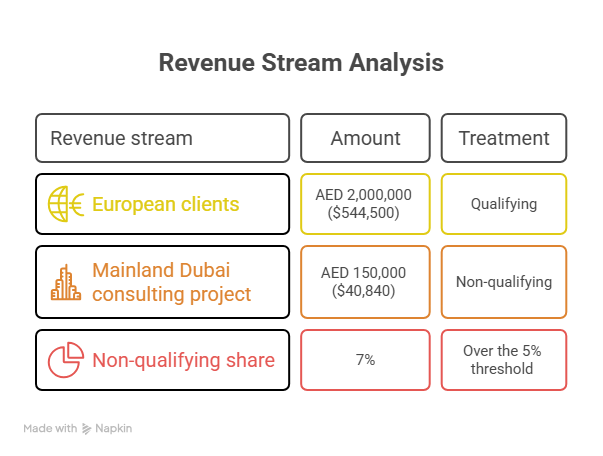
The consequence: the full taxable income faced the 9% rate, and the company was locked out of QFZP status for four additional years.
The FTA's own guidance includes worked examples showing how even a 6.85% non-qualifying ratio disqualifies an entity entirely.
How to Calculate Your De Minimis Ratio
We build a quarterly de minimis tracker into every client's compliance calendar. Waiting until year-end to calculate it is how founders discover a problem too late.
Economic Substance in a UAE Free Zone: What the FTA Actually Audits
The Economic Substance Regulations era taught the FTA how to audit "mind and management." A flexi-desk and a PO Box no longer suffice for any business generating meaningful revenue. The law requires adequate assets, qualifying employees, and operating expenditure commensurate with the activity conducted in the Free Zone.
We have seen audit queries that ask for:
- Board minutes showing where strategic decisions were made
- Employment contracts proving staff are actually in the UAE
- Statements from the company's corporate bank account in the UAE showing operational spending flows through the Free Zone entity
One client, a holding company with AED 8 million ($2.18 million) in assets, initially ran everything from London. The FTA queried the "place of effective management."
We restructured the board meeting schedule and appointed a UAE-resident director. It was not optional; it was the difference between 0% and 9%.
Audited financial statements are mandatory for every QFZP, regardless of turnover. This is a hard cost, typically AED 15,000–40,000 ($4,085–10,890) annually depending on complexity. Budget for it before you incorporate.
Qualifying Activities Under Ministerial Decision 229 of 2025: Does Your Revenue Fit?
Not all income counts. Qualifying Activities are narrowly defined and include:
- Manufacturing, logistics, and distribution of goods in or from a Designated Zone
- Holding shares, headquarters services, and treasury and financing to related parties
- Ship management, aircraft leasing, and regulated reinsurance
- Fund and wealth management
What does not qualify? Income from transactions with natural persons (with limited exceptions), regulated banking and insurance, and income from immovable property outside specific Free Zone commercial property transactions.
If you sell services to a mainland company and that activity is not on the list, that revenue is non-qualifying, and it counts against your 5% de minimis allowance.
We advise clients to map every revenue stream against this list before applying for a trade license. If your business model is predominantly mainland-facing consulting, a QFZP structure may not be the right fit. Small Business Relief, available for resident entities with revenue at or below AED 3 million ($816,800), might be the more honest short-term route while you restructure.
Can a Free Zone Company Work With Mainland UAE Clients?
Yes, within its license terms, but mainland income is generally non-qualifying. Freelancers and consultants serving mostly mainland clients usually exceed the 5% cap, so the 9% rate likely applies.
NEW: Small Business Relief Ends With 2026 Tax Periods
Small Business Relief covers tax periods ending on or before 31 December 2026, so for calendar-year companies 2026 is the final year. It is not available to a QFZP or to members of large multinational groups.
If relief has been your bridge, decide now whether your 2027 structure is a QFZP, a mainland company, or a split between the two.
Corporate Tax Enrollment, Filing Deadlines and Your Compliance Calendar
Enrollment is step one, not the finish line. UAE Corporate Tax enrollment through the EmaraTax portal must be completed within the prescribed deadline; missing it triggers an AED 10,000 ($ 2,723) penalty. The tax return is due within nine months of your financial year-end.
Beyond filing and annual license renewal, QFZP status needs a quarterly review of three numbers:
- Total revenue for the quarter
- Non-qualifying revenue for the quarter
- The resulting non-qualifying ratio
If the ratio approaches 3%, escalate. That buffer prevents a late-year contract from tipping you over 5% without warning.
Transfer pricing is the other quiet risk. If you have related parties abroad, your intercompany pricing must be arm's-length. The FTA has been requesting transfer pricing documentation in QFZP audits. A GBP 50,000 management fee from a UK parent that cannot be substantiated is a red flag.
Do I Need to Enroll for Corporate Tax if I Owe Nothing?
Yes. The FTA has confirmed that all Free Zone Persons must enroll, regardless of expected tax liability.
Large Groups and the 15% Domestic Minimum Top-up Tax
QFZP status does not protect every business. Since 1 January 2025, UAE entities of multinational groups with consolidated revenue of EUR 750 million or more face a Domestic Minimum Top-up Tax that lifts their effective rate to 15%. For a Free Zone subsidiary, that can largely cancel the 0% benefit.
How RadiantBiz Structures Free Zone Companies for 0% Tax
We work with founders at the pre-incorporation stage because that is when the structure can still be shaped. Our team, led by Rizwan Ansari, a former banker with over 15 years at institutions including ADCB, Barclays, and Standard Chartered, has supported more than 15,000 free zone and mainland company formations across the UAE. That banking background means we know what the FTA and the banks look for.
Our QFZP setup service begins with a revenue-mapping session that stress-tests your client list, contract types, and growth plan against the Qualifying Activities list and the de minimis threshold.
If the numbers do not work for 0%, we say so and propose alternatives. If they do, we build the compliance calendar, coordinate the audit, and handle Corporate Tax enrollment and filing. The goal is not to sell you a license, it is to build a structure that survives an audit.
Structure First, License Second
The tax-free company in Dubai still exists, but it is now a status you earn through structure, documentation, and discipline. Too many founders buy a Free Zone license expecting automatic zero tax, then discover a 9% liability and a five-year lockout.
Before you sign a lease or pay an enrollment fee:
- Map every projected revenue stream
- Run the de minimis calculation on your first-year income
- Confirm your activity fits the Qualifying Activities list
If the numbers are tight, get advice before incorporation, not after.
Ready to test your structure? Contact RadiantBiz for a QFZP eligibility review. We will tell you plainly whether 0% is realistic, or whether a different structure serves you better.
Seek our professional on-the-ground guidance, contact us via mail at info@radiantbiz.com, WhatsApp, or call us at +971521322895!



With over 15 years of experience in the banking and business consulting sector, Rizwan Ansari leads RadiantBiz with a vision to simplify business setup in the UAE.