
Saudi Arabia


Commercial enrollment in Saudi Arabia records a business in the official commercial register. To prepare an application, identify your business activity and legal structure, check the requirements for your ownership profile, and gather the required documents. Foreign investors should also check the applicable Ministry of Investment registration requirements before proceeding.
The author is a business setup consultant who has spent over a decade advising foreign investors on GCC market entry, handling commercial enrollments across manufacturing, technology, professional services, and trading sectors, and working with clients from initial activity mapping through full operational setup.
Key Takeaway:
Let's start with a number that stops people cold: Saudi Arabia issued 9,018 investment licenses in the second quarter of 2026 alone, a 252% jump from the same period last year. Foreign companies are moving in, and company formation in Saudi Arabia is accelerating fast.
The regulatory door has genuinely opened under Saudi Vision 2030. The old foreign investment license was replaced with a simpler MISA enrollment, and in most sectors you can now own 100% of your Saudi entity.
But here's what the brochures don't tell you: Saudi Arabia expects substance. Real offices. Real Saudi hires. Real capital deployed.
We tell every client to treat this as a strategic foreign direct investment, not a compliance checkbox. Companies that cut corners on the front end pay for it in delays, remediation costs, and lost market opportunities.
Note: Currency conversions in this article are based on the pegged exchange rate of SAR 3.75 = $1 and are provided for general reference only. Actual fees should be verified with the relevant Saudi authorities or our qualified advisors before making financial decisions.
You have three realistic options. Choose wrong, and you'll be restructuring within eighteen months.
Expert advice: If you're in manufacturing, logistics, consulting, or most service activities, go with the LLC. Don't overthink it. The joint venture route adds complexity and partner risk that most companies don't need.
Yes, in most sectors. Under MISA's investment enrollment system, foreign investors can hold 100% of a Saudi LLC unless the activity is on the restricted or excluded list. Restricted activities need a Saudi partner or sector approval, so confirm your activity code first.
We cannot overstate this: document preparation is the critical path. Everything else waits on it.
Your corporate documents (certificate of incorporation, board resolution authorizing Saudi investment, audited financials, and power of attorney) must travel through a four-stage authentication chain:
A UAE free zone or mainland company should budget two to four weeks for this alone. From a non-Hague jurisdiction, add another week or two. We've seen companies lose a full month because a single board resolution was stamped by the wrong official.
The financial statements requirement catches people off guard. MISA wants the parent company's last fiscal year financials, authenticated by the Saudi embassy. If your financials are more than six months old, get fresh ones.
Applications go through the Invest Saudi portal at investsaudi.sa, with no office visit required. Standard processing runs five to fifteen business days, and the MISA FAQ states review takes up to ten days.
The rejection triggers we see most often:
MISA issues the investment enrollment in Arabic only, so you'll need a certified translation for your bank and other government entities.
MISA enrollment gives a foreign investor permission to invest in Saudi Arabia. The Commercial Enrollment, issued by the Ministry of Commerce, legally creates the company so it can trade, sign contracts, and bank. You need MISA approval first, then the Commercial Enrollment.
Once MISA approves, the Commercial Enrollment through the Ministry of Commerce is processed in 72 hours. Here's the catch: it requires a physical, Ejar-certified office. Flexi-desks are not accepted for foreign-owned entities, and we've watched clients scramble for compliant space at the last minute.
Plan for eight to twelve weeks with documents ready: two to six weeks for attestation, five to fifteen business days for MISA, and about 72 hours for the Commercial Enrollment. Banking and visas follow, so full operations take longer.
Government fees are the smallest part of your business setup cost in Saudi Arabia; office location and advisory scope drive the rest.
Getting your Commercial Enrollment is not the finish line. It's the starting gun for a separate set of obligations.
VAT enrollment with ZATCA is mandatory once taxable supplies exceed SAR 375,000 ($100,000) a year. The rate is 15%, triple the UAE's 5%, and Fatoorah e-invoicing is mandatory.
Foreign shareholders' profit share faces 20% corporate income tax, while Saudi and GCC shareholders' share falls under Zakat at 2.5% of the Zakat base.
The trap: Zakat is charged on adjusted net worth, not profit. A heavily capitalized, loss-making company may owe Zakat while paying zero income tax. Model this before finalizing your capital structure.
Saudization applies from your first hire. The Nitaqat system, tracked through Qiwa, classifies entities by their ratio of Saudi to expatriate workers within their sector. Over-hire expatriates in year one, and your work visa and Iqama quota tightens in year two.
Saudi Arabia's Companies Law, in force since January 2023, requires companies to identify their beneficial owners and keep that record current with the Ministry of Commerce. For foreign-owned LLCs, that means tracing ownership through every holding layer to the individuals who ultimately own or control the company.
Prepare an ownership chart and passport copies for each ultimate owner during attestation, not after the Commercial Enrollment is issued. Any share transfer, new investor, or change in control needs a matching update. Mismatches between your MISA file, Commercial Enrollment, and ownership record are a common reason banks slow down account opening during KYC.
Most of our Saudi clients already run a UAE company, and the two systems differ more than founders expect.
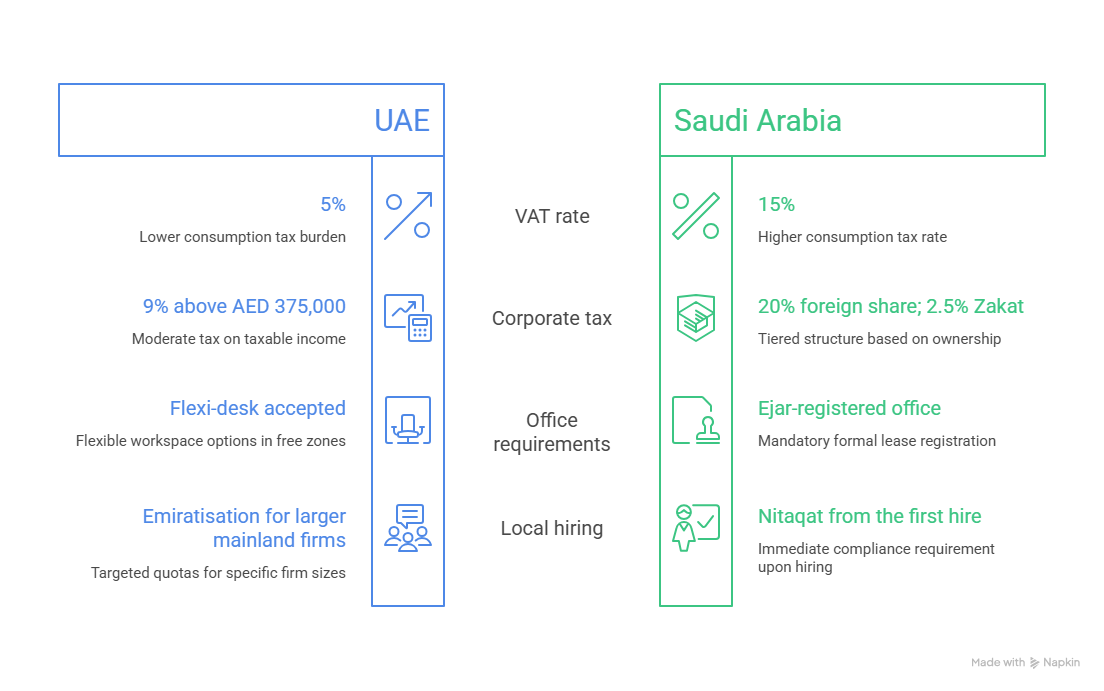
Dividends paid from a Saudi subsidiary to a UAE parent generally attract 5% Saudi withholding tax. Whether they qualify for the UAE participation exemption depends on ownership and holding conditions. Model both sides before choosing which entity holds the Saudi shares.
A European industrial equipment manufacturer navigated MISA alone for four months. Their activity code was too narrow, their financials were outdated, and they had no office. We restructured the application, engaged Saudi legal counsel for their articles of association, and had them operational in nine weeks. The advisory cost was SAR 45,000 ($12,000), a fraction of what they lost in delays.
RadiantBiz KSA was founded by Rizwan Ansari, who spent over a decade in banking with leading UAE institutions. That background means faster corporate bank account opening in Saudi Arabia, the step that delays most setups by weeks. We've completed 15,000+ business setups for clients from 160+ countries, are rated 4.5/5 on Trustpilot across 90+ reviews, and have been profiled in Gulf News.
Our Saudi team handles the full lifecycle:
Yes, with a major constraint. Under the Commercial Agencies Law, only Saudi nationals or wholly Saudi-owned companies can act as agents or distributors, and the agreement must be enrolled with the Ministry of Commerce within three months. A replacement can't be enrolled until the prior agreement is formally dissolved.
No. MISA and Ministry of Commerce enrollment are fully electronic, and attestation runs through Saudi embassies abroad. You will need a local authorized signatory for some steps and someone on the ground to open the bank account.
Choosing activity codes that are too narrow. Saudi Arabia uses a national activity classification system. Too narrow blocks revenue streams you planned, and too broad triggers scrutiny or rejection. We've seen companies spend months amending their Commercial Enrollment over this.
The companies that succeed in Saudi Arabia build their timeline around substance, not paperwork. Get the entity structure and activity codes right, prepare documents meticulously, and budget for the office, Saudization, and Zakat before you commit.
Start with the MISA portal and engage Saudi legal counsel for your articles of association. The advisory cost, SAR 15,000 to 75,000 ($4,000 to $20,000), is the highest-return investment you'll make here.
Seek our professional on-the-ground guidance, contact us via mail at info@radiantbiz.com, WhatsApp, or call us at +971521322895!
