
.png)

.png)

2.avif)
Import-Export Business in Dubai License, Setup & Requirements

Table of Contents
About the Author
The author is a business consultant specializing in import-export operations, commodity trading, and corporate setup in the UAE. With over a decade of experience advising local and international clients, having helped more than 15,000 companies navigate licensing, regulatory compliance, and operational planning for global trade, logistics, and freight management.
Key Takeaway:
- Jurisdiction is everything, the mainland gives you UAE market access but needs a physical office. Free zones are cheaper but lock you out of direct mainland sales.
- The quoted price isn't the full price, most quotes hide the separate AED 15,000 ($4,050) activity fee. Real first-year mainland cost is AED 28k–40k+ ($7.6k–$10.8k+) before rent.
- The 2026 HS Code shift is a deadline, not a suggestion. Dubai Customs moves from 8 to 12 digits in phases from Aug 2025–Feb 2027. Outdated codes mean delays, fines, or rejected shipments. Free zones are exempt.
Dubai General Trading License Cost 2026: Customs Changes, Jurisdiction Tips & Q1 Trade Insights
Dubai's trade volumes rose 7.2% year-on-year in Q1 2025, and the city sits where the shipping lanes of Asia, Europe, and Africa meet.
For traders, that intersection is the whole business case. For entrepreneurs trading across multiple product categories, the general trading license remains the most flexible and cost-effective way in.
We've guided over 15,000 businesses through their UAE setup during this decade. Below are the real costs, the 2026 customs change that will affect your shipments, and the jurisdiction decision that defines your business model.
Note: All prices are estimates based on market rates at the time of publication. Actual costs may vary due to daily exchange rate fluctuations and potential bank transfer fees.
What a Dubai General Trading License Actually Permits
A general trading license is a type of commercial license issued by the Department of Economy and Tourism (DET) for mainland companies, or by a free zone authority for free zone companies.
It lets one legal entity import, export, distribute, store, and sell multiple unrelated product categories under a single license. The DET lists over 2,100 approved trading activities, and the general trading category gives you the broadest coverage.
You can trade consumer electronics, textiles, building materials, and household goods at once, with no separate license per category.
Which Products Need Extra Approvals?
A general trading license covers most unregulated goods. Several categories need separate approvals:
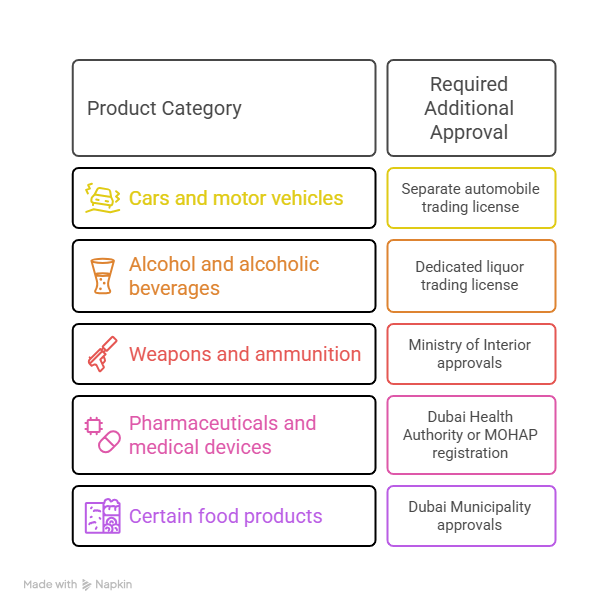
For any of these, add the relevant specialised activity to your license and obtain the required No-Objection Certificates (NOCs) before trading.
Mainland vs Free Zone Trading License: Which is Right for Your Import-Export Business?
This is the single most consequential decision you'll make. In our experience, choosing the wrong jurisdiction is the most common, and most expensive, mistake new traders make.
The Dubai Mainland Trading License Route (DET)
A Dubai mainland company licensed with DET can sell directly to any buyer in the UAE without restriction. Here are the features of the mainland jurisdiction:
- Physical office mandatory: A mainland general trading company needs a physical, Ejari-certified tenancy. Flexi-desks do not satisfy the DET requirement.
- 100% foreign ownership: Under the 2021 commercial law reforms, full foreign ownership is now available for most activities.
- Government contracts: Eligible to bid on substantial government supply contracts.
- First-year cost: AED 28,000 to 40,000+ ($7,560 to $10,800+) before office rent.
Can a Foreigner Own 100% of an Import-Export Company?
Yes, since the 2021 reforms, foreign investors can own 100% of a mainland trading company for most activities, with no local sponsor. Free zones have always allowed full ownership.
Expert insight: Before anything, confirm your activity isn't on the restricted "strategic impact" list.
The Dubai Free Zone Trading License Route
A free zone trading company offers 100% foreign ownership, import duty deferral and customs duty benefits, and lower initial licensing costs. Other features include:
- Mainland limitation: Cannot sell directly to UAE mainland businesses without a licensed mainland distributor or separate entity.
- Flexi-desk accepted: Most free zones accept flexi-desk arrangements.
- Tax benefits: Corporate tax exemptions for qualifying activities, verify your zone's status under the corporate tax framework.
- First-year cost: From approximately AED 12,500 ($3,375) (non-visa package).
Mainland or Free Zone: Which Should You Choose?
Choose mainland if your primary customers are UAE-based and you need direct domestic access. Choose a free zone if your model is primarily international: importing goods, holding them under a free zone authority, and handling re-export to GCC and regional markets.
General Trading License Cost in Dubai: The Real First-Year Breakdown
How Much Does an Import Export License Cost in Dubai?
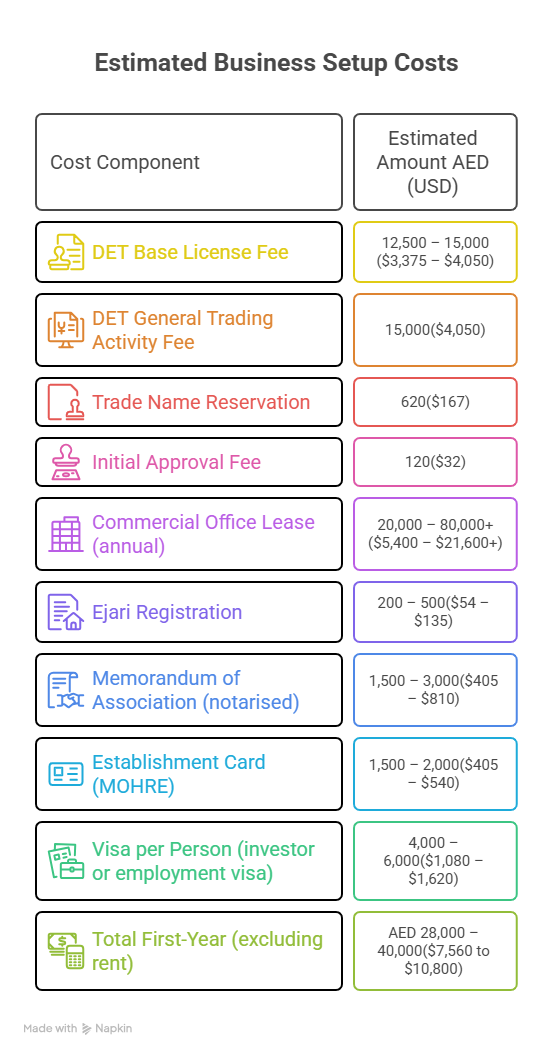
A mainland general trading license costs roughly AED 28,000 to 40,000 ($7,560 to $10,800) in the first year, excluding rent. That includes the base DET license fee and the separate general trading activity fee of about AED 15,000 ($4,050), which most single-number quotes leave out. Free zone packages start from around AED 12,500 ($3,375) (non-visa).
Is there a Minimum Capital Requirement for a Trading License?
No, the DET sets no minimum paid-up capital for most general trading LLCs. But when you open a corporate bank account, banks usually want a capital figure declared in the MOA. A declared range of AED 50,000 to 300,000 ($13,500 – $81,000) is what most banks are comfortable with.
How to Get an Import Export License in Dubai: Step-by-Step
1. Define your activities
Confirm your products are permissible via the DET activity list on the Invest in Dubai portal.
2. Choose a structure and trade name
Usually an LLC for the mainland, reserve a compliant trade name.
3. Get initial approval
Submit through Invest in Dubai, the system flags any external approvals.
4. Secure premises
Ejari-certified office for the mainland, flexi-desk is usually fine for the free zone.
5. Submit the license application
Gather documents including passport copies, business plan, MOA, tenancy proof, and any NOCs, pay the license and activity fees.
6. Enroll with Dubai Customs
Enroll and receive your importer/exporter code.
7. Open a UAE corporate bank account
Submit your trade license, shareholder IDs, and enrollment documents for account opening.
Do You Need a Customs Code to Import Goods?
Yes, you can't legally move goods across the border without a Customs Client Code linked to your license. Apply on the Dubai Trade Portal, attach your license, Emirates ID, and undertaking letter, pay roughly AED 120 ($32), and you'll usually get the code in 1–2 working days.
How Dubai Customs Declarations Work: The Mirsal 2 System
All customs declarations in Dubai are processed through Mirsal 2, the official online declaration and clearing system operated by Dubai Customs. Whether you're importing, exporting, or re-exporting, Mirsal 2 is where you file your declaration, pay your duties, and receive your Customs Declaration Certificate.
While the declaration itself is submitted online, the supporting documents, commercial invoices, certificates of origin, packing lists, and any NOCs must be handed over to the Customs Officer in person for verification. The Customs Office conducts a thorough check on the goods and documents before releasing any shipment.
For exports, the process works as follows:
1. Submit the required documents at the Customs Office
2. Pay the declaration filing fee
3. Receive a Customs Declaration Certificate
3. You will also need an approved Export Declaration Certificate or the Instructions of the Declaration of Goods Application (IDG) from your licensing agency, which is mandatory at the customs point of entry at the airport or port.
For imports
1. The shipping agent issues a delivery order 3–4 days before the vessel arrives, and your cargo clearance must be completed within that window.
2. Once the Import Declaration form is submitted online and all fees are paid, you'll receive a Customs Import Declaration Certificate.
3. Dubai Customs will inspect the documents and, in some cases, the vessel itself.
4. After clearance, you can appoint a transport company to collect the goods.
If additional inspection is required, the container moves to the competent authority's inspection area and cannot leave until clearance is granted.
Key documents for import clearance include:
- Commercial invoice (description, quantity, and value of each item, addressed to the importer)
- Certificate of Origin approved by the country of origin's Chamber of Commerce
- Detailed packing list with weight, packaging specifications, and HS codes for all items
- Import permit from the relevant agency if importing restricted or duty-exempted goods
Key documents for export clearance include:
- Approved Export Declaration Certificate or IDG from the licensing agency
- Sales invoice with goods description, quantity, and value, addressed to the buyer outside the UAE
- Permit from the regulatory agency if the commodity falls on the restricted list
Temporary Export and Re-Import: What You Need to Know
Temporary export applies when goods are transported to a location outside the UAE for a limited period and returned in the same condition, common scenarios include exhibition display, equipment servicing abroad, or goods sent for testing.
Documents required for a temporary export:
- Goods clearing declaration from the authorities
- Original commercial invoice
- Packing list with HS codes
- Original export permit from the competent agency (if restricted goods)
- A formal letter from the company requesting a temporary export, specifying the reason and expected return timeline
Traders who regularly send goods for trade fairs or equipment for overseas projects should enroll a temporary export code to avoid delays and reclassification issues at the point of re-entry.
How Long Does it Take to Get a Trade License in Dubai?
Free zone licenses are often issued within 3–7 working days once documents are in order. Mainland setups typically take 1–3 weeks, mainly due to Ejari and notarised MOA steps. Regulated activities needing NOCs take longer.
The 2026 Dubai Customs HS Code Change Every Trader Must Know
Dubai Customs is moving from an 8-digit to a 12-digit HS Code system, in phases.
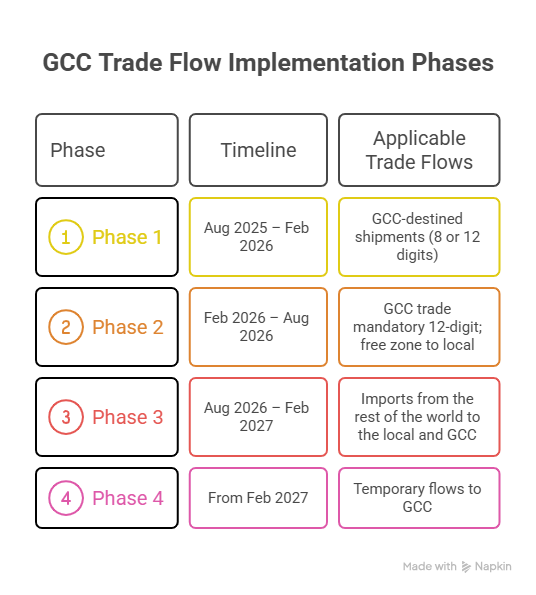
Free Zone shipments stay permanently exempt and keep using 8-digit codes. Outdated codes can mean customs delays, fines, or rejected shipments, update product databases, invoices, and declarations by each phase date.
UAE Corporate Tax for Import-Export Businesses in 2026
The UAE applies a 9% corporate tax on profits above AED 375,000 ($101,250), with profits below that taxed at 0%. Mainland traders are generally in scope and must enroll and file annually, even when no tax is owed.
Free zone companies may keep a 0% rate on "qualifying income" if they meet the qualifying free zone person conditions, adequate substance, and audited accounts.
Re-export and some trading activities can qualify, mainland sales usually don't. Budget for accounting from year one.
Common Import-Export Setup Mistakes to Avoid in Dubai
Underestimating mainland cost
The AED 15,000 ($4,050) general trading activity fee is separate from the base license fee.
Wrong jurisdiction
Picking a free zone for cheap entry, then finding you can't sell to the UAE market without a distributor.
Incorrect product classification
HS code errors stall customs clearance for weeks, work with an experienced customs broker.
Missing external approvals
Assuming the license covers regulated goods.
Office shortcuts on mainland
Flexi-desks don't qualify, you need an Ejari-certified tenancy.
Skipping Mirsal 2 preparation
Treating customs enrollment as the last step and not having your export declaration certificates, import permits, or packing lists ready before the vessel arrives.
Ignoring temporary export procedures
Sending goods abroad for exhibitions or servicing without a formal temporary export declaration. When the goods return, customs may treat them as a new import, triggering duties and delays.
Set Up Your Import-Export Business in Dubai with RadiantBiz
At RadiantBiz, our experienced business setup specialists in Dubai have helped entrepreneurs establish their companies across the UAE mainland and free zones with the right structure, licensing, and setup support.
Starting with the initial consultation that analyses the business model, product, and feasibility, the business consultant then assigns a jurisdiction and industry specialist to your case.
Our team handles the mainland vs. free-zone call, the full paperwork chain from trade name and MOA through to customs enrollment, and the bank setup that trips up most new traders.
With a 95% client retention rate and a team of 50+, you get one point of contact from license to first shipment.
FAQs
1. What is Mirsal 2 and do I need to use it?
Mirsal 2 is Dubai Customs' official online declaration and clearing system. Every import and export shipment passing through Dubai must be declared through Mirsal 2. You file the declaration online, but physical documents must be presented to the Customs Officer in person for verification.
2. Can I temporarily export goods and bring them back without paying duty?
Yes, temporary exports are allowed for goods sent abroad for exhibitions, servicing, or testing, provided you file a formal temporary export declaration with the required documents. The goods must return in the same condition. Without the proper declaration, customs may treat the returning goods as a fresh import and apply duties.
3. What's the difference between a General Trading License and a specific import-export license?
In Dubai, they're essentially the same. A general trading license is the flexible commercial license for importing and exporting multiple product categories, a specific license restricts you to one product type.
Starting Your Import-Export Business in Dubai: Final Takeaways
Starting an import-export business in Dubai is one of the cleaner routes into regional and global trade, if you get three things right: jurisdiction, working capital, annual trade license renewal, and customs enrollment.
Dubai's location, ports, and trade agreements make it a practical base for reaching Asia, Europe, and Africa from one hub. Real first-year mainland cost is AED 28,000–40,000 ($7,560 to $10,800) once you add the DET activity fee, higher than most single-number quotes suggest. Free zones cost less to enter but limit direct UAE market access.
Ready to take the next step? Seek our professional on-the-ground guidance, contact us via mail at info@radiantbiz.com, WhatsApp, or call us at +971521322895!



.webp)
Anjali Jawahar ensures the seamless execution of business setup processes, making compliance and licensing effortless for clients. Her keen attention to operational efficiency helps the RadiantBiz businesses establish themselves smoothly in the UAE.

.avif)


.svg)


.svg)
.svg)
.svg)