.png)

.png)

2.avif)
How to Start an Online Clothing Business in Dubai


Table of Contents
Quick Answer
To start an online clothing business in Dubai, pick your business model (dropshipping, private label, or made-to-order). Then get a free zone e-commerce license, which starts at AED 6,500 and is issued in 3–5 business days, or a mainland DET license if UAE customers are your main market. Finally, set up payments, fulfilment, and VAT compliance.
About The Author
The author is a business consultant specializing in regulatory compliance, corporate setup, and operational planning across multiple sectors in the UAE. With over a decade of experience advising local and international clients, we've helped more than 15,000 companies navigate licensing, regulatory compliance, and operational frameworks, including clothing businesses.
Key Takeaways:
- Your license must match your business model and sales channels before you apply. Choosing the wrong jurisdiction (mainland vs. free zone) or activity code is the most expensive mistake founders make, one client paid AED 3,500 ($950) and lost three weeks just to add handbags to a clothing license, while another lost AED 20,000 ($5,400)+ in amendment fees and penalties for a mismatched activity code.
- Free zone licenses are cheaper and faster but restrict mainland access. An e-commerce license starts from AED 6,500 ($1,770) and issues in 3–5 business days with 100% foreign ownership, but you cannot sell directly to UAE mainland customers without a distributor or fulfilment partner handling customs and VAT — so if the UAE is your primary market, a mainland DET license (AED 12,000–20,000 / $3,270–$5,450 plus office lease) is the cleaner long-term structure.
- Returns and tax compliance will quietly erode your margins if you ignore them at launch. UAE fashion return rates of 35–45% (the highest in the GCC, mostly from sizing issues) can be cut by 22% with detailed measurement charts and customer photos, while VAT enrollment triggers at AED 375,000 ($102,000) turnover with a 14% annual late-payment penalty, making compliance a design requirement, not an afterthought.
Why Dubai is One of the Best Markets to Launch an Online Clothing Brand
Fashion already accounts for 30% of all online retail spending in the UAE - more than in the United States. If you are considering how to start an online clothing business in Dubai, the market opportunity is real. We have been helping founders set up businesses, and we have watched the fashion e-commerce space transform from a niche experiment into one of the most competitive and rewarding markets in the region.
Fashion now commands 30% of online retail GMV in the UAE, significantly higher than mature markets like the USA. Online retail penetration sits at 16%, slightly ahead of Saudi Arabia's 15%.
Here is what we tell every founder who walks into our office: the brands that succeed are not necessarily the ones with the best designs. They are the ones who made the right structural decisions before spending a single dirham on inventory.
We have seen too many founders lose AED 20,000 ($5,400) or more in amendment fees and compliance penalties because they chose a license activity that did not match their actual sales channels.
Step 1: Choose Your Online Clothing Business Model - Dropshipping, Private Label, or Made-to-Order
The biggest mistake we see new founders make is applying for a license before they understand their own business model. Your license must reflect how you sell, not just what you sell.
There are three primary models for online clothing in Dubai:
- Dropshipping - You hold no inventory and forward orders to suppliers who ship directly. This is the lowest-risk entry point, and free zone e-commerce licenses typically cover it without additional approvals. Your main cost is marketing, not stock.
- Private-label and wholesale - You buy finished garments, store them, and fulfil orders yourself or through a third-party logistics provider. This model requires warehousing and ties up working capital, but it offers better margins and brand control.
- Made-to-order or small-batch manufacturing - You design and produce your own collections. This can require additional approvals if you are manufacturing within the UAE, including Ministry of Industry and Advanced Technology clearances.
Expert experience: We have seen a founder launch a modest abaya brand from a free zone flexi-desk with AED 15,000 ($4,085) in starting capital, reach AED 400,000 ($108,900) in annual revenue within 18 months, and then migrate to a mainland license once UAE customers became 70% of her sales. That transition cost her an additional AED 18,000 ($4,900) in new licensing and office setup. Had she started on the mainland, she would have saved that sum - but she also would have needed AED 40,000 ($10,900) upfront instead of AED 15,000.
Is Selling Clothes Online Profitable in Dubai?
Fashion e-commerce in Dubai offers strong margins for well-positioned brands. With online retail penetration at 16% and fashion commanding 30% of total e-commerce GMV, the addressable market is substantial. Profitability depends on your business model - dropshipping offers lower risk but thinner margins, while private-label brands typically achieve 40–60% gross margins once sourcing and fulfilment are optimized. The key variable is return management: UAE fashion return rates of 35–45% can erode margins quickly if sizing and photography are not handled well.
Step 2: Mainland vs Free Zone - Choosing the Right License for Your Clothing Brand
Dubai offers three main structures for online clothing businesses, and the choice between them is the most consequential financial decision you will make.
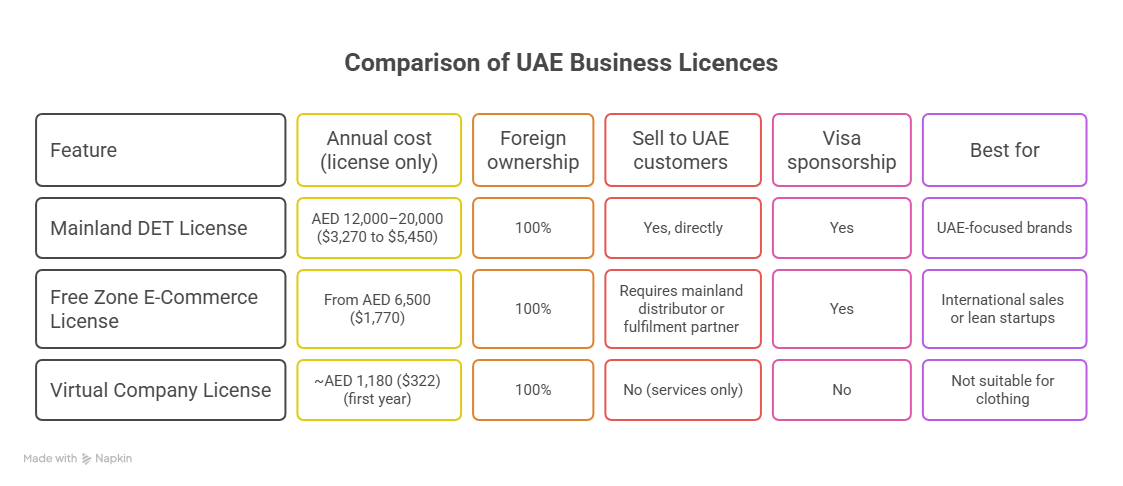
The mainland DET license from the Dubai Department of Economy and Tourism is the cleanest option if your primary customers are inside the UAE. It allows you to sell directly to UAE customers, hold stock locally, and contract with logistics providers without intermediaries. The trade license cost runs AED 12,000 to AED 20,000 ($3,270 to $5,450) annually, plus an office lease starting around AED 15,000 ($4,085). You will also need a TDRA No Objection Certificate for your electronic activity.
The free zone e-commerce license is the standard choice for brands selling primarily to international customers or starting lean. Free zones such as IFZA, Meydan, and SHAMS offer an e-commerce license in Dubai starting from approximately AED 6,500 ($1,770) per year, often including a flexi-desk address. You retain 100% foreign ownership of your company, and goods stored within the free zone are exempt from customs duty until they enter the UAE mainland.
The critical limitation: a free zone license does not automatically grant you the right to sell directly to UAE mainland customers. If you intend to ship to UAE addresses, you will need either a mainland distributor or a structured arrangement with a fulfilment partner.
The virtual company license costs approximately AED 1,180 ($322) for the first year in Dubai, but it does not permit visa sponsorship or an investor visa and is restricted to service activities - not physical goods like clothing. We mention it only to rule it out for clothing brands.
Can a Foreigner Start an Online Business in Dubai Without a Local Partner?
Yes. Since the UAE's 2020 commercial companies law amendments, foreigners can own 100% of most mainland and free zone companies without a local sponsor or partner. Online clothing businesses qualify under standard commercial activity codes. The only exceptions involve activities on the UAE's strategic activities list, which does not include retail clothing or e-commerce.
What Is the Cheapest Way to Start a Clothing Business in Dubai?
The most affordable entry point is a free zone e-commerce license, starting from approximately AED 6,500 ($1,770) per year. Combined with a dropshipping model — where you hold no inventory — total launch costs can stay below AED 15,000 ($4,085). However, the cheapest license is not always the best fit. If UAE mainland customers are your primary market, a mainland DET license avoids the added cost of restructuring later.
How Long Does It Take to Get a Clothing Trade License in Dubai?
Most free zone e-commerce licenses are issued within 3–5 business days once documents are complete. Mainland DET licenses typically take 7–10 business days, depending on activity approval and office lease verification. Delays usually stem from incomplete documentation or mismatched activity codes, not processing backlogs.
Step 3: Select the Correct DET or Free Zone Activity Code for Clothing Retail
Your license activity must match what you actually sell. This is where many founders unintentionally create compliance issues.
For finished clothing sold online, the relevant activity is typically "Retail Sale of Articles of Clothing" (4771.01), which covers menswear, womenswear, childrenswear, and modest fashion including abayas. If you are selling via e-commerce channels broadly, you may also require "Retail Sales of Any Kind of Product over the Internet" (4791.02).
Many free zones allow you to combine your core e-commerce activity with up to two additional commercial activities on a single license. This is useful if you plan to expand into accessories or footwear later.
Expert experience: We recently worked with a founder who selected only "Retail Sale of Clothing" and later wanted to add handbags to her store. The activity amendment cost her AED 3,500 ($950) and delayed her product launch by three weeks. Explain to your licensing authority exactly what you will sell, where products originate, and how customers will receive them - before you apply.
What Permits and Approvals Do You Need to Sell Clothing Online in the UAE?
At minimum, you need a valid trade license with the correct retail or e-commerce activity code. If your store operates as an electronic trader, a TDRA No Objection Certificate is required for mainland licenses. Importing garments requires a Dubai Customs import code. No special permits are needed for selling standard clothing, but items like children's sleepwear or protective apparel may trigger additional safety compliance checks.
Step 4: Source Clothing Products and Set Up UAE Fulfilment and Logistics
This is where your clothing brand becomes an operating business. Your sourcing decision affects cost structure, customs obligations, and delivery timelines.
Local UAE suppliers offer shorter lead times and no import duties, but limited selection and higher per-unit costs. International suppliers from Turkey, China, or India offer better margins at scale but introduce customs requirements. The customs duty on clothing imports into the UAE is 5% of CIF value, per Dubai Customs and the GCC common external tariff. Goods entering a free zone remain duty-free until they move to the mainland. If you are importing, you will need a Dubai Customs import code, which free zone e-commerce license holders can apply for.
For fulfilment, third-party logistics providers such as Aramex, Fetchr, and Emirates Post handle last-mile delivery across the UAE and GCC. If you are operating from a free zone without mainland access, your 3PL partner can structure the customs and VAT handling when shipping to UAE customers.
One thing we have learned the hard way through client experiences: fashion return rates in the UAE average 35–45%, the highest in the GCC. "Wrong size" accounts for the majority of returns. This makes your sizing information and photography absolutely critical to your bottom line.
We have seen brands reduce returns by 22% simply by adding detailed measurement charts and customer-submitted photos to their product pages.
Do You Need a Warehouse to Sell Clothes Online in Dubai?
Not necessarily. Dropshipping businesses require no warehousing at all. For private-label or wholesale models, third-party logistics providers offer shared warehousing and fulfilment services, eliminating the need for a dedicated lease. A standalone warehouse becomes cost-effective only once monthly order volumes justify the fixed overhead — typically above 500 orders per month.
Step 5: Build a Compliant E-Commerce Store — Website, Payments, and Legal Requirements
Your website must do more than display good photography. Under Federal Decree-Law No. 14 of 2023, online traders in the UAE must provide accurate product information, operate transparently, protect customer data, and issue digital invoices. Cabinet Decision No. 200 of 2025 introduced enforcement mechanisms, including fines of AED 500 to AED 20,000 ($136 to $5,450) for violations such as undisclosed fees or missing complaint infrastructure.
For clothing specifically, prioritize these elements before launch:
- Detailed sizing information and fit guidance - significantly reduces returns, which average 35–45% in UAE fashion
- Clear returns and exchange policies - both a legal requirement and a trust driver for first-time buyers
- Accurate pricing and delivery terms - must include VAT implications where applicable
- Contact information and privacy policy - required under UAE data protection regulations
For payment processing, you will need a UAE corporate bank account and a payment gateway merchant account. Popular payment gateway options in the UAE include Telr, PayTabs, Checkout.com, and Stripe. Both the bank account and gateway application require your trade license as the primary document.
For platform choice, Shopify dominates the D2C fashion space in the UAE. The global average Shopify store revenue is approximately $5,583/month (Folio3, 2026).
Step 6: UAE VAT Enrollment, Corporate Tax, and Ongoing Compliance for Clothing Brands
VAT enrollment is mandatory once your taxable supplies exceed AED 375,000 ($102,000) over the previous 12 months, or when you expect to exceed that threshold within the next 30 days. Voluntary enrollment is available above AED 187,500 ($51,000).
The UAE corporate tax rate is 9% on taxable profits above AED 375,000, with Small Business Relief available for resident businesses with revenue below AED 3,000,000 ($817,000). Free zone companies may qualify for 0% corporate tax on qualifying income under the qualifying free zone person rules, but the conditions are strict and require annual verification.
For a growing clothing brand, VAT enrollment is a milestone, not a launch requirement. But you should monitor turnover monthly rather than waiting until year-end to check.
We have seen founders get caught off guard by a VAT bill they did not plan for - and the late payment penalty is 14% per annum, charged monthly.
UAE Corporate Tax Implications for New Clothing Businesses (2026)
If you are forming a new clothing business in 2026, corporate tax planning should be part of your setup strategy from day one. The 9% corporate tax applies to taxable profits above AED 375,000, but Small Business Relief - available to resident businesses with revenue under AED 3,000,000 - can defer your tax obligation during the early growth phase. Free zone businesses must meet the qualifying income conditions each year to retain their 0% rate; selling directly to UAE mainland customers generally disqualifies that income. Transfer pricing documentation is now required for transactions between related parties, even for small businesses. Founders should factor in the cost of annual corporate tax filing (typically AED 3,000–5,000 through an agent) when budgeting their first-year operating costs.
Beyond VAT and corporate tax, textile and clothing businesses should be aware of Economic Substance Regulations, Ultimate Beneficial Owner disclosure obligations, and ongoing PRO services for license renewals and visa processing. These are ongoing compliance tasks, not one-time enrollment.
Can a Dubai Clothing Business Help You Qualify for a Golden Visa?
The UAE Golden Visa now extends to entrepreneurs and investors who meet specific thresholds. Business owners who invest AED 2,000,000 or more in a company - or who run a project endorsed by an accredited business incubator - may qualify for a 10-year residency visa. For clothing brand founders, this means that scaling your business beyond the startup phase can unlock long-term residency without employer sponsorship. The Golden Visa also allows 100% business ownership regardless of jurisdiction. If long-term UAE residency is part of your strategy, discuss eligibility criteria with your setup consultant during the licensing stage so your company structure supports a future application.
How to start an online clothing business in Dubai with RadiantBiz
Radiantbiz is a Dubai-based business setup consultancy, we have worked across mainland DET and free zone jurisdictions, with particular depth in fashion, apparel, and beauty ventures.
Our team includes business setup consultants in dubai who previously worked within free zone departments and DET processing centres, giving us direct insight into what approvers look for, and what triggers rejection or delay.
We have guided clients through every stage of the startup journey, from initial business model consultation through license selection, bank account opening, payment gateway integration, and VAT enrollment.
FAQs
1. Do I need a physical office to start an online clothing business in Dubai?
No, if you choose a free zone license. Most free zones include a flexi-desk address that satisfies the physical premises requirement without the cost of a full office. Mainland licenses require an Ejari-certified office lease, which adds significantly to your startup costs.
2. Can I sell to UAE customers if I have a free zone license?
Not directly. A free zone license does not grant automatic mainland trading rights. You will need either a mainland distributor, a local partner, or a structured arrangement with a fulfilment provider that handles the customs and VAT when goods cross into the mainland. If the UAE mainland is your primary market, a mainland DET license is usually the cleaner long-term structure.
3. How much does it cost to start an online clothing business in Dubai?
The license itself can start as low as AED 6,500 ($1,770) in a free zone. But the cheapest license does not mean the cheapest business. Budget for inventory, website development, product photography, branding, marketing, and fulfilment. A founder ordering AED 50,000 ($13,600) of inventory has a very different financial model from someone launching a small made-to-order collection. Think total launch cost, not company formation cost alone.
Final Checklist: Launching Your Dubai Online Clothing Brand
- Start with your business model, not your license.
- Let your customer geography determine your jurisdiction.
- Choose an activity code that matches your actual sales channels.
- Build fulfilment and payment infrastructure before you launch marketing.
- Treat compliance as a design requirement, not an afterthought.
Dubai's fashion e-commerce market rewards founders who treat business setup as a strategic decision rather than a bureaucratic hurdle. The infrastructure is here. The consumers are here.
What separates the brands that scale from those that stall is the quality of the foundation you build in the first ninety days.
Ready to launch? Your next step is deciding whether the UAE mainland or a free zone better fits your customer base. That single decision shapes everything that follows.
Seek our professional on-the-ground guidance, contact us via mail at info@radiantbiz.com, WhatsApp, or call us at +971521322895!

.webp)

With over 15 years of experience in the banking and business consulting sector, Rizwan Ansari leads RadiantBiz with a vision to simplify business setup in the UAE.

.avif)


.svg)


.svg)
.svg)
.svg)