
.png)

.png)

2.avif)
Business Banking and SME Finance in the UAE: A Practical Guide for Entrepreneurs

Table of Contents
About the Author
The author is a UAE banking consultant with over 15 years of experience in the financial sector. He has worked with leading regional and international banks, advising more than 15,000 startups and SMEs on corporate structuring, bank onboarding, and regulatory positioning.
Key Takeaway:
- The UAE’s SME funding gap isn’t about a shortage of capital. It’s about outdated underwriting models that don’t capture how small businesses actually operate. Government programmes and digital platforms are starting to fill that gap.
- Match your business to the right product. Micro-enterprises and growing SMEs benefit from digital and transaction-based lending. Manufacturers should explore government-backed export facilities. Government suppliers can access invoice financing. Choosing the wrong channel wastes months.
- Most account rejections come down to compliance, not viability. Banks reject applications because of document mismatches, unclear fund sources, and weak transaction history, not because the business is bad. Prepare your AML/KYC file properly and fix your digital footprint before you apply.
Why SME Banking in the UAE Is Harder Than It Should Be
SMEs make up over 94% of all businesses in the UAE and employ approximately 86% of the private-sector workforce. Despite that, they receive only around 9.5% of total bank lending directed at commercial and industrial sectors, a fraction of their economic weight (Ministry of Economy & Tourism)(Arab News).
The gap isn’t because banks don’t have money. The UAE banking system closed 2025 with total assets of approximately AED 5.4 trillion ($1.47 trillion), making it one of the most liquid in the region. Credit grew 17.9%, and deposits grew 16.2% year-on-year (Arabian Business).
The problem is a data gap. Traditional credit underwriting models were built for large corporates with audited financials, collateral, and long banking histories. Most SMEs, especially micro-enterprises, don’t fit that template. Across the MENA region, SMEs receive just 8% of total bank credit, compared to 22% in high-income economies globally (International Banker).
We’ve watched this disconnect frustrate thousands of business owners over the years. A restaurant doing AED 200,000 ($54,460) a month in card transactions gets turned away because it doesn’t have three years of audited accounts. A tech consultancy billing clients in four countries can’t open a basic current account because the bank’s compliance team doesn’t understand the business model.
The good news is that the landscape is shifting. The UAE attracted around 760,000 new companies since introducing full foreign ownership in September 2021, and by 2025 the total number of businesses operating in the country reached 1.4 million. Government financing programmes, digital banking platforms, and transaction-based lending models are opening doors that were closed five years ago (Arab News).
Note: While the AED is pegged to the USD at a fixed rate, all USD figures are estimates based on this rate. Actual charges may differ due to bank transfer fees.
Types of Business Bank Accounts in the UAE
Before choosing a bank, it helps to understand what’s available.
Current Account
This is the standard operating account for any UAE business. You need one to receive payments, pay suppliers, process salaries, and handle day-to-day transactions. Most banks require a minimum balance, and fees vary.
Multi-Currency Account
This allows you to hold and transact in multiple currencies without converting each time. Useful if you import goods, pay overseas suppliers, or invoice clients in USD, EUR, or GBP.
Trade Finance Facilities
Cover letters of credit, bank guarantees, and documentary collections. If you’re importing or exporting goods, these instruments reduce counterparty risk and are often required by overseas suppliers.
Islamic Business Account
Operate on Sharia-compliant principles, with no interest, profit-and-loss sharing structures. Several UAE banks offer full Islamic banking suites for SMEs. Islamic banking assets in the UAE reached approximately $242.7 billion in 2025, accounting for about 18% of total banking assets and 22% of total deposits (Bank-UAE).
Digital Business Account
This is a newer category. These platforms bundle corporate cards, domestic and cross-border payments, invoice automation, and sometimes financing into a single interface, often with faster onboarding than traditional banks. The number of CBUAE-licensed fintech companies more than doubled by the end of 2025 (Voice of Emirates).
How to Open a Business Bank Account in the UAE
Opening a business bank account starts with a valid trade license, mainland or free zone. Beyond that, you’ll typically need:
- Shareholder and director passport copies (with UAE visa pages, if applicable)
- Emirates ID copies for UAE-resident signatories
- Proof of address (utility bill or tenancy contract, usually less than three months old)
- Memorandum of Association or Articles of Incorporation
- A clear description of your business activity
- Board resolution authorising the account opening and naming signatories
- Source of funds documentation, especially if the initial deposit is large
The bank then runs KYC (Know Your Customer) and AML (Anti-Money Laundering) checks. This is where most delays happen. Banks verify the identity of all shareholders, screen names against sanctions lists, and assess the risk profile of your business activity.
Free zone and mainland companies can both apply, but the experience differs. Some banks have dedicated free zone banking desks, others treat free zone companies with extra caution depending on the jurisdiction. The key is matching your activity and transaction profile to a bank that actually serves your segment.
How Long Does it Take?
Anywhere from one week to three months, depending on the bank, your documentation, and how complex your ownership structure is. Simple single-shareholder mainland LLCs tend to get through fastest. Multi-layered holding structures with offshore shareholders take longer. As of the end of 2025, the UAE banking system comprised 61 licensed banks, including 23 national and 38 foreign banks (Ken Research).
Why Do UAE Banks Reject Business Account Applications?
Most rejections come down to compliance, not the business itself. Here are the common reasons:
High-Risk Activity Classification
Certain activities, such as cryptocurrency trading, money exchange, and certain consultancy categories, trigger higher scrutiny. That doesn’t mean you can’t get an account. It means you need to approach banks that have an appetite for your sector.
Unclear Source of Funds
If you can’t clearly document where the initial capital is coming from, the bank will decline. This is especially common with new businesses funded by overseas transfers or cash.
Document Mismatches
The name on your trade license doesn’t match your passport exactly. The shareholder structure in your MOA doesn’t match what you told the relationship manager. Small inconsistencies create big compliance red flags.
Thin or Non-Existent Transaction History
New businesses with no prior UAE banking history face a chicken-and-egg problem: banks want to see transaction history, but you can’t build history without an account. Digital platforms and smaller banks are often more flexible here.
Incomplete KYC Files
Missing an Emirates ID, an expired passport, an unsigned board resolution, any gap in the documentation gives the compliance team a reason to send it back.
Expert insight: Choosing a bank that serves your sector, and preparing the file to its specific AML and KYC standards before you apply, removes most of the friction. We’ve seen businesses get rejected by three banks and approved by the fourth, same company, same documents, different bank appetite.
Government SME Financing Programmes in the UAE
The UAE government has moved to address the SME funding gap through several direct financing channels. These programmes change and expand over time, so verify current availability, but here are the main categories:
Export Financing for Manufacturers
Emirates Development Bank (EDB), in partnership with entities like the Abu Dhabi Exports Office (ADEX), provides export financing facilities for UAE manufacturers. In May 2025, ADEX and EDB signed a strategic partnership to deploy AED 1 billion ($272 million) over the coming years to UAE-based exporters and manufacturers.
The first AED 367 million ($100 million) tranche under this framework has already been drawn. In 2024, ADEX alone extended over AED 4 billion ($1.09 billion) in export financing, enabling UAE enterprises to reach more than 40 international markets (ADFD) (Global Trade Review) (Zawya).
These typically cover working capital and export readiness for businesses in sectors like advanced manufacturing, food security, healthcare, and renewable energy. If you manufacture in the UAE and export (or plan to), this is worth exploring before going to a commercial bank.
Invoice Financing for Government Suppliers
One of the most practical programmes for SMEs. Invoice financing lets you draw cash against approved but unpaid government or semi-government invoices, instead of waiting 30, 60, or 90 days for payment. Some programmes allow access to up to 90–95% of an approved invoice’s value, turning a future receivable into working capital today.
Under Federal Law No. 2 of 2014, federal entities must allocate at least 10% of their annual procurement spend to SMEs. This creates a substantial pipeline of government invoices available for financing. In Dubai alone, the Emirati Supplier Programme facilitated AED 1.78 billion ($485 million) in contracts to SMEs in 2025, a 38% increase over AED 1.29 billion ($351 million) in 2024 (UAE Legislations) (MOET) (Zawya).
How Does Invoice Financing Work for SMEs?
You deliver goods or services to a government entity. Once the invoice is approved, you submit it to a financing platform. The platform advances a large portion of the invoice value (often 90–95%) and collects the full amount when the government entity pays. You receive the remaining balance minus a financing fee. It’s not a loan, it’s a money advance you’ve already earned.
Credit Guarantee Schemes
EDB operates a Credit Guarantee Scheme that partially guarantees SME lending, reducing the risk for commercial banks. By partnering with commercial banks, EDB provides partial guarantees of up to 50% of the financing extended to SMEs, capped at AED 10 million ($2.72 million). In 2024, AED 758 million ($206 million) was deployed through the scheme in partnership with 11 commercial banks, alongside AED 2.1 billion ($572 million) in direct financing to mSMEs and AED 107 million ($29 million) for SME-micro projects. EDB reported a record 222% year-on-year increase in total financing in 2024, reaching AED 8.7 billion ($2.37 billion). The bank set a financing target of AED 23 billion ($6.26 billion) for 2025 (Zawya) (EDB).
Industrial and Infrastructure Support
Various UAE economic zones periodically offer subsidised industrial units, SME hubs, and co-working spaces for small businesses. Abu Dhabi, Dubai, and the northern emirates all have programmes aimed at reducing overhead costs for startups and micro-enterprises. The UAE government has invested $8.7 billion under the “Project of the 50” initiative aimed at fostering innovation and the growth of SMEs (MOET).
Digital Business Banking: What’s Changed for SMEs
The UAE’s digital banking space has expanded significantly. Here’s what matters for SMEs:
Embedded Financing at the Point of Sale
Some digital banks now partner with payment providers to offer financing directly through the merchant network. If you accept card payments through a POS terminal, you may qualify for credit lines based on your transaction volume, with no separate loan application and no collateral.
This model works because the bank can see your actual revenue in real time. Assessment, approval, and disbursement happen in one flow, which is a big shift from the traditional process of applying for a corporate account, then a payment terminal, then a separate loan.
AI-Powered Business Accounts
A newer wave of fintech platforms offers AI-native business accounts. These combine corporate cards, domestic and cross-border payments, invoice automation, and accounting integration into a single platform. In 2025, Abu Dhabi-based Islamic digital banking group Mal secured in-principle regulatory approval from the CBUAE to establish a licensed bank, making the UAE among the first markets globally to grant in-principle approval to an AI-native digital banking platform (Fintech Futures).
Are Digital Business Bank Accounts Regulated in the UAE?
Yes, licensed digital platforms operate under the Central Bank of the UAE. Some hold full banking licenses, others issue accounts through partner banks regulated under the CBUAE’s Electronic Money Regulations.
In April 2024, the CBUAE published the Open Finance Regulation and the Sandbox Conditions Regulation, establishing frameworks for fintech innovation and consent-based data exchange. By 2025, open-finance operations had begun with four live institutions (Ken Research).
Expert advice: Always confirm a platform’s license before depositing funds. “Fintech” is not a regulated category, what matters is whether the entity holding your money is licensed.
Which Business Banking Option is Right for Your Company?
A practical way to match your business to the right route:
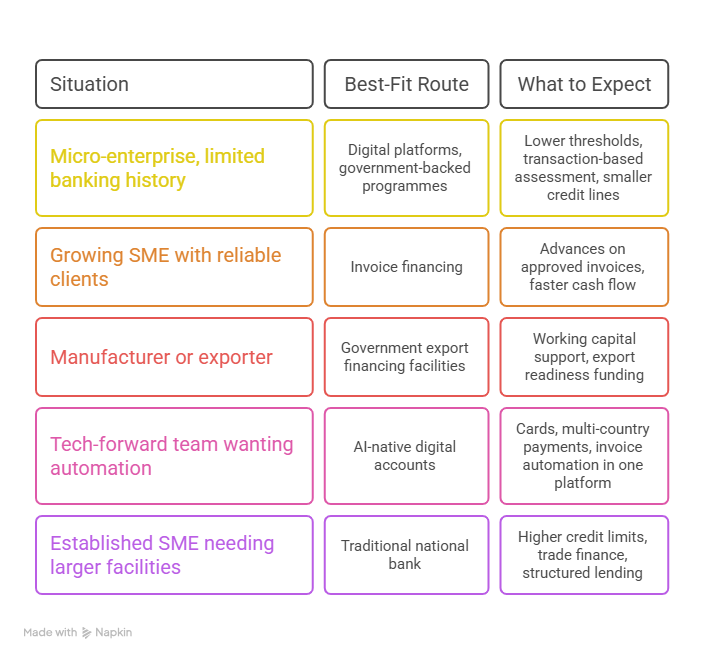
Digital financing leans on transaction-based lending with faster approvals but generally smaller amounts.
Traditional bank loans require more documentation and collateral, but can fund larger needs.
UAE banks extended AED 81.2 billion ($22.1 billion) in total lending to SMEs by mid-2024. Most businesses benefit from having both, a digital account for speed and a national bank relationship for scale (Arab News).
How to Choose the Right Business Banking Partner
Three things we advise every client to get right:
1. Fix Your Digital Footprint First
Banks increasingly rely on transaction-based assessment and tighter KYC compliance, not just audited financials. Structured VAT filing, clean corporate tax records, and consistent bank statements give you an advantage before you even walk in.
2. Match the Product to Your Lifecycle
A digital-first account suits a tech startup. A manufacturer may need an export financing facility. Government suppliers should look at invoice financing. Don’t spend three months chasing a traditional loan when a different channel would have funded you in a week.
3. Keep Relationship Banking in the Mix
National banks still account for the vast majority of corporate lending in the UAE. Total bank credit rose to over AED 2.57 trillion ($700 billion) in 2025, an increase of approximately 18% year-on-year. For larger credit facilities, trade finance, and long-term banking relationships, you need a national bank that understands your sector. Digital accounts are great for operations, but they’re not replacing relationship banking for bigger needs (Economy Middle East).
Business Banking and SME Finance Support with RadiantBiz
RadiantBiz bridges traditional banking and the needs of modern UAE SMEs. With strong relationships across leading UAE banks, our banking and business setup consultants in dubai help entrepreneurs, whether they operate on the mainland or in a free zone, align their trade license activities with the right banking products, reducing the rejection risk many face under stringent AML requirements.
Beyond account setup, we advise on trade finance, multi-currency account structuring, and access to government-backed financing programmes. With 50+ professionals serving over 15,000 entrepreneurs, we make business banking an enabler of growth rather than a barrier.
FAQs
1. What government financing programmes are available for SMEs in the UAE?
The main channels include Emirates Development Bank’s co-financing facilities with commercial banks, export financing through EDB and ADEX for manufacturers (with AED 1 billion / $272 million pledged under their 2025 partnership), invoice financing programmes for government suppliers, and the EDB Credit Guarantee Scheme that partially guarantees lending to SMEs without deep collateral. EDB deployed AED 3 billion ($817 million) in total SME financing in 2024. Programme availability and terms change, so check directly with EDB or speak with an advisor.
2. What’s the difference between a digital business account and a traditional SME loan?
Digital platforms bundle accounts, cards, payments, and sometimes financing in one interface with faster, transaction-based approvals and lower thresholds. Traditional bank loans require more documentation and collateral, but can fund larger amounts.
3. How long does it take to open a business bank account in the UAE?
It depends on the bank, your documentation, and your ownership structure. Simple single-shareholder mainland LLCs can sometimes get through in one to two weeks. Multi-layered structures with offshore shareholders may take two to three months. Preparing a complete KYC file before you apply is the single biggest factor in reducing delays.
The Bottom Line
Business banking in the UAE has more options today than at any point in the past decade. Government financing programmes are putting real capital into SME channels, EDB alone has deployed AED 15.7 billion ($4.28 billion) in total financing since launching its transformational strategy in 2021, creating over 14,000 jobs.
Digital platforms are removing friction from account opening and day-to-day banking. Traditional banks still provide the backbone of corporate lending (Zawya).
SMEs contribute 63.5% to the UAE’s non-oil GDP, and the government aims to grow the number of SMEs to 1 million by 2030. The gap between capital available and capital accessible is narrowing. But success still depends on knowing what’s out there and positioning your business for it (U.AE) (Gulf Today).
Talk to multiple providers. Explore both the new platforms and the government programmes. Prepare your documentation before you apply, not after. And don’t assume what was difficult a few years ago is still difficult today, the landscape is shifting, and for the first time in a while, it’s shifting in your favour.
Seek our professional on-the-ground guidance, contact us via mail at info@radiantbiz.com, WhatsApp, or call us at +971521322895!



.webp)
Anjali Jawahar ensures the seamless execution of business setup processes, making compliance and licensing effortless for clients. Her keen attention to operational efficiency helps the RadiantBiz businesses establish themselves smoothly in the UAE.

.avif)


.svg)


.svg)
.svg)
.svg)