.png)

.png)

2.png)
Why UAE TRC Applications Get Rejected (Common Mistakes) and Fix this Errors

%20.webp)
Table of Contents
The author is a tax consultant with over a decade of experience helping international entrepreneurs and SMEs navigate UAE Corporate Tax compliance, VAT, and regulatory frameworks. Having guided clients across Europe, Asia, and the Middle East through free zone setups, offshore structures, and corporate banking, understanding the full regulatory ecosystem businesses operate in, ensuring tax filing aligns with broader compliance obligations.
Key Takeaway:
- Non-refundable fees make first-time accuracy mandatory. Since October 2025, the FTA charges AED 500 ($136) (enrolled entities) or AED 1,750 ($476) (unenrolled) per TRC application, with no refunds for rejections. Every documentation error now carries a direct financial penalty, making pre-submission verification essential.
- Physical presence alone does not guarantee TRC approval. Whether you meet the 183-day or 90-day test, the FTA requires documented evidence of permanent residency ties valid Emirates ID, residence visa, Ejari-certified tenancy contract, and proof of income or business activity. A residence visa or Golden Visa is a supporting document, not standalone proof of tax residency.
- Corporate Tax enrollment is now linked to TRC eligibility. The FTA cross-references TRC applications against its CT database. Companies must have a valid Corporate Tax Number and, where applicable, have filed their first CT return. Free zone entities claiming QFZP status must ensure their TRC application is consistent with their CT filing and substance reporting.
Are You a UAE Tax Resident or Just a Visa Holder? The 2026 TRC Reality Check
In 2025, the FTA made TRC application fees non-refundable for rejected submissions. That single policy change turned every documentation error from an inconvenience into a direct financial loss (FTA).
We have spent years guiding individuals and companies through the UAE Tax Residency Certificate (TRC) process, and we have watched the application standards tighten year after year.
Since the introduction of Cabinet Decision No. 85 of 2022 and its subsequent clarifications, the FTA has sharpened its focus on genuine substance, not just paper presence.
The days of a straightforward application sailing through are long gone. Today, the FTA's digital verification system cross-references every piece of submitted documentation.
This means any discrepancy, however minor, can trigger a rejection and the loss of your non-refundable application fee.
Most rejections are entirely preventable. Here are the common mistakes we see fail applications daily, and how to fix them.
Note: While the AED is pegged to the USD, all prices are estimates based on current market rates. Actual charges may differ due to bank transfer fees.
Mistake #1: Selecting the Wrong TRN on the EmaraTax Portal
This is the new king of rejection reasons since the introduction of Corporate Tax. Many companies assume their Corporate Tax Number (CT TRN) is the correct identifier for a TRC application.
This assumption often causes portal errors. We have seen the FTA EmaraTax portal return blank screens or apply incorrect fees when a CT TRN is selected directly.
Here is what actually works:
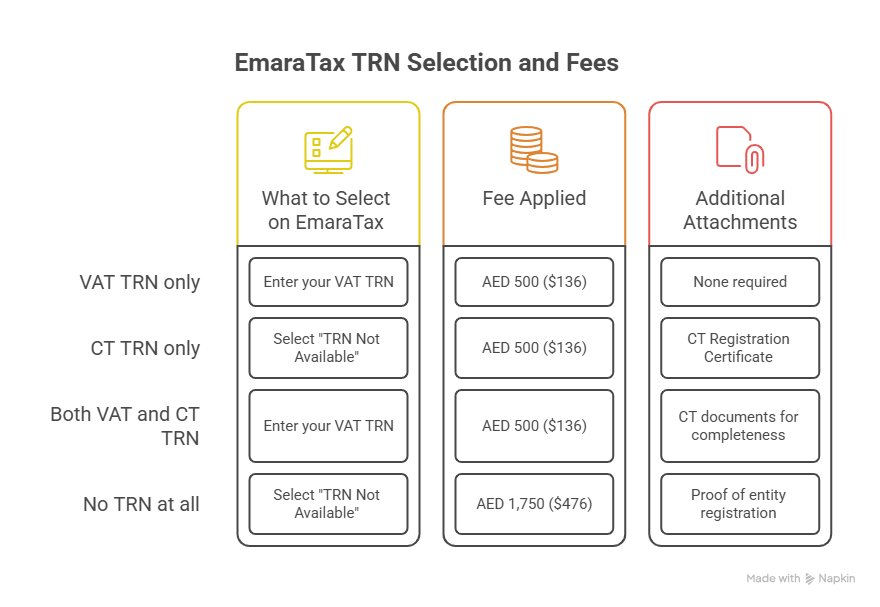
The rule here is to work with how the portal behaves, not how you think it should behave.
Is the UAE TRC Application Fee Refundable After Rejection?
No, as of October 2025, the FTA charges a non-refundable application fee of AED 500 ($136) for enrolled entities and AED 1,750 ($476) for unenrolled applicants. If your application is rejected for any reason, incorrect TRN selection, document mismatch, or incomplete forms, you lose the fee and must resubmit with a new payment. This policy makes first-time accuracy essential.
Mistake #2: International Form Errors That Trigger Instant Rejection
The FTA recently issued a specific clarification on international form errors, and the list of common mistakes is stunningly basic. A mismatch here leads directly to rejection.
The most common errors:
Period mismatch
The tax period on your international form must match the period on your TRC application exactly
Country mismatch
The country referenced on the form must align with the country selected in your application
Missing attestation
If attestation is required, you must select this option during online submission
Incomplete submissions
For companies, forms must be fully completed, signed, and officially stamped, missing stamps invalidate the document
Expert insight: The FTA will not amend or correct these forms for you. The responsibility for accuracy lies entirely with the applicant.
Mistake #3: Miscounting Your 183 Days of Physical Presence
The 183-day rule is one of the most misunderstood requirements. The FTA verifies physical presence through official ICP Entry and Exit Reports, not your passport stamps. If you claim 183 days but the report shows 170, your application is rejected. There is no rounding up.
The bigger trap is that even with 183 days, you need documented evidence of permanent residency ties. A valid Emirates ID, residence visa, and a tenancy contract with Ejari certification are mandatory. Without the full package, the day count alone will not save your application.
The 90-Day Residency Test: An Alternative Path to TRC Eligibility
If you do not meet the 183-day test, you may still qualify under the 90-day rule. This UAE tax residency test requires a valid residence permit, a permanent place of residence (Ejari or Title Deed), and employment or business activity in the UAE.
Can You Qualify for a UAE TRC With Only 90 Days in the Country?
Yes, but the 90-day test has additional conditions beyond physical presence. You must hold a valid UAE residence permit or GCC nationality, maintain a permanent place of residence in the UAE (proven through an Ejari-certified lease or property title deed), and show active employment or business activity here. Meeting the day count without these supporting ties will not pass the FTA's review.
Golden Visa Holders: Does a Long-Term Visa Simplify TRC Approval?
A 10-year Golden Visa does not automatically qualify you for a TRC. The FTA still applies the same residency tests: 183-day or 90-day physical presence, documented residential ties, and proof of income or business activity.
Where a Golden Visa does help is in satisfying the "valid residence permit" requirement without the need for employer sponsorship, which simplifies one leg of the test.
Golden Visa holders who spend most of their time outside the UAE often assume their visa status alone is sufficient. It is not. The FTA treats residence permits as a supporting document, not a standalone proof of tax residency.
Mistake #4: Name and Address Mismatches Across Your Documents
Your document trail needs to be flawless. Every single document must agree with every other document.
The Name Problem
Your passport, Emirates ID, tenancy contract, and bank statements must show your name the same way. A missing middle name or a different spelling will trigger a red flag.
The Address Problem
Your Ejari, bank statements, and utility bills must show the same address. If your bank onboarded you with a hotel address and your Ejari shows a different residential one, you have a broken paper trail.
Expert experience: A consultant stayed in a hotel apartment while house hunting. His bank onboarded him with the hotel address. When he moved and got an Ejari with a different unit number, the mismatch triggered a bank review that delayed his application by weeks. The fix was simple but slow: update all records to reflect a single, permanent address.
Mistake #5: Expired or Invalid Documents
The FTA will not process your application if any core document is expired. This includes:
- Emirates ID
- Residence visa
- Trade license
- Tenancy contract (with current Ejari certification)
All your core TRC documents must be valid for the entire period you are claiming.
Mistake #6: Applying Too Early or for a Future Period
You cannot apply for a future period. The FTA only certifies tax residency for periods that have already occurred.
For Individuals
Apply as soon as you have completed the required days in the relevant tax period.
For Companies
Newly incorporated companies must have been established for at least 12 months before applying (if they have not filed a tax return yet).
Mistake #7: Applying Without Operational Substance in the UAE
Offshore companies generally do not qualify for a TRC because they lack operational substance in the UAE. The FTA is looking for genuine presence that satisfies the Economic Substance Regulations (ESR): a physical office, locally based management, and UAE bank accounts with operating income.
If your company, whether a free zone company or mainland LLC, exists primarily on paper, do not expect a TRC approval.
Do Offshore Companies Qualify for a UAE TRC?
Generally, no. Offshore companies licensed in jurisdictions like JAFZA Offshore or RAK ICC typically lack the operational substance the FTA requires: a physical office, UAE-based management, and local banking activity.
These entities may instead apply for a tax exemption certificate. If your structure is offshore but you have genuine management operations in the UAE, consult a tax advisor about whether restructuring could establish eligibility.
How UAE Corporate Tax Affects Your TRC Application in 2026
Since UAE Corporate Tax took effect in June 2023, the FTA has tightened the link between your CT filing status and TRC eligibility. Companies applying for a TRC in 2026 are expected to have a valid Corporate Tax Number and, where applicable, to have filed their first CT return.
The FTA cross-references TRC applications against its CT database, a company that claims UAE tax residency but has not enrolled for or filed Corporate Tax raises an immediate red flag.
For free zone companies claiming the 0% Qualifying Free Zone Person (QFZP) rate, the connection is even more direct: your TRC application must be consistent with the income and substance you reported in your CT filing.
What Happens If the FTA Requests Additional Information (RFI)?
The FTA sometimes issues a Request for Information instead of an outright rejection. If you receive one, respond within the deadline stated in EmaraTax, typically 10 business days. Late or incomplete responses to an RFI are treated the same as a rejection, and your fee is not refunded.
How Long Does FTA TRC Processing Take in 2026?
Standard FTA processing for a complete TRC application takes approximately 5 to 10 business days.
However, if the FTA issues a Request for Information because documents are missing or inconsistent, the timeline can extend by several weeks.
Applications submitted during peak periods, particularly January through March, may also take longer to process.
DTAA-Purpose TRC vs. Domestic Tax Residency Certificate: What is the Difference?
The FTA issues two types of TRC. A DTAA-purpose certificate is used to claim treaty benefits with a specific country, it must reference the correct treaty partner and may require an accompanying international form.
A domestic TRC confirms UAE tax residency for local purposes such as banking compliance or corporate reporting. Applying for the wrong type is a frequent mistake, especially when a foreign tax authority requires the DTAA version with an attested international form.
How RadiantBiz Helps You Get Your TRC Approved on the First Attempt
Navigating the TRC, also referred to as a tax domicile certificate, application process is no longer a simple administrative task. The FTA's focus on substance means your application must be consistent, accurate, and fully documented.
At RadiantBiz, our team of tax consultants brings years of experience to this process. We assess which of the three UAE tax residency tests actually applies to your situation before any application is submitted.
Applying the wrong test, or mismatching your certificate type with the relevant double taxation avoidance agreement (DTAA), is one of the most common and avoidable reasons for rejection.
We prepare the full documentation set, manage submission through the FTA's EmaraTax portal, and advise on the distinction between domestic and DTA-purpose certificates so the certificate you receive actually matches what your foreign tax authority requires.
Our team tracks each application through to final issuance rather than treating submission as the end of our involvement.
FAQs
1. Does spending 183 days in the UAE guarantee TRC approval?
No, physical presence is only one requirement. The FTA also requires documented evidence of permanent residency ties, a valid residence visa, Emirates ID, tenancy contract or property ownership, and proof of income.
2. What happens if my TRC application is rejected?
You will lose the application fee, AED 500 ($136) for enrolled entities, and must restart the process. You may also miss tax treaty deadlines in your home country. The FTA does not refund fees for rejected applications.
3. Can I apply for a TRC immediately after getting my Emirates ID?
Sometimes, but the practical issue is whether you can show enough supporting evidence. You typically need several months of banking activity, a stable address trail, and documented income to build a strong application.
Your Pre-Submission Checklist: Avoid Rejection Before You Click Submit
Before you click submit, run through this list:
- Verify your TRN selection (VAT TRN preferred, or "TRN Not Available" with CT documentation)
- Confirm the international form matches your TRC application period and country
- Pull your ICP Entry/Exit Report and verify your day count
- Check all documents for name and address consistency
- Verify all documents are valid and unexpired
- Confirm the application timing (not for future periods, company minimums met)
- For companies: verify operational substance documentation is complete
- Confirm Corporate Tax enrollment and filing status is current
The cost of getting it wrong has never been higher. Take the extra hour to double-check everything. Or, better yet, let the experts at RadiantBiz handle it for you. Seek our professional on-the-ground guidance by contacting us via mail at info@radiantbiz.com, WhatsApp, or call us at +971521322895!

.webp)
With a PhD in Microfinance and a deep understanding of market trends, Salman Ansari drives business development at RadiantBiz. He specializes in helping entrepreneurs and corporations make strategic business moves in the UAE.


.avif)


.svg)


.svg)
.svg)
.svg)

