




How to Start an E-Commerce Business in the UAE for Indians: Licensing, CEPA, Tax & Amazon.ae


Table of Contents
Short Answer
Indians can start an e-commerce business in the UAE without leaving India by registering a free zone company, which allows 100% foreign ownership and typically takes 1–3 weeks. Budget for a trade license (from about AED 6,500), a corporate bank account, and VAT registration once turnover exceeds AED 375,000. Under India-UAE CEPA, most Indian goods enter duty-free, lowering landed costs.
About the Author
Written by a UAE business setup and compliance advisor with over a decade of experience, advising startups, SMEs, and international investors across free zone and mainland jurisdictions. The author has supported hundreds of businesses through licensing, banking, restructuring, and regulatory compliance in the UAE.
Key Takeaway:
- CEPA is your biggest cost advantage. The India-UAE Comprehensive Economic Partnership Agreement eliminates or sharply reduces customs duties on most Indian products, with Indian D2C brands cutting landed costs per unit by 15–20%—a decisive edge in a market with thin margins.
- Start in a free zone, then scale to mainland. Free zones offer 100% foreign ownership, faster setup (1–3 weeks), and potential 0% corporate tax on qualifying income. Begin there, prove your unit economics, and only expand to the mainland once direct market access becomes a genuine bottleneck.
- Run the margin math before you list, and treat compliance as a foundation. Enforce a 25–30% margin floor after all fees, build in a 5–8% FX buffer, and respect VAT (5%, mandatory above AED 375,000 / $102,000) and Corporate Tax (9%, with conditional 0% for Qualifying Free Zone Persons). Mistakes in jurisdiction or tax status can cost AED 10,000–30,000 ($2,720–8,160) in rework.
Starting a UAE E-Commerce Business from India: What to Know First

An Indian D2C brand can now ship most products into the UAE duty-free under CEPA, set up a free zone company without leaving India, and start selling on Amazon.ae within three months. We have spent the past decade helping Indian entrepreneurs do exactly that.
The market is also more crowded. E-commerce is now one of the most competitive lanes in the region.
This guide covers jurisdiction, licensing costs, tax obligations, Amazon UAE strategy, and the India-UAE trade advantage most sellers underuse, plus the mistakes we see most.
Note: While the AED is pegged to the USD, all prices are estimates based on current market rates. Actual charges may differ due to bank transfer fees.
How the India-UAE CEPA Lowers Your Landed Cost
The India-UAE Comprehensive Economic Partnership Agreement is the biggest cost advantage Indian sellers hold over competitors from China, Europe, or Southeast Asia.
Since it entered into force on May 1, 2022, India has secured preferential access on over 97% of UAE tariff lines, covering 99% of its exports by value. Customs duty on most Indian products entering the UAE is now zero or sharply reduced.
We have worked with Indian D2C brands that cut landed cost per unit by 15–20% purely from CEPA duty elimination. On a product with a 12% margin, that separates viability from failure.
The biggest gains land where Indian sellers already operate:
- Textiles and home furnishings
- Gems and jewellery
- Pharmaceuticals
- Engineering goods
Mainland vs Free Zone: Which E-Commerce License Should Indian Sellers Choose?

We tell every Indian founder the same thing: choose your jurisdiction based on what you need to do, and treat today's cost as secondary.
Free zone: 100% foreign ownership, simplified company formation, and potential 0% corporate tax on qualifying income. Selling directly into the UAE mainland needs a distributor or branch arrangement. For export-focused, Amazon UAE, or international D2C models, a free zone works.
Mainland: Sell to any customer in any emirate. You need a physical office, and a mainland e-commerce trade license runs AED 12,000–20,000 ($3,270–5,450) annually.
Our recommendation: begin in a free zone, prove unit economics, and expand to the mainland once mainland access becomes a genuine bottleneck.
Free zone business setup typically takes one to three weeks, compared with three to four weeks for the mainland.
Can Indians Own 100% of a Company in the UAE?
Yes. Free zones have always allowed 100% foreign ownership, and since 2021, most mainland commercial activities, including e-commerce, also allow it without an Emirati partner. The real trade-offs are market access and office requirements.
Which Free Zone is Best for E-Commerce in the UAE?
Expert experience: A Jaipur-based home textiles brand we advised started with a SHAMS Trader Package at AED 6,500 ($1,770). Total first-year spend, including bank account setup and initial inventory, came to AED 28,000 ($7,620). They hit AED 100,000 ($27,200) in monthly Amazon.ae sales by month four and upgraded to a mainland branch in year two.
How Much Does It Cost to Start an E-Commerce Business in the UAE?
The license fee is never the full story. Here is what we tell clients to budget.
Can You Start a UAE E-Commerce Business Without Leaving India?
Yes. Free zone licenses carry no physical presence requirement. A passport copy and application form are enough to begin, and no UAE visa is required for the initial setup.
How Long Does It Take Before You Can Accept Payments?
Plan six to twelve weeks from decision to first payment: two to four weeks for the trade license, then four to eight weeks for the corporate bank account and payment gateway. The bank account is consistently the bottleneck.
Selling on Amazon.ae from India: Fees, FBA vs MFN, and Margins
Amazon.ae is where most Indian sellers start. Its fees differ from Amazon India, and the fulfilment decision matters.
Referral fees on Amazon.ae range from 4.5% to 16% depending on category:
- Apparel and kitchen: 15%
- Consumer electronics: 7%
- Jewellery: tiered, starting at 16% for the first AED 1,000
FBA vs MFN: FBA gives you the Prime badge, which UAE customers actively look for, but long-term storage fees punish slow-moving inventory. MFN gives you control, with no Prime badge and slower delivery.
Our approach: launch new SKUs on MFN. Move a product to FBA only after it sells 20–30 units per month for two straight months.
The margin floor we enforce is 25–30% after all fees, before ads. Below that, returns, FX swings, and customs delays erode profitability faster than you can scale. Build a 5–8% FX buffer into your AED pricing, since INR-AED can swing 3–5% in a quarter.
Expert experience: An Indian consumer electronics accessory brand we worked with launched 12 SKUs on MFN. Six never hit 15 units a month and were cut. Four moved to FBA and became Prime-eligible. Two became top-20 category performers.
Do You Need a UAE Trade License to Sell on Amazon.ae?
Yes. Amazon.ae requires a valid UAE trade license, so you cannot list as an Indian entity without UAE incorporation. The license activity must explicitly cover e-commerce or online retail. If you hold stock, add general trading.
UAE VAT and Corporate Tax Rules for E-Commerce Sellers
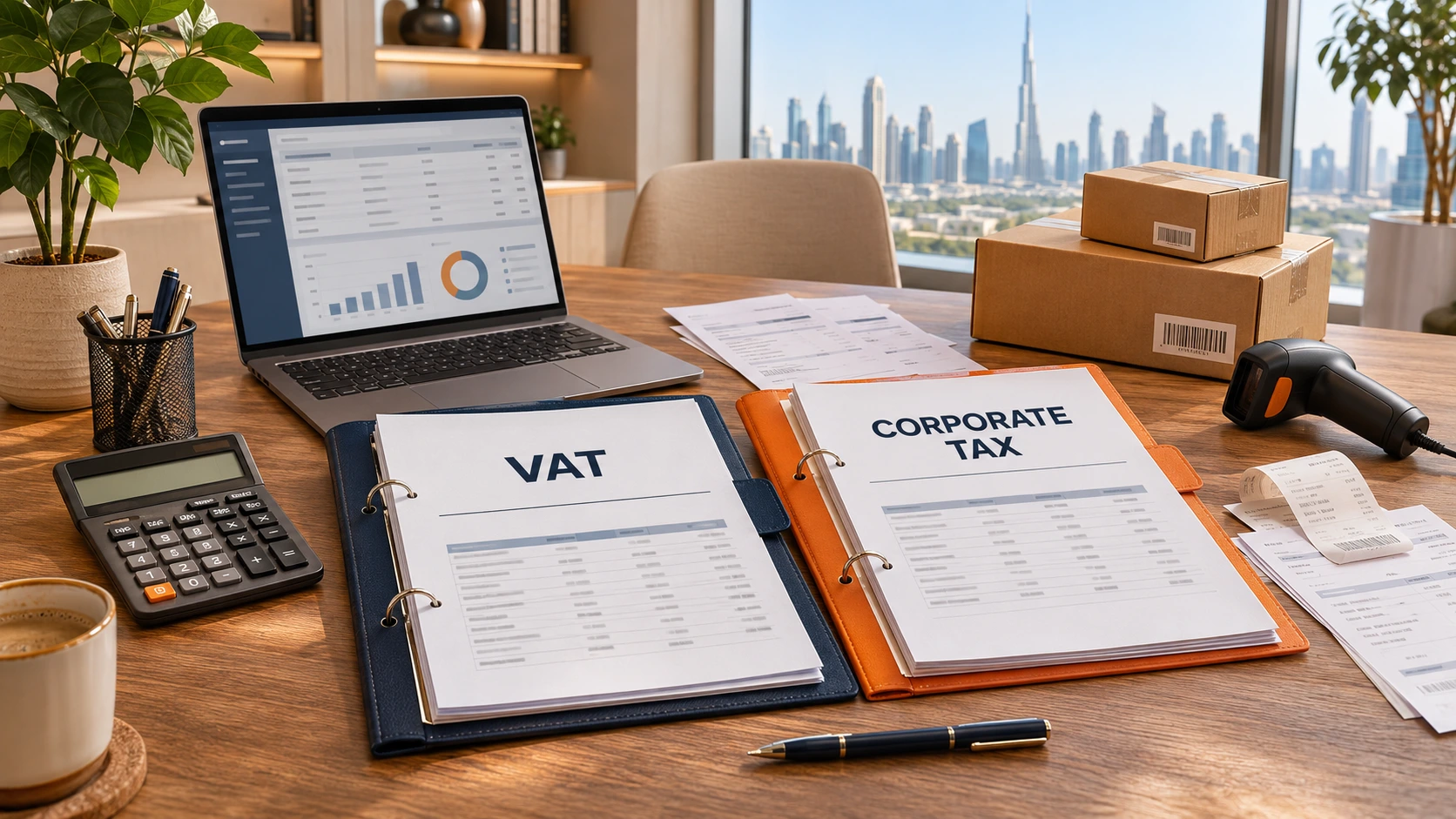
VAT: 5% on taxable supplies.
- Mandatory VAT registration once turnover exceeds AED 375,000 ($102,000) in 12 months
- Voluntary registration available from AED 187,500 ($51,000)
- Late registration penalty: AED 10,000 ($2,720)
Corporate Tax: 9% on profits above AED 375,000 ($102,000). Free zone companies may qualify for 0% on qualifying income if they meet the Qualifying Free Zone Person (QFZP) conditions: adequate substance, qualifying income sources, and a de minimis test where non-qualifying revenue stays under 5% of total revenue or AED 5 million, whichever is lower.
That 0% is conditional. We have seen free zone companies lose QFZP status for a full tax period because one mainland client contract breached the de minimis threshold, and the entire income was then taxed at 9%.
On the India side, file your LUT to export without paying IGST. That preserves zero-rated status and keeps your Indian entity compliant.
Authoritative source: Federal Tax Authority (tax.gov.ae) for UAE VAT enrollment thresholds and Corporate Tax registration.
How RadiantBiz Helps Indian Founders Set Up in the UAE
RadiantBiz was built to simplify UAE market entry for international entrepreneurs, with a specific focus on the India corridor. Among business setup consultants in Dubai, we stand apart because of our banking roots: our CEO, Rizwan Ansari, spent over 15 years in global banking before founding the firm, and that background shapes every setup.
We evaluate how your corporate structure affects bankability, payment gateway approval, and long-term access to credit. That banking perspective separates a setup that works from one that creates problems six months later.
Our track record includes over 15,000 business launches across 160+ nationalities.
For Indian e-commerce founders, we handle the full chain:
- Free zone selection and license issuance
- Establishment card and visa processing
- Corporate bank account introduction
- VAT and Corporate Tax registration
- Amazon.ae seller account support
We have seen mistakes cost founders AED 10,000–30,000 ($2,720–8,160) in rework. You can find more about our work at radiantbiz.com.
Your Next Step: Validate Demand Before You Apply
The UAE is the most accessible international market for Indian e-commerce founders. CEPA gives you a structural cost advantage, and consumers spend more per order than almost anywhere in the region. The founders who succeed pick the right jurisdiction, run the margin math before listing, and treat compliance as a foundation.
Your first move: validate demand on Amazon.ae. Check pricing, review counts, and whether your category is already saturated. If the numbers work, start the license application.
For a no-obligation assessment of your UAE e-commerce setup options, reach out to the RadiantBiz team. We will tell you honestly whether the market is ready for your product and what it will cost to find out.
Seek our professional on-the-ground guidance, contact us via mail at info@radiantbiz.com, WhatsApp, or call us at wa.me/971521322895!


With over 15 years of experience in the banking and business consulting sector, Rizwan Ansari leads RadiantBiz with a vision to simplify business setup in the UAE.