.png)

.png)

2.png)
E-Commerce Business Setup in Singapore: Structures, GST, and Fulfilment Options

Table of Contents
About the Author
Our business setup consultant writes this article with over a decade of experience helping entrepreneurs establish companies in Singapore and the UAE. Having worked with startups, SMEs, and international investors, they have guided businesses through jurisdiction selection, tax structuring, and banking strategies across both regions.
Key Takeaway:
- Choose a Pte Ltd, not a sole proprietorship. Over 95% of serious online sellers incorporate a Private Limited company for limited liability, tax efficiency (flat 17% with startup exemptions on the first SGD 100,000 ($74,000)), and investor readiness. Sole props leave personal assets at risk and face banking friction with payment gateways like Stripe.
- Track GST exposure monthly, not yearly. Mandatory GST enrollment kicks in at SGD 1 million ($740,000) in taxable turnover, but voluntary enrollment benefits import-heavy businesses by allowing input tax credits. Missing the 30-day IRAS notification window triggers penalties starting at 5% of the GST due.
- Migrate from Amazon local FBA before 31 July 2026. Amazon is ceasing its Singapore marketplace and FBA operations. Switch to a local 3PL like Ninja Van or SingPost eCommerce with API integration to Shopify or WooCommerce, and ensure your cross-border strategy accounts for varying de minimis thresholds across ASEAN (e.g., Indonesia at effectively zero).
Why Singapore is the Smart Base for E-Commerce in 2026
Singapore handled billions in e-commerce sales last year, yet roughly one in three founders we meet picked the wrong business structure before their first sale.
The fundamentals are unbeatable: political stability, Changi Airport's cargo throughput, and a transparent common law system. The problem is rarely the market. It's the setup.
In our decade of advising multiple e-commerce founders, the same three failures repeat: wrong business structure, missed GST enrollment, and logistics partners that cannot scale.
This guide is a compliance-first, operationally practical blueprint. Every tax figure reflects IRAS's current revisions, and every logistics insight reflects contracts we've negotiated for clients in 2025–2026.
Note: All prices are estimates based on market rates at the time of publication. Actual costs may vary due to daily exchange rate fluctuations and potential bank transfer fees.
Singapore Company Incorporation: Which Business Structure Suits Your Online Store?
For company registration in Singapore, the Accounting and Corporate Regulatory Authority (ACRA) offers several structures, but only two matter for online retail.
Sole Proprietorship for E-Commerce: High Risk, Low Ceiling
A sole prop incorporates through an authorized filing agent on ACRA's BizFile+ in under an hour for around SGD 115 ($85). Why we advise against it for e-commerce:
- Unlimited liability: if a product liability claim arises (say, a defective accessory causes a fire), your personal savings, CPF, and HDB flat are all claimable.
- No investor eligibility: venture capital and even angel investors cannot invest in sole props.
- Banking friction: international payment gateways like Stripe and Airwallex often reject sole prop applications from high-volume merchants.
Verdict: Acceptable only for testing a single dropshipping product under SGD 10,000 ($7,400) annual turnover.
Private Limited Company (Pte Ltd): The Best Structure for Online Sellers
Over 95% of serious e-commerce operators choose a Pte Ltd at the point of company incorporation. Key benefits clients use monthly:
- Limited liability: your risk stops at your share capital.
- Separate legal entity: you can sign warehouse leases and 3PL contracts in the company's name.
- Tax efficiency: a flat 17% corporate tax, but the Start-Up Tax Exemption (SUTE) exempts the first SGD 100,000 ($74,000) of chargeable income for the first three years. The next SGD 100,000 ($74,000) is taxed at an effective 4.25%.
Compliance requirement: You need at least one resident director. Foreign entrepreneurs can use a nominee director service, but appoint a qualified corporate secretary in Singapore directly, not an anonymous online listing.
We have watched clients face ACRA penalties because their nominee director went uncontactable during the annual filing season. That risk is entirely avoidable.
How Much Does it Cost to Incorporate an E-Commerce Pte Ltd in Singapore?
Incorporating a Pte Ltd through an authorized filing agent typically costs SGD 300–SGD 800 ($222–592) in agent fees, plus ACRA's incorporation fee.
Foreign founders should budget an additional SGD 1,500–SGD 3,000 ($1,110–2,220) annually for a nominee resident director and corporate secretarial services.
Total first-year setup, including GST advisory, usually lands under SGD 5,000 ($3,700).
EntrePass and Employment Pass: Do You Need a Work Visa to Run Your Store?
Many foreign founders incorporate a Pte Ltd remotely and never set foot in Singapore, perfectly legal. But if you intend to relocate and actively manage operations, you'll need a work pass.
The EntrePass suits founders building innovative or venture-backed businesses; the Employment Pass requires a minimum monthly salary (currently SGD 5,600+ ($4,144) for new applicants) paid by your own company.
A common 2026 structure: incorporate first, prove revenue traction, then apply for an EntrePass once viability is clear. Until then, a nominee resident director satisfies ACRA's local-director rule, letting you operate compliantly from abroad while you scale.
GST Enrollment in Singapore: Thresholds, Voluntary Enrollment, and Imported Services Rules
The GST rate is 9%. Ignoring the threshold is the single most expensive mistake we encounter.
Do You Have to Charge GST on Every Online Sale?
No. You only charge the 9% GST once you complete GST registration in Singapore - mandatory above SGD 1 million ($740,000) in taxable turnover, optional below it.
Below the threshold and unenrolled, you neither charge GST nor reclaim input tax. Once enrolled, GST applies to all standard-rated local sales.
Mandatory threshold: You must enroll if your taxable turnover exceeds SGD 1 million ($740,000) either at the end of any calendar year (retrospective) or on a rolling 12-month basis (forward-looking).
You have 30 days to notify IRAS. Late penalties start at 5% of GST due and reach 10% plus interest.
Expert experience: A furniture dropshipper hit SGD 850,000 ($629,000) in November and expected SGD 1.1 million ($814,000) by March. He enrolled voluntarily in December, saving himself a late penalty. Don't wait for year-end.
Voluntary Enrollment — When to Use It
Voluntary enrollment lets you claim input tax credits on business purchases (inventory, software, 3PL fees) before sales require charging GST.
Strategic use case: Import-heavy businesses. If you import SGD 50,000 ($37,000) of goods monthly, you reclaim roughly SGD 4,500 ($3,330) in GST each quarter, otherwise a permanent cost.
Expert warning: Once voluntarily enrolled, you must stay enrolled for two years and file quarterly returns even with zero sales.
Expert experience: A client paused his store for six months, missed two filings, and received a SGD 2,000 ($1,480) penalty. Don't enroll without consistent operations.
The Imported Services and Low-Value Goods Rules
- Overseas Vendor Enrollment: Foreign digital service providers (SaaS, e-books, subscriptions) must charge GST to Singapore consumers if global B2C sales exceed SGD 100,000 ($74,000).
- Low-Value Goods (LVG) Regime: All imported goods at or below SGD 400 ($296) are now subject to GST at the point of sale, collected by platforms like Shopee, Lazada, or Amazon.
Corporate Tax Filing Deadlines E-Commerce Founders Miss
Two IRAS deadlines trip up sellers yearly. The Estimated Chargeable Income (ECI) filing is due within three months of your financial year-end, even if you expect to owe nothing.
Your corporate income tax filing - the Form C-S or C-S Lite return - is due by 30 November. Miss either and IRAS issues an estimated assessment, usually higher than reality, plus penalties.
For first-year companies, accurate ECI filing is what unlocks the SUTE.How Much Does It Cost to Register a Pte Ltd Company in Singapore?
Singapore E-Commerce Fulfilment in 2026: Life After Amazon's Local FBA Exit
Amazon announced it will cease its local marketplace and FBA operations in Singapore effective 31 July 2026. If you rely on Amazon.sg, you have a hard migration deadline.
What Happens to Your Listings After Amazon's Singapore FBA Closure?
After 31 July 2026, local Amazon.sg listings and FBA storage will cease. Withdraw your stock from Amazon fulfilment centres and migrate to a local 3PL such as Ninja Van or SingPost eCommerce.
Order data does not transfer automatically, so export your history before the deadline.
3 fulfilment models for 2026:
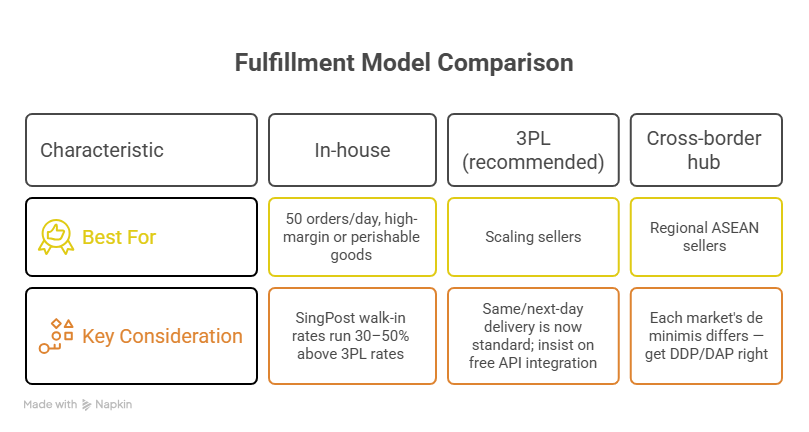
Major 3PLs include Ninja Van (strong last-mile and regional cross-border, with Shopify/WooCommerce/Shopee/Lazada APIs), SingPost eCommerce (Speedpost plus Asendia for Europe/US), and Qxpress (high-volume, low-weight parcels).
A cross-border e-commerce operation can hold regional stock here and ship to Jakarta, Kuala Lumpur, Bangkok, and Ho Chi Minh City within 2–4 days under Singapore's FTAs.
But customs vary: Indonesia's de minimis is effectively zero, Malaysia's is RM500, Thailand's is THB 1,500. We've seen sellers lose 40% margins, assuming "free shipping" covered duties.
Payment Gateway Integration in Singapore: PayNow, Stripe, and Multi-Currency Accounts
Local payment preferences differ from Western markets, PayNow accounts for over 45% of consumer transfers.
Is PayNow Required for Singapore Online Stores?
PayNow isn't legally mandatory, but it's commercially essential. Omitting it pushes away local buyers.
Corporate PayNow via your UEN is free and instant, one of the cheapest rails you can offer.
Required integrations:
- PayNow (via HitPay or bank APIs).
- Stripe (international cards, Alipay, WeChat Pay, plus Radar fraud protection).
- GrabPay (younger demographics).
- Multi-currency account via Airwallex or Wise Business to cut conversion costs from 2–3% to under 0.5%.
Expert warning: Chargeback fraud targeting electronics and fashion stores is on the rise. Always enable 3D Secure 2.0, and never process card-not-present orders without address verification.
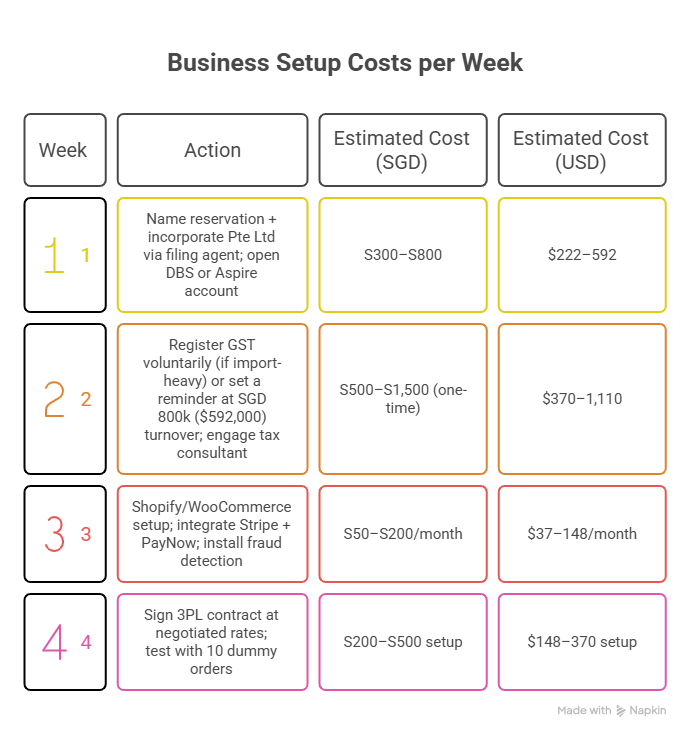
From Incorporation to First Sale: A 2–4 Week E-Commerce Launch Timeline
The Accounting and Corporate Regulatory Authority (ACRA) offers several structures, but only two matter for online retail.
Can Non-Residents Open a Singapore Business Bank Account?
Yes, though opening a business bank account in Singapore is harder for non-residents. DBS and OCBC often require an in-person visit, while Aspire and Wise Business onboard remotely within days. after verifying your licensed company and director identity.
Expert advice: Don't launch marketing in Week 1. We've seen founders run Facebook ads before signing a 3PL contract, then scramble to fulfil 200 orders from their living room. Build operations first, then turn on the traffic.
E-Commerce Business Setup in Singapore with RadiantBiz
Setting up an e-commerce business in Singapore means navigating everything from corporate structure to GST compliance and logistics.
RadiantBiz steps in as your strategic partner, streamlining incorporation with ACRA, advising on the most tax-efficient structure, and helping you assess the SGD 1 million ($740,000) GST threshold and Imported Services rules before costly errors arise.
Beyond paperwork, RadiantBiz is your operational backbone, connecting you to vetted 3PL providers so fulfilment scales smoothly across ASEAN. Whether you're a solo founder or a scaling enterprise, their end-to-end support turns a complex setup into a clear path to growth.
FAQs
1. What is the GST enrollment threshold for e-commerce in Singapore in 2026?
SGD 1 million ($740,000) in taxable turnover over the trailing or forward 12 months. The rate remains 9%.
2. Can a foreigner without a Singapore visa incorporate a Pte Ltd?
Yes, appoint a resident director (citizen, PR, or EntrePass holder), often via an ACRA-certified corporate secretarial firm.
3. With Amazon ending local FBA, what's the best fulfilment alternative?
A local 3PL with API integration, Ninja Van, or SingPost eCommerce for SMEs. Complete migration before 31 July 2026.
Final Word: Why Operational Excellence Wins in Singapore E-Commerce
Singapore's e-commerce market is mature, and price competition alone won't sustain you. The winners we've advised succeed because they:
- Incorporate as a Pte Ltd for liability protection and investor readiness.
- Track GST exposure monthly, not yearly.
- Lock in a 3PL contract before they need it.
- Accept PayNow and international cards seamlessly.
Ready to start? Test your numbers against the SGD 1 million ($740,000) threshold, then speak to our seasoned business setup consultants who work with ACRA-accredited specialists, not a budget online service.
Seek our professional on-the-ground guidance, contact us via mail at info@radiantbiz.com, WhatsApp, or call us at +971521322895!

.webp)

.webp)
With over 15 years of experience in the banking and business consulting sector, Rizwan Ansari leads RadiantBiz with a vision to simplify business setup in the UAE.

.avif)


.svg)


.svg)
.svg)
.svg)