.png)

.png)

2.avif)
Free Zone vs Mainland Company Setup: Cost & Pros/Cons Compared

Table of Contents
About the Author
Written by a UAE business setup and compliance advisor with over a decade of experience, advising startups, SMEs, and international investors across free zone and mainland jurisdictions. The author has supported hundreds of businesses through licensing, banking, restructuring, and regulatory compliance in the UAE.
Key Takeaway:
- Cost comparisons alone can be misleading, as free zone setups may be cheaper upfront, but long-term expenses depend on market access, compliance, banking, and restructuring needs.
- Both the free zone and the mainland allow full foreign ownership, but the mainland offers greater flexibility for local trading, hiring, and scaling within the UAE.
- Early structural decisions have long-term impact, and choosing the wrong setup can lead to higher costs, compliance challenges, and operational restrictions over time.
The Question We’ve Answered for Over a Decade (Still Relevant in 2026)
“Are free zones cheaper than the mainland?”
Even in 2026, this remains the most common question we get from founders looking to start or restructure a business in Dubai especially those comparing free zones with a mainland company setup in Dubai. And despite regulatory updates over the years, the underlying issue hasn’t changed: many founders still choose a structure based on upfront cost rather than long-term suitability.
After years of advising startups, SMEs, consultants, traders, and overseas investors in the UAE, we’ve seen how decisions made in year one often shape profits, compliance burden, and growth options in years three and five.
This 2026-updated guide explains free zone vs mainland company setup using current cost ranges, operational realities, and real examples, so you can make an informed choice that holds up over time.
Free Zone vs Mainland: What’s the Difference in 2026?
In 2026, the legal foundations remain consistent, but enforcement, compliance expectations, and banking scrutiny are tighter than they were a few years ago.
A free zone company is licensed by a specific free zone authority (such as DMCC, IFZA, Meydan, etc.), each with its own rules on:
- Approved activities
- Visa quotas
- Office requirements
- Substance expectations
A mainland company is licensed by Dubai’s Department of Economy and Tourism (DET) and can operate freely across the UAE without geographic restrictions.
Both structures:
- Also, allow 100% foreign ownership for most activities
- Are subject to UAE corporate tax regulations
- Must maintain proper economic substance
The difference lies in how easily you can trade, scale, hire, and bank.
Freezone vs Mainland Company Setup Cost Dubai (2026 Figures)
Let’s address the most searched question directly, using 2026-realistic figures.
When comparing freezone vs mainland company setup cost in Dubai, here’s what businesses actually spend, not promotional pricing.
Free Zone Company Setup Cost (2026)
For professional services, consulting, digital businesses, and light trading:
- AED 14,000 to AED 28,000 ($3,800 to $7,600)
- License and business enrollment
- Usually includes 1–2 residence visas
- Flexi-desk or shared office
Costs have increased slightly since previous years due to higher visa fees and stricter compliance checks, particularly around economic substance.
- Expert experience: In 2025–2026, we’ve seen free zone setups work best for founders serving international or online clients, where physical presence in the UAE market isn’t critical.
Mainland Company Setup Cost (2026)
Mainland company costs typically range between:
- AED 20,000 to AED 40,000+ ($5,450 to $10,900+)
- DET trade license
- Ejari-approved office
- Immigration and labor establishment files
- Activity-specific approvals where required
Office rentals have become a more significant cost factor in 2026, but they also directly impact visa allocation and bank credibility.
This is why the free zone vs mainland company setup cost in Dubai comparison still favours free zones on paper, but not always in practice.
Market Access: Still the Biggest Deciding Factor in 2026
Free Zone Market Access
In 2026, free zone companies:
- Cannot directly trade with mainland UAE clients in most cases
- Must use a distributor, mainland branch, or approved structure
- Works best for service-based or export-focused businesses
Mainland Market Access
Mainland companies can:
- Trade anywhere in the UAE without restrictions
- Invoice local clients directly
- Bid for government and semi-government contracts
- Open branches across the Emirates
Case Example (Trading Business – 2026)
A Dubai-based trading company initially opted for a free zone to reduce costs. By Q2 2026, most institutional buyers required mainland invoices and an onshore presence. The company restructured, incurring additional costs that exceeded the difference between the free zone and mainland setup originally.
This pattern hasn’t changed.
Ownership, Control, and Structural Flexibility (2026 Reality)
The sponsor myth is long gone, thanks to the recent Companies Commercial Law changes that allow 100% foreign ownership without a local sponsor even on the mainland, but structural rigidity is now the bigger issue.
Mainland companies offer easier activity additions, smoother restructuring, and greater flexibility for future expansion.
Free zones remain highly structured environments that clarity helps in the early stages, but can limit pivoting later.
In 2026, regulators expect businesses to operate in line with their licensed activity, making flexibility more important than before.
Visas, Hiring, and Office Requirements in 2026
Free Zone Visas
Visa quotas tied strictly to office type and size, flexi-desks usually allow 1–3 visas. Larger offices significantly increase cost but allow for a greater visa quota.
Mainland Visas
Even on the mainland visa eligibility is linked to office size. Mainland is better suited for hiring and scaling. It does have higher operating cost, but fewer growth limits.
- Expert insight: We’ve noticed banks and auditors increasingly favour businesses with physical offices and operational staff, especially for trading, consulting, and B2B services.
Banking, Compliance, and Corporate Tax (What Matters Most Now)
Bank Account Reality
In 2026, UAE banks are more compliance-driven than ever. They assess the nature of business activity, client base, physical presence, economic substance, and staffing.
Some free zone businesses still face longer account opening timelines, particularly for cross-border or trading activities.
Corporate Tax Implications
Mainland companies incur a 9% corporate tax on taxable profits, whereas free zone companies qualify for 0% tax only on eligible income, subject to Federal Tax Authority (FTA) rules and substance requirements.
This makes tax planning a structural decision, not an afterthought, when evaluating free zone vs mainland company setup cost in Dubai.
Which Structure Makes Sense in 2026?
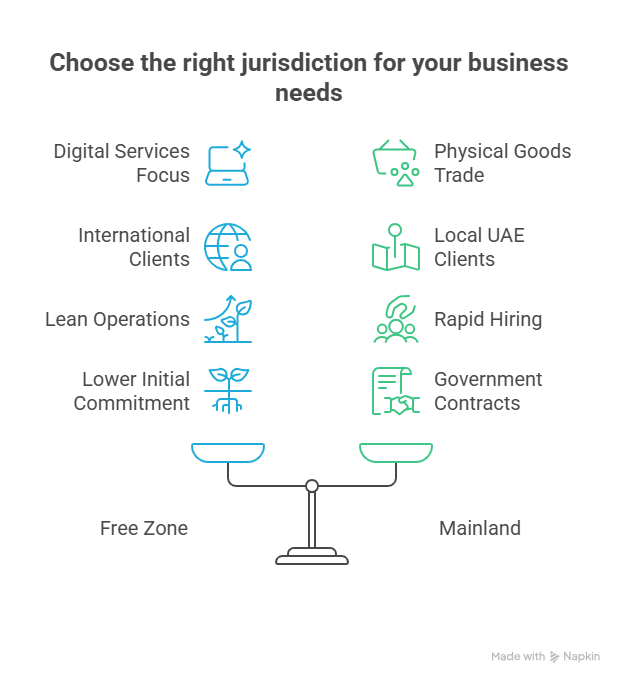
There is no general answer, only a better-aligned structure on a case-by-case basis.
Common Mistakes Still Happening in 2026
1. Choosing based only on upfront pricing
Many founders focus on the lowest setup fee without considering how the structure affects market access, hiring, banking, and future expansion. What looks affordable in year one can lead to restricted operations, forced restructuring, and higher cumulative costs within 12–24 months.
2. Ignoring compliance and substance expectations
In 2026, authorities and banks expect businesses to show real economic substance, such as offices, staff, and genuine activity aligned with the license. Ignoring these requirements can lead to tax exposure, licensing issues, and delays in renewals or bank account approvals.
3. Assuming restructuring is simple and cheap
Switching from a free zone company setup in Dubai to the mainland, or changing activities later, often involves new licenses, tenancy contracts, visa cancellations, and bank updates. Restructuring is rarely a minor administrative step and usually costs significantly more than choosing the right structure initially.
4. Delaying tax planning
Corporate tax and VAT obligations are now a standard part of UAE business operations. Delaying tax planning can result in missed exemptions, incorrect filings, penalties, or unexpected tax liabilities that could have been avoided with proper structuring from the outset.
5. Underestimating banking scrutiny
UAE banks conduct detailed due diligence in 2026, especially for trading, consulting, and cross-border businesses. Underestimating this scrutiny can lead to prolonged account opening timelines, rejected applications, or frozen transactions, affecting cash flow and credibility.
Each of these mistakes compounds over time, increasing operational friction, compliance risk, and long-term costs, often far beyond what was saved at the setup stage.
Free Zone vs Mainland Company Setup with RadiantBiz
At RadiantBiz, this is exactly where we see most cost overruns happen not at the license stage, but at the jurisdiction decision stage. As experienced business setup consultants in Dubai, we’ve seen how an early shortcut here often leads to expensive restructuring later.
When advising clients on a free zone or mainland company setup, our process always begins with a focused assessment. We look at your business model, long-term goals, budget comfort, visa requirements, and target market before recommending any jurisdiction. This ensures you’re not just choosing a cheaper option on paper, but a structure that genuinely supports how you plan to operate and grow in the UAE.
If a free zone setup is the right fit, we don’t default to a single recommendation. Instead, we assess which of Dubai’s cost-effective free zones genuinely align with your activity and scale, rather than pushing a one-size-fits-all package.
Once the direction is clear, you’re paired with a dedicated specialist part of our core team of business setup consultants in Dubai with hands-on experience across multiple Dubai free zones, including IFZA, Meydan, Dubai Silicon Oasis, DAFZA, and Dubai CommerCity, as well as mainland setups licensed by the DET.
Your consultant works closely with you to finalise the correct business activity, license type, and cost-efficient structure, while coordinating directly with the relevant authorities. The goal is to keep the setup compliant, predictable, and scalable from day one so you don’t end up restructuring later due to early decision-stage shortcuts.
FAQs
1. Is a free zone still cheaper than the mainland in 2026?
Usually upfront, yes, but long-term costs depend on market access, compliance, and restructuring needs.
2. Can I move from a free zone to the mainland later?
Yes, but it involves new licensing, approvals, and costs. Planning correctly at the start is usually more efficient.
3. Does corporate tax affect free zone companies in 2026?
Yes. Only qualifying income may benefit from 0% tax, subject to FTA conditions and substance requirements.
In 2026, Structure is Strategy
The free zone vs mainland company setup cost in Dubai debate isn’t about which option is cheaper, it’s about which option lets you operate freely, compliantly, and profitably.
After more than a decade in this field, our advice hasn’t changed:Choose the structure that supports your business model, not the one with the lowest entry price.

.webp)
.webp)
With a PhD in Microfinance and a deep understanding of market trends, Salman Ansari drives business development at RadiantBiz. He specializes in helping entrepreneurs and corporations make strategic business moves in the UAE.

.avif)


.svg)


.svg)
.svg)
.svg)