.png)

.png)

2.png)
Documents Required for Hong Kong Company Formation


Table of Contents
About the Author
This article is written by our business setup consultant with over a decade of experience helping entrepreneurs establish companies in Hong Kong and the UAE. Having worked with startups, SMEs, and international investors, they have guided businesses through jurisdiction selection, tax structuring, and banking strategies across both regions.
Key Takeaway:
- The difference between a 3-day approval and a 2-month rejection often lies in document accuracy, even minor errors like a mismatched name spelling, an expired ID, or a "soft" proof of address (like a mobile bill) can halt the entire process and jeopardize bank account openings.
- Strict adherence to requirements, such as appointing a licensed company secretary (who cannot be the sole director), using an official physical address, and providing certified translations for non-English documents, is not just bureaucracy but a necessary foundation for legal stability and banking credibility.
- While the government has no minimum capital requirement, banks strictly require tangible "proof of trade" (invoices, contracts, Letters of Intent) rather than generic business plans to approve corporate accounts, making early preparation of these documents critical for operational success.
Why Paperwork is Your First Asset, Not Just Bureaucracy
Having worked with founders, bankers, and Companies Registry officers on company formation in Hong Kong, we've learned one hard truth: the difference between a smooth, three-day approval and a two-month nightmare is almost always the paperwork.
It is rarely about the brilliance of your business idea. It is about the precision of the documents needed to incorporate in Hong Kong (HK). In HK, compliance isn't bureaucracy, it is your first asset.
In this guide, we won’t give you generic advice scraped from a blog. We’re sharing the exact HK company formation checklist we use with our premium clients, backed by real-world case studies of what goes wrong when you cut corners.
Whether you are a solo founder or scaling a multinational, getting these details right is your fastest route to doing business in Asia's financial hub.
The High Cost of "Good Enough" Paperwork
Let's be real: time is money. The Hong Kong Companies Registry is efficient, but it is unforgiving of ambiguity. Electronic submissions usually clear in 1 to 3 working days, but that clock stops the moment an officer spots an inconsistency. A blurry ID, a mismatched name spelling, or a utility bill older than three months can send your application back to the queue.
When you prepare the documents needed to incorporate in HK correctly from the start, you aren't just avoiding rejection, you are signaling to banks and partners that your entity is stable and compliant.
Expert experience: In 2023, we worked with a logistics startup that rushed its incorporation. They had submitted a scanned driver's license instead of a passport for a non-HK director. The Companies Registry didn't reject it immediately, they simply paused the application for "clarification."
The application sat in limbo for 14 days. By the time it was resolved, the bank's compliance team had already moved on to the next applicant. The client lost their preferred bank account slot and had to wait another month with a different institution.
Core Incorporation Documents: The Non-Negotiables
Every company starts with a few essential filings. These are the backbone of your legal existence.
1. The Company Name & Form NNC1
You need a unique company name. The system checks this instantly against the Companies Registry database. If your name is too similar to an existing one, or contains restricted words like "Bank," "Insurance," or "University" without specific government approval, it will be rejected.
The primary document is Form NNC1 (Notice to Incorporate a Company). This captures your company's DNA: the name, official address, share structure, and details of directors.
Expert insight: In the past, we filed paper forms. Now, it's digital via e-Registry. However, the data accuracy requirement is higher. A single typo in a director's ID number can trigger a manual review, adding 5–7 days to the process.
2. Articles of Association (AoA)
This is your company's constitution. It dictates how decisions are made, how shares are transferred, and how meetings are run.
Most new companies use the standard model articles provided by the Registry. This is fine for 90% of businesses. However, the standard template is not customized to the specificity of a business and is quite generic, making it inflexible.
If you have complex shareholder agreements, do not use the default template. Draft a bespoke AoA.
3. Certificate of Incorporation
This is your company’s birth certificate. Without it, you cannot open a bank account or sign contracts. It is issued immediately upon successful company formation.
Identity and Address Verification: Where Most Fail
This is the number one bottleneck we see. The Registry and banks have strict Anti-Money Laundering (AML) rules under the Anti-Money Laundering and Counter-Terrorist Financing Ordinance. They need to verify the Ultimate Beneficial Owner (UBO).
The Passport Rule
For every director and shareholder, you must provide a clear, color copy of a valid passport. If you are a foreigner, a passport is mandatory. The name must match the application exactly. No nicknames.
Proof of Residential Address
You need a utility bill, bank statement, or government letter dated within the last three months.
Do not use a mobile phone bill. Banks and the Registry often reject these as they are considered "soft" proof. Stick to electricity, water, or landline bills.
If your document is not in English or Chinese, a certified translation is required. We recommend using a sworn translator in your home country to avoid rejection.
Office Address and Company Secretary: The Legal Backbone
Hong Kong law is strict, every company must have an official physical office address in Hong Kong. A P.O. Box is illegal for this purpose.
The "Virtual Office" Reality
Most foreign founders use a licensed corporate service provider to supply a virtual office address. This is standard and accepted. However, ensure the provider is licensed by the Companies Registry. Unlicensed "virtual offices" can lead to your company being struck off.
The Company Secretary
Every Hong Kong company must appoint a company secretary. The critical rule is that the secretary cannot be the sole director. If you are a one-person show, you must hire an external secretary.
The secretary is your compliance shield. They file your annual returns, maintain the statutory records, and ensure you don't miss tax deadlines.
Expert experience: We had a client who tried to be their own secretary (by appointing a friend who wasn't a resident). The Registry rejected the filing. The company was fined HKD 1,000 ($129) per day for late filing. Hiring a professional secretary costs roughly HKD 3,000–5,000 ($383-515)/year but saves you from massive penalties.
Capital Declarations and Banking Readiness
There is no minimum capital requirement. You can incorporate with HKD 1 ($7.75). However, declaring HKD 10,000 ($1,290) is standard practice to look credible to banks.
The Banking Hurdle
While the government doesn't demand proof of funds for incorporation, banks do. This is where our experience is most valuable.
There has been a circulating myth that business plans are enough, they are not. Banks want to see proof of trade.
Expert experience: A client opened a trading company. Their bank application was rejected because they had no invoices or contracts. We helped them draft a "Letter of Intent" from a supplier and a projected cash flow statement. The bank approved the account within 48 hours.
Documents Needed for Banking
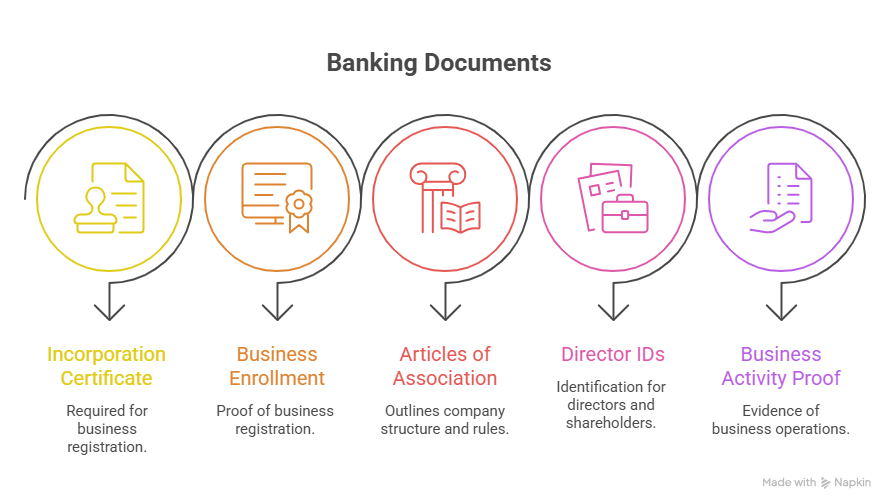
Industry-Specific Licenses
Not every business is the same. Businesses from different industries require different approvals. Operating without these, even if your company is incorporated, is a criminal offense.
Food & Beverage
Requires a Food Hygiene License from the Food and Environmental Hygiene Department.
Financial Services
Requires a license from the Securities and Futures Commission (SFC).
Travel Agents
Requires a license from the Tourism Industry Council.
Post-Incorporation Compliance
Your job isn't done after incorporation. Missing these compliance specifics leads to progressive fines up to HKD 50,000 ($6,451) and potential prosecution.
- Annual Return (NAR1)
Must be filed within 42 days of your anniversary.
- Audit
You must prepare audited financial statements annually.
- Profits Tax Return
Filed with the Inland Revenue Department (IRD) usually 18 months after incorporation.
Documents Required for Hong Kong Company Formation with RadiantBiz
At RadiantBiz, we streamline the documents required for Hong Kong company formation into a process designed to eliminate back-and-forth and prevent costly delays.
First, we conduct a pre-assessment to identify specific needs based on the business structure and the directors' nationalities. Next, we provide a customized digital checklist with clear templates and examples for every required document, from passport scans to proof of address.
Our team then performs a rigorous pre-submission audit to verify that every file meets the strict standards of the Companies Registry and local banks, catching errors before they become rejections.
Finally, we handle the secure submission and tracking, ensuring the application moves through the system efficiently.
FAQs
1. How long does it take to get the Certificate of Incorporation?
For electronic applications submitted with all correct documents, the Companies Registry typically issues the Certificate of Incorporation within 1 to 3 working days. Paper applications can take up to 7 to 10 days.
2. Can I incorporate a company in Hong Kong without living there?
Yes. There are no residency requirements for directors or shareholders.
3. What happens if I submit the wrong address for my official office?
If the address is invalid (e.g., a P.O. Box) or cannot receive mail, the Registry may reject your application. Even if approved, failing to update your address when you move can lead to missed legal notices and fines.
Start Strong, Stay Compliant
Setting up a company in Hong Kong is straightforward if you respect the process. The key is preparation. By gathering the correct documents needed to incorporate in HK and understanding the role of each piece of paperwork, you avoid the delays that frustrate so many entrepreneurs.
Don't wait until the last minute to sort out your IDs or find a secretary. Treat your incorporation as a strategic project. With the right documentation in hand, you can move quickly from concept to operation.
Use our HK company formation checklist today to ensure you have every document ready before you submit:
- Proposed Company Name (at least 2-3 options)
- Shareholder(s)/Director(s) Passport Copy
- Shareholder(s)/Director(s) Proof of Address
- Official Office Address (physical Hong Kong address, not P.O. Box)
- Company Secretary Details
- Articles of Association (standard model or customized version)
- Form NNC1
- Authorized Share Capital Declaration
- Beneficial Ownership Information (details of ultimate owners holding 25%+)
- Business Nature Description
- Business Enrollment Certificate Application
- Corporate Director Documents (if applicable)
- Certified Translation (if any documents are not in English or Chinese)
- Notarized/Certified Copies (for foreign directors/shareholders as required)
- Initial Bank Deposit Funds (depending on bank)
- Proof of Business Activity
- Reference Letter
If you have complex structures or specific industry needs, seek our professional on-the-ground guidance, contact us via mail at info@radiantbiz.com, WhatsApp, or call us at +971521322895!

.webp)

.webp)
With over 15 years of experience in the banking and business consulting sector, Rizwan Ansari leads RadiantBiz with a vision to simplify business setup in the UAE.


.avif)


.svg)


.svg)
.svg)
.svg)

