.png)

.png)

2.png)
Hong Kong Vs Singapore: Which is Better for Company Formation?


Table of Contents
About the Author
Our business setup consultant writes this article with over a decade of experience helping entrepreneurs establish companies in Hong Kong and the UAE. Having worked with startups, SMEs, and international investors, they have guided businesses through jurisdiction selection, tax structuring, and banking strategies across both regions.
Key Takeaway:
- Hong Kong remains the superior choice for businesses targeting Mainland China due to CEPA benefits and seamless RMB flows, while Singapore is the preferred hub for global startups seeking venture capital, neutrality amidst US-China tensions, and access to a network of over 90 Double Taxation Agreements.
- Although Hong Kong offers a lower headline tax rate, claiming "offshore" status has become a regulatory minefield requiring rigorous proof of management control, conversely, Singapore's effective tax rate for startups can drop to 8–9% through partial exemptions, supported by a more robust treaty network for cross-border withholding tax savings.
- While Hong Kong allows for 100% foreign ownership with no local director requirement and offers a clearer 7-year path to permanent residency, Singapore mandates a resident director and enforces strict "economic substance" rules for bank account approval, making it harder for solo remote founders to secure accounts without a physical presence.
Hong Kong vs Singapore Company Formation: Which Jurisdiction Wins in 2026?
In 2026, choosing between Hong Kong and Singapore is no longer a coin flip. With Singapore now hosting over 4,200 family offices and Hong Kong tightening its offshore tax claims, the wrong jurisdiction can cost a founder six figures in taxes and months of stalled banking.
We have spent the last decade helping founders, investors, and traders navigate these two powerhouses. From Hong Kong company formation for global trade and investment structures to setting up a company in Singapore for regional expansion and long-term credibility, we have seen clients save thousands in taxes, and others lose months of momentum because they picked the wrong base. The truth is, there is no single “best” option. There is only one best option for your specific business model.
This guide cuts through the noise. We look at tax rates, the real-world friction of banking, compliance realities, and the strategic future of your business.
Whether you are weighing Hong Kong vs Singapore company formation or trying to decide where to set up a company, this analysis will give you the clarity you need.
Note: All prices are estimates based on market rates at the time of publication. Actual costs may vary due to daily exchange rate fluctuations and potential bank transfer fees.
Hong Kong vs Singapore at a Glance: 2026 Comparison Table
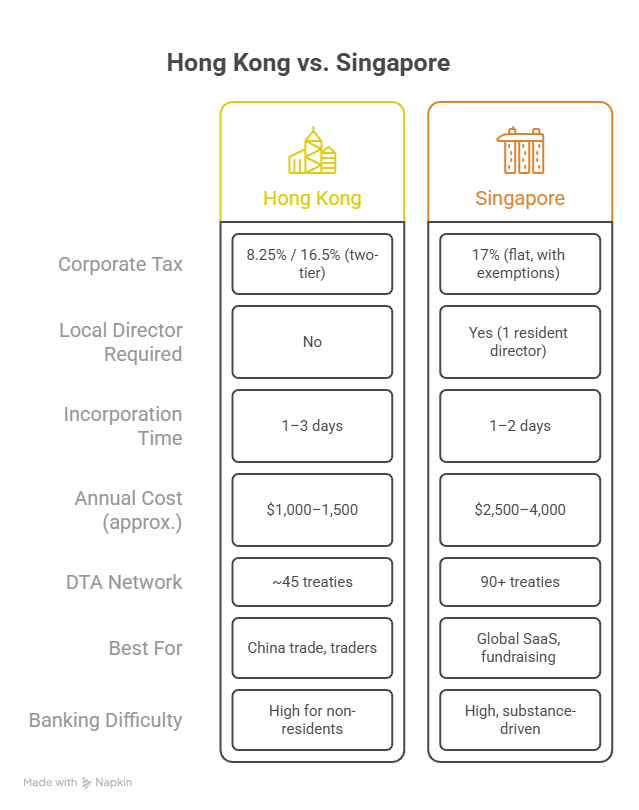
Hong Kong vs Singapore Tax Rates: Corporate Tax, Exemptions & DTAs Compared
Everyone fixates on the headline tax rate. Hong Kong's territorial system, which taxes only locally sourced income, looks unbeatable. Singapore's 17% rate seems high by comparison. But after a decade of watching audits and tax rulings, the math is more nuanced.
Hong Kong operates a two-tiered profits tax: 8.25% on the first HKD 2 million ($256,410) of profit, and 16.5% above that. However, the offshore profits tax exemption claim, declaring income as foreign-sourced to pay zero Hong Kong tax, has become a regulatory minefield. The Inland Revenue Department now demands rigorous proof of where management and control occur.
Singapore offers a flat 17% corporate tax rate, but partial tax exemptions often bring the effective rate down to 8–9% for new startups. Singapore's network now exceeds 90 Double Taxation Agreements as of 2026, compared to Hong Kong's roughly 45.
For businesses paying cross-border royalties or dividends, Singapore's treaty network saves significantly more in withholding tax.
Which has a Lower Corporate Tax - Hong Kong or Singapore?
Hong Kong has a lower headline rate at 8.25% on the first HKD 2 million ($256,410). Singapore's flat 17% looks higher, but partial tax exemptions and startup incentives can bring the effective rate down to 8–9% for the first three years.
For startups under $200,000 in profit, the effective rates are often comparable.
Incorporation Speed and Compliance: Hong Kong vs Singapore Requirements
Hong Kong shines in speed, a certificate of incorporation in three days, fully digital, and cheap. But that speed brings scrutiny: the registry is flooded with shell entities, triggering stricter anti-money laundering checks.
Singapore is slightly more bureaucratic but offers stability. The Accounting and Corporate Regulatory Authority (ACRA) enforces economic substance requirements rigorously. You cannot just have an official address, Singapore expects real business decisions to be made on the ground.
One major friction point for foreigners is the director requirement. Hong Kong allows a sole non-resident director and shareholder. Singapore requires at least one locally resident director. Many founders try to bypass this with nominee director services, but we generally advise against using them as a long-term solution.
Both jurisdictions are fully compliant with global transparency standards, including ultimate beneficial ownership (UBO) disclosure rules and FATF guidelines.
How Long Does Incorporation Take in Hong Kong vs Singapore?
Hong Kong incorporation completes in 1–3 working days through the e-Registry.
Singapore typically takes 1–2 working days through ACRA's BizFile+ portal, provided KYC documents and the resident director appointment are ready.
Opening a corporate bank account, however, usually adds 4–8 weeks.
Can a Foreigner Own 100% of a Company in Hong Kong or Singapore?
Yes, both jurisdictions allow 100% foreign ownership of a private limited company. The key difference is the director rule: Hong Kong permits a sole non-resident director, while Singapore requires at least one resident director, a citizen, PR, or Employment Pass holder.
How Much Does it Cost to Incorporate a Company in Each Jurisdiction?
A Hong Kong Ltd costs roughly $1,500–2,500 to incorporate, with annual renewal around $1,000–1,500.
Singapore incorporation runs $2,000–3,500 upfront, with annual costs of $2,500–4,000 due to the resident director and official address requirements.
Corporate Bank Account Opening in Hong Kong vs Singapore
The hardest part of Hong Kong vs Singapore company formation isn't the paperwork, it's corporate bank account opening.
In Hong Kong, HSBC and Standard Chartered are notoriously strict with non-resident directors. They require a physical visit, a detailed business plan, and proof of existing contracts. Digital banks like Airwallex and Aspire have eased entry, but transaction limits constrain scaling businesses.
Singapore banks (DBS, OCBC, UOB) demand economic substance. A solo founder living in Bali with a Singapore company will struggle to open an account without a local partner or significant deposit.
Once approved, however, the Singapore dollar is a fortress, far less volatile than the USD-pegged Hong Kong dollar.
Market Access in 2026: China Gateway (Hong Kong) vs Global Hub (Singapore)
This is the most critical strategic decision. Where is your customer?
If your primary market is Mainland China, Hong Kong is the undisputed king. The Closer Economic Partnership Arrangement (CEPA) gives Hong Kong companies preferential treatment unmatched by any foreign entity. Renminbi (CNH) flow is seamless, and the Greater Bay Area is your backyard.
If your target is Southeast Asia, the Middle East, or the West, Singapore is the superior choice. In a world of rising US-China tensions, a Singaporean entity signals neutrality.
Singapore's Variable Capital Company (VCC) structure has made it the preferred domicile for venture capital firms and fund managers. US investors are far more comfortable writing checks to a Singaporean VCC than a Hong Kong Ltd.
Visa, Residency & Talent Pathways in Hong Kong and Singapore
Hong Kong offers the IANG scheme and the Quality Migrant Admission Scheme. Incorporate a company, hire yourself as an executive, and the path to permanent residency is relatively clear: seven years of residence.
Singapore is harder. The Employment Pass operates under the COMPASS framework, a points-based system rewarding high salaries, qualifications, and team diversity. Singapore PR is opaque and often requires significant investment or exceptional talent.
If you want to live in Asia and gain residency, Hong Kong is the more accessible route today.
When to Choose Hong Kong vs Singapore
Choose Hong Kong if:
- Your primary market is Mainland China or the Greater Bay Area
- You need a low-cost entry point with minimal setup friction
- You are seeking a clear seven-year path to residency
- You operate in import/export, logistics, or traditional trading
Choose Singapore if:
- You are raising venture capital from US or European investors
- You need access to 90+ Double Taxation Agreements
- You want a neutral, stable jurisdiction to hold IP or assets
- You are building a SaaS, fintech, or tech platform targeting global markets
Is It Better to Incorporate a Company in Hong Kong or Singapore?
It depends on your target market and funding goals. Hong Kong wins for China trade, fast incorporation, and clearer residency. Singapore wins for global fundraising, DTA coverage, and IP holding.
Hong Kong vs Singapore Company Formation with RadiantBiz
Choosing between Hong Kong and Singapore requires more than filling out forms, it demands a partner who understands Asian corporate law, banking friction, and substance requirements.
At RadiantBiz, our business setup consultants help you build the right foundation for your specific growth trajectory.
Whether you need a Hong Kong entity to unlock the Greater Bay Area, a Singaporean VCC to attract global venture capital, or a UAE free zone setup as a strategic alternative, our team handles the heavy lifting, from resident directors and registered addresses to navigating corporate banking approvals.
Hong Kong or Singapore: Making the Right Choice for 2026
The debate isn't about a magic bullet. Hong Kong offers speed and access to China. Singapore offers stability, global trust, and a robust treaty network.
Assess your target market, funding needs, and residency goals, then pick the jurisdiction that supports that vision.
Ready to build your Asian headquarters? Seek our professional on-the-ground guidance, contact us via mail at info@radiantbiz.com, WhatsApp, or call us at +971521322895!
.webp)

.webp)
%20.webp)
With over 15 years of experience in the banking and business consulting sector, Rizwan Ansari leads RadiantBiz with a vision to simplify business setup in the UAE.


.avif)


.svg)


.svg)
.svg)
.svg)

