.png)

.png)

2.png)
How to Start a Company in Singapore as a Foreigner (2026 Step-by-Step Guide)

.webp)
Table of Contents
About the Author
This article is written by our business setup consultant with over a decade of experience helping entrepreneurs establish companies in Singapore and the UAE. Having worked with startups, SMEs, and international investors, they have guided businesses through jurisdiction selection, tax structuring, and banking strategies across both regions.
Key Takeaways:
- Foreign entrepreneurs can fully own a Private Limited Company, benefit from low corporate taxes, enjoy strategic regional access, and gain credibility with investors, making Singapore an ideal hub for startups and expansion.
- Navigating local director requirements, incorporation, banking, visas, and ongoing compliance can be complex, but working with experienced consultants like RadiantBiz streamlines the process, reduces delays, and ensures regulatory adherence.
- Singapore provides diverse funding options, including government grants, angel investors, venture capital, and fintech alternatives, but securing capital and opening corporate bank accounts is faster and smoother when companies are properly structured, documented, and investor-ready.
Why Singapore is a Top Choice for Foreign Entrepreneurs in 2026
Singapore is one of the most attractive business hubs in the world, particularly for foreign entrepreneurs looking to expand in the Asia-Pacific. Its combination of low corporate taxes, regulatory transparency, and global credibility makes it a preferred destination.
But starting a company as a foreigner can be daunting, with specific legal requirements, compliance obligations, and visa considerations.
Over the past decade, we’ve helped countless founders navigate these challenges. Some have quickly secured funding due to Singapore’s credibility, while others faced delays due to missing documentation or misunderstanding local director requirements.
This 2026 step-by-step guide will show you exactly how to start a company in Singapore as a foreigner, including practical tips from real-world experience to ensure a smooth launch.
Note: All prices are estimates based on market rates at the time of publication. Actual costs may vary due to daily exchange rate fluctuations and potential bank transfer fees.
Why Singapore is Ideal for Foreign Entrepreneurs
Singapore consistently ranks among the top economies globally for ease of doing business.
According to the World Bank’s Ease of Doing Business Index, Singapore ranked 2nd worldwide in 2020, reflecting its streamlined processes for starting a business, enforcing contracts, and trading across borders.
For foreign entrepreneurs, this translates into:
- 100% foreign ownership: No local partner required.
- Corporate tax benefits: 17% standard rate with exemptions for startups and no capital gains tax.
- Strategic location: Access to Southeast Asia, China, and Australia.
- Credibility with investors: A highly trusted regulatory framework increases funding opportunities.
Expert experience: A fintech startup we advised in 2022 chose Singapore for investor trust. Within six months, the company secured $500,000 in seed funding, onboarded three clients across two countries, and met all regulatory filings on time.
Whether you are launching a tech startup, consultancy, or import/export business, Singapore offers a stable, credible environment for long-term growth.
Types of Business Entities in Singapore
Choosing the right entity is the first critical step when starting a company in Singapore. The entity type affects liability, tax, compliance, and investor credibility.
Private Limited Company (Pte Ltd)
It is the most common choice for foreign founders, providing limited liability to protect personal assets. The structure allows for 1 to 50 shareholders, making it ideal for startups seeking investor funding.
Sole Proprietorship / Partnership
It is simple to set up, but it is not recommended for foreign investors as it's less credible for funding or banking purposes, and the owner is personally liable for debts.
Branch Office / Subsidiary
A branch office operates as the same legal entity as its parent company, while a subsidiary is a separate legal entity incorporated in Singapore, making both structures suitable options for foreign businesses looking to expand into the Singapore market.
Expert tip: Most foreign founders benefit from a Private Limited Company due to investor trust and flexibility for scaling.
Step-by-Step Company Formation Process
Typical timeline: 1–3 days if all documentation is complete.
Here’s a practical roadmap for foreigners looking to start a company in Singapore in 2026:
Step 1: Name Approval
Select a business name and ensure the name is unique, not obscene, and doesn’t infringe on trademarks.
Then submit it via the government authority of ACRA (Accounting and Corporate Regulatory Authority).
Step 2: Appointment of Directors
Appoint a local director or use a nominee director service. At least one resident director is required.
Expert experience: A client used a nominee director while completing their Employment Pass, enabling operations to start immediately.
Step 3: Shareholders and Paid-Up Capital
Minimum paid-up capital is SGD 1 ($0.78). Foreigners can hold 100% of shares.
Step 4: Official Office Address
Can be a physical or virtual office, but must comply with Singapore regulations for official correspondence.
Step 5: Appointment of Company Secretary
Mandatory within 6 months of incorporation. Recommended to use professional services for compliance and filings.
Step 6: Incorporation Filing with ACRA
Submit documents through the BizFile ACRA portal.
Expert insight: Preparing all documents, including director IDs, shareholder information, and office proof, reduces processing delays.
Post-Incorporation Compliance for Foreigners
Ongoing compliance is essential to maintain your legal status and credibility:
Corporate bank account
Opening a corporate bank account for business transactions is a must. Foreigners must submit detailed KYC documentation, and banks may require a business plan.
Accounting and bookkeeping
Annual financial statements are mandatory.
Annual returns
Must be filed with ACRA.
Corporate tax filing
Submit taxes with the Inland Revenue Authority of Singapore (IRAS).
Employee CPF contributions
Employee CPF stands for Central Provident Fund. It is a mandatory, comprehensive social security savings scheme in Singapore requiring monthly contributions from both employees and employers. It is mandatory to hire local employees.
Expert experience: A SaaS founder delayed filing annual returns and incurred fines that could have been avoided with proper guidance.
Employment Pass & Visas for Foreign Founders
Foreigners need the correct pass to live and work in Singapore:
Employment Pass (EP)
For professionals earning above SGD 5,000 ($3909) /month, requires relevant qualifications and business activity.
EntrePass
For innovative startups meeting government criteria.
Dependent visas
Available for spouses and children.
Expert insight: Timing is critical, apply early for EP or EntrePass to avoid delays in opening bank accounts or signing office leases. One client successfully brought in family members within three months using an EntrePass.
Costs of Starting a Company in Singapore
Accurate budgeting helps prevent surprises.
Note: USD figures are approximate and may vary slightly depending on exchange rates.
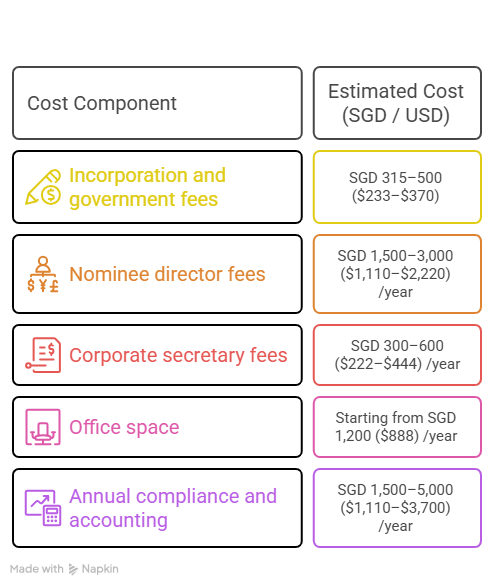
Expert tip: Many founders underestimate ongoing compliance and director costs, which should be included in your first-year budget.
Banking and Funding for Foreign Entrepreneurs
Banking
Opening a corporate bank account is often the biggest challenge. Banks are reputable but strict, approval can take anywhere from 2 to 4 weeks.
Preparing the required documents beforehand can speed up the process. The required documents include a business plan, shareholding structure, and proof of operations.
Fintech alternatives are available for digital-first businesses, offering more flexible and faster banking solutions compared to traditional banks.
Funding
Funding for foreign businesses in Singapore is well-developed, but it requires preparation, credibility, and the right structure to access it effectively. The ecosystem supports startups at every stage, from early validation to scaling globally.
For early-stage founders, government-backed grants are a strong starting point. Agencies like Enterprise Singapore offer schemes such as the Startup SG Founder grant, which can co-fund innovative businesses.
However, these typically require a locally incorporated Private Limited Company and, in some cases, a Singapore-based co-founder or strong local presence.
Angel investors are active in Singapore’s startup scene, especially in sectors like fintech, SaaS, and e-commerce. These investors not only provide capital but also mentorship and connections.
Based on our experience, foreign founders who clearly demonstrate market potential in Southeast Asia tend to attract more interest at this stage.
As the business grows, Venture Capital (VC) becomes a key funding route. Singapore is home to major regional and global VC firms, and many prefer investing in companies incorporated locally due to regulatory clarity and investor protection.
A well-structured company, a clean cap table, and a strong compliance record significantly improve your chances of securing VC funding.
Foreign entrepreneurs can also explore accelerators and incubators, which offer seed funding, mentorship, and networking opportunities. Programs like those run by global tech hubs or government-supported initiatives can fast-track growth and visibility.
Another emerging option is fintech and alternative financing, including revenue-based financing and digital lending platforms. These are particularly useful for digital-first businesses that may not yet qualify for traditional bank funding.
Overall, Singapore offers diverse funding opportunities for foreign businesses, but success depends on how well you position your company within its highly structured and investor-friendly ecosystem.
Expert experience: A SaaS startup we advised secured a bank account and early-stage funding within two months because all documentation was properly prepared and investor-ready.
Common Challenges and How to Overcome Them
Foreign entrepreneurs often face several challenges when setting up in Singapore, including meeting the local director requirement, understanding ongoing compliance and tax obligations, navigating strict banking procedures, and managing visa and Employment Pass approval timelines.
To overcome these hurdles, working with experienced Singapore business setup consultants can make a significant difference, as they help coordinate incorporation, banking, and visa processes simultaneously, reducing delays and ensuring a smooth and compliant setup.
How to Start a Company in Singapore as a Foreigner with RadiantBiz
Starting a company in Singapore as a foreigner can be a seamless process with the right guidance. Our team at RadiantBiz specializes in making it straightforward and efficient.
From selecting the most suitable business structure to meeting the local director requirements, handling regulatory compliance, and navigating corporate tax obligations, our business setup consultants provide end-to-end support.
They also assist with opening corporate bank accounts, obtaining necessary visas and Employment Pass approvals, and ensuring your company meets all legal and reporting requirements.
With RadiantBiz, foreign entrepreneurs can focus on growing their business while experts manage incorporation, banking, and compliance simultaneously, helping avoid delays and costly mistakes.
FAQs
1. Can foreigners fully own a company in Singapore?
Yes. Foreigners can hold 100% of shares in a Private Limited Company, though at least one resident director is required.
2. How long does it take to start a company in Singapore as a foreigner?
Incorporation via ACRA usually takes 1–3 days, but banking and visa approvals may take 2–6 weeks.
3. What visas are available for foreign founders?
Foreigners can apply for the Employment Pass or EntrePass. Dependent visas are available for family members.
Your Path to Starting a Company in Singapore in 2026
Starting a company in Singapore as a foreigner offers tremendous opportunities, but success requires careful planning. Singapore provides credibility, investor trust, and regulatory transparency, making it ideal for scaling and fundraising.
However, compliance, banking, and visa requirements can be complex. By preparing thoroughly and working with experienced consultants like RadiantBiz, you can avoid pitfalls, save time, and ensure your company is structured for sustainable success from day one.
Ready to start your Singapore company? Seek our professional on-the-ground guidance, contact us via mail at info@radiantbiz.com, WhatsApp, or call us at +971521322895!
%20.webp)

.webp)
With over 15 years of experience in the banking and business consulting sector, Rizwan Ansari leads RadiantBiz with a vision to simplify business setup in the UAE.


.avif)


.svg)


.svg)
.svg)
.svg)

