.png)

.png)

2.png)
Annual Filing Obligations for Singapore Companies: Deadlines and Penalties

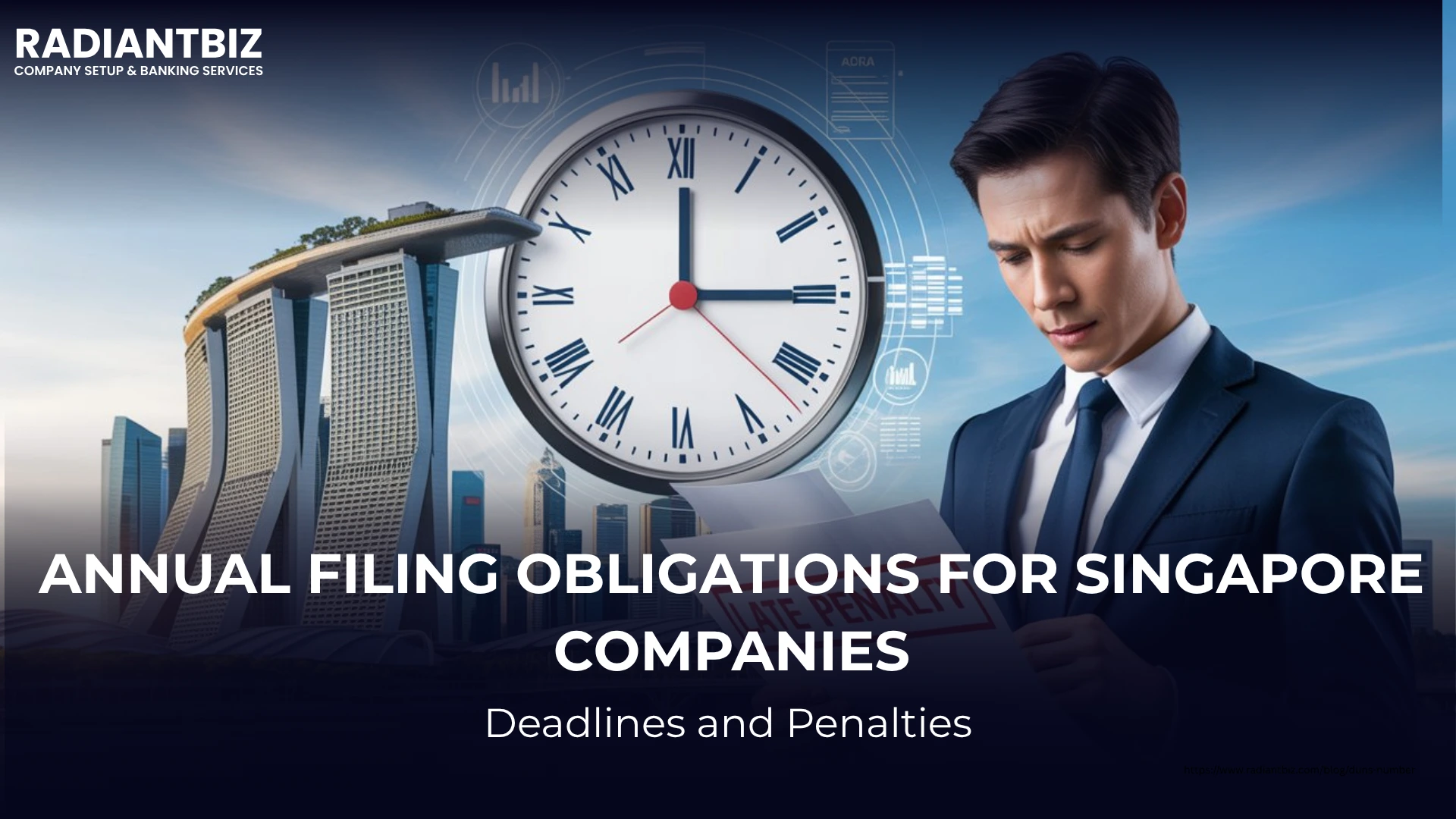
Table of Contents
About the Author
Our business setup consultant writes this article with over a decade of experience helping entrepreneurs establish companies in Singapore and the UAE. Having worked with startups, SMEs, and international investors, they have guided businesses through jurisdiction selection, tax structuring, and banking strategies across both regions.
Key Takeaway:
- Filing obligations begin 7 months after your Financial Year End (FYE), not your incorporation date, with a special 18-month window only for the very first return, missing these triggers an automated "sliding scale" penalty system that can escalate from $60 to $300+ per document, with no grace periods.
- Companies with zero revenue or those classified as dormant are not exempt from filing, they must still submit an Annual Return and a Dormant Declaration, and failing to do so for two consecutive years can lead to the company being struck off, assets seized by the State, and costly court reinstatement procedures.
- A clean ACRA record is essential for securing bank loans, investor funding, and government grants. Relying on professional guidance to manage AGM waivers, audit exemptions, and filing checklists is far more cost-effective than paying late penalties or legal fees to fix non-compliance issues.
The Real Risks of Missing ACRA Annual Filing Deadlines in Singapore
Missing a single ACRA filing deadline can cost a Singapore company SGD 600 in automated penalties - and missing two consecutive years can cost it everything, including legally held assets seized by the State. Non-compliance with annual filing obligations is one of the leading causes of company closure in Singapore, and it consistently catches well-intentioned business owners off guard.
Compliance is not just a post-incorporation concern - it is a core pillar of successful company formation in Singapore. Many entrepreneurs mistakenly believe that a lack of revenue or a dormant status exempts them from regulatory duties, only to discover too late that the Accounting and Corporate Regulatory Authority (ACRA) enforces strict, automated penalties with no grace periods.
The consequences of missing these deadlines extend far beyond simple late fees, they can result in the striking off of a company, the freezing of bank accounts, and the loss of corporate assets to the State.
With over a decade of experience managing corporate secretarial functions for diverse entities, it is clear that the most significant risks to business continuity often stem from administrative oversights rather than market failures. Singapore's regulatory framework is designed for efficiency and transparency, but it demands precision and timeliness. This guide compiles extensive practical experience with hundreds of filings, penalty assessments, and reinstatement cases to provide a definitive roadmap for compliance.
Singapore's regulatory framework is designed for efficiency and transparency - but it demands precision and timeliness. This guide draws on experience with hundreds of filings, penalty assessments, and reinstatement cases to provide a practical roadmap for staying compliant.
It outlines the exact statutory deadlines, clarifies common misconceptions regarding exemptions, and details the specific mechanisms to avoid the severe financial and legal repercussions of non-compliance.
Singapore Annual Return Deadlines: Why Your FYE - Not Your Incorporation Date - Starts the Clock
The most common error we correct in our first meeting with a new client is the confusion between the Incorporation Date and the Financial Year-End (FYE).
Your filing clock does not start when you incorporate it starts when your Financial Year ends. Companies can apply to change their Singapore financial year end once incorporated, which some founders use strategically to align their first FYE with a full 12-month trading period.
For a standard private limited company, Singapore's Companies Act requires you to lodge your ACRA annual return within 7 months of your Financial Year End - a deadline that is fixed, automated, and carries no grace period.
For example, if your FYE is 31 December 2025, your deadline is 31 July 2026. Remember, if you incorporate on 1 January 2025, your first FYE might be 31 December 2025. As a new company, you have 18 months from the date of incorporation to file your first return, but in subsequent years, you revert to the strict 7-month rule.
When Does a Singapore Company Need to File Its Annual Return with ACRA?
A Singapore private limited company must file its Annual Return within 7 months of its Financial Year End (FYE). For example, if your FYE is 31 December 2025, your deadline is 31 July 2026. Newly incorporated companies get a longer window - 18 months from the date of incorporation for the first return only. After that, the strict 7-month rule applies permanently, with no grace period and automated penalties from day one of non-compliance.
What Is the ACRA BizFile+ Portal and How Do You File Your Annual Return?
All Singapore annual return filings are submitted through ACRA's BizFile+ online portal - the central registry platform for all corporate filings, updates, and searches. To file, you will need your company's Unique Entity Number (UEN), the completed financial statements, and confirmation of the AGM waiver or meeting resolution where applicable. Most authorised company secretaries can file directly on behalf of the company, which is the recommended approach to avoid formatting errors that trigger ACRA rejection.
Singapore AGM Requirements for Private Companies: Can You Waive It and Still Need to File?
Yes - private limited companies in Singapore can waive the AGM requirement entirely if all shareholders sign a written resolution confirming they have received and approved the financial statements. However, waiving the AGM does not waive the Annual Return filing obligation. The Annual Return and financial statements must still be submitted to ACRA within 7 months of the FYE. Missing this deadline because you assumed "no AGM = no filing" is one of the most common and costly compliance errors.
Expert insight: When drafting the waiver resolution, ensure it explicitly states that the shareholders have received and approved the financial statements. If you skip this step, ACRA may reject your filing, claiming the statutory requirements for the waiver weren't met.
The Real Cost of ACRA Non-Compliance: Two Scenarios Every Singapore Company Director Must Know
To understand the gravity of these deadlines, let's look at two practical cases.
Scenario A: Missing the ACRA Deadline by 45 Days - How the Sliding Scale Penalty Works
A company missed its FYE deadline by 45 days due to a delayed audit. They expect a flat $60 fine. Instead, ACRA's late filing penalty schedule escalates automatically — because the delay crosses the 30-day threshold, the penalty jumps from $60 to $300 for the Annual Return and another $300 for the financial statements, totalling $600 in ACRA penalties alone before any professional remediation costs.
Total cost is $600 in penalties and $1,200 in expedited audit fees to fix the delay. The penalty structure is automated and aggressive. A delay of one month can double your costs.
Scenario B: Two Missed Filings - How a Dormant Company Gets Struck Off by ACRA
A dormant holding company owned by a family trust assumes "dormant" means "no filing required." They missed two consecutive years of filings. ACRA initiates strike-off proceedings. The company gets removed from the record.
The family's property, held in the company's name, becomes legally entangled with the State. The solution required involves filing a High Court application for reinstatement. This takes 6 months, costs $8,000 in legal fees, and requires paying all outstanding penalties plus interest.
Dormant companies must still file. Silence is not compliance - and ACRA does not send reminders.
How Do You Reinstate a Singapore Company After It Has Been Struck Off by ACRA?
Reinstating a company struck off by ACRA requires filing a High Court application - it cannot be done through BizFile+ alone. The process typically takes 4–8 months, costs SGD 6,000–10,000 in legal fees, and requires paying all outstanding penalties and interest in full before reinstatement is granted. Any assets held in the company's name during the strike-off period become State property and may require separate legal proceedings to recover. Prevention is categorically cheaper than reinstatement.
What Is the Penalty for Late Filing of an Annual Return in Singapore?
ACRA applies a sliding scale penalty for late annual return filings. If filed within 30 days of the deadline, the penalty is $60 per document. Beyond 30 days, the penalty escalates to $300 per document - applied separately to the Annual Return and the financial statements. For a single late submission crossing the 30-day mark, the total automated penalty can reach $600 or more, before any professional remediation costs are added.
Singapore Small Company Audit Exemption: Criteria, the Two-Year Rule, and Common Pitfalls
Singapore offers a lifeline to smaller businesses: the Small Company Exemption. This exemption allows qualifying companies to submit unaudited financial statements in Singapore rather than full statutory audit accounts a significant saving in both time and professional fees for small businesses managing tight margins.
However, the criteria are strict. To qualify for the small company audit exemption, your company must meet at least two of the following three conditions in the current financial year:
- Total annual revenue does not exceed SGD 10 million
- Total gross assets do not exceed SGD 10 million
- Total number of employees does not exceed 50
The "Two-Year" Rule: A company qualifies as a small company if it meets the criteria for the current financial year and the immediately preceding financial year.
Expert experience: We once worked with a startup that blew past the $10 million revenue mark in Year 2. They failed to audit their Year 2 accounts, thinking they were still "small." When they filed their Year 3 return, ACRA flagged the discrepancy. The company was forced to re-file Year 2 with audited accounts, incurring retroactive audit fees and a late filing penalty.
Expert advice: Run the "Small Company" test every single year. Do not assume your status carries over automatically.
Special Filing Rules for Dormant, Newly Incorporated, and Foreign Branch Companies in Singapore
Newly Incorporated Singapore Companies: The 18-Month First Filing Window Explained
As mentioned, your first filing has a longer window: 18 months from incorporation.
Expert warning: Do not treat this as a "free pass." Set a reminder for Month 17. If you miss the 18-month mark, the penalties apply immediately.
Filing Requirements for Dormant Companies in Singapore: What "Dormant" Actually Means
Yes — a dormant company in Singapore is still legally required to file an Annual Return with ACRA. While a dormant company declaration can be filed alongside simplified financial statements, failing to file for two consecutive years triggers automatic strike-off proceedings. Even a single bank interest transaction - if undeclared - voids dormant status and requires full financial statement preparation. Dormant does not mean exempt; it simply means a reduced compliance workload, not zero compliance.
Annual Filing Requirements for Foreign Branch Companies Operating in Singapore
If you are a foreign branch operating in Singapore, the rules differ. You must file your financial statements prepared according to the laws of your home country, translated into English if necessary.
The deadline is usually 18 months from the end of your financial year, but local branches often have stricter reporting requirements depending on their industry (e.g., finance or insurance).
How Singapore's Annual Filing Obligations Apply to UAE-Based Founders Running a Singapore Company
A growing number of Radiantbiz clients are UAE-based entrepreneurs who incorporate in Singapore for international billing, e-commerce, or holding purposes - while managing day-to-day operations from Dubai. For these founders, ACRA's annual filing obligations apply identically regardless of where the directors or shareholders reside.
The most common compliance gap we see in this group is the AGM waiver process: UAE-based directors often assume a virtual signature on WhatsApp or email constitutes a valid written resolution. It does not. The resolution must be a formally structured document signed by all shareholders, and ideally reviewed by the company's appointed corporate secretary.
Additionally, UAE-based founders should be aware that their Singapore company's tax residency - and therefore its IRAS filing obligations - may be affected if the "control and management" of the company is demonstrably exercised from Dubai rather than Singapore. ACRA filings and IRAS filings are separate obligations, both of which must be maintained.
The Pre-Filing Compliance Checklist: 4 ACRA Red Flags That Get Annual Returns Rejected
Before we submit any client's annual return through the BizFile+ ACRA portal, we run a structured pre-filing checklist - because ACRA's system processes submissions automatically and errors cannot be easily reversed once filed. This is where most errors happen.
Official Office Address
Has your office moved? If you updated your lease but not the ACRA record, your AR will be rejected.
Director Resignations
Did a director leave last month? If you file the AR listing them as a current director, you are filing false information. This is a criminal offense under the Companies Act.
Shareholder Changes
Did a shareholder transfer shares? The AR must reflect the current shareholding structure.
AGM Waiver Validity
Is the written resolution signed by all shareholders? If even one shareholder missed the signature, the waiver is invalid, and you must hold an AGM.
Why Proactive ACRA Compliance Is Cheaper Than Fixing Penalties - and Better for Your Business
Based on our decade of practice, the most successful clients are not the ones who hire us to fix their messes, they are the ones who hire us to prevent them.
A clean ACRA record is a currency. Banks check it before approving loans. Investors check it before signing term sheets. Government agencies check it before awarding grants. A record with late penalties or strike-off history signals incompetence and risk.
Meeting Singapore company secretary requirements by appointing a qualified, licensed corporate secretary who monitors filing deadlines proactively - costs a fraction of a single late penalty, let alone the legal fees required to reinstate a struck-off company
Treat your annual filing as essential maintenance, like changing the oil in your car. You do it so the engine keeps running, not because you want to be pulled over by the police.
Singapore Annual Filing and Corporate Tax: How Your ACRA Record Affects Your IRAS Filing in 2026
ACRA compliance and IRAS (Inland Revenue Authority of Singapore) corporate tax compliance are separate but deeply connected obligations. A clean, on-time ACRA record is a prerequisite for a smooth IRAS filing process - because the financial statements submitted to ACRA form the foundation of your corporate income tax return.
In 2026, IRAS continues to require companies to file their Estimated Chargeable Income (ECI) within 3 months of their FYE, and the full tax return (Form C or Form C-S) within the prescribed statutory deadline.
Companies that delay their ACRA annual return - and therefore delay finalising their financial statements - often find themselves filing their IRAS returns late as a consequence. The result is parallel penalty exposure from two separate regulatory authorities. Maintaining ACRA compliance on time is therefore the most direct way to protect your IRAS filing timeline as well.
Annual Filing Obligations for Singapore Companies: Deadlines and Penalties with RadiantBiz
At RadiantBiz, we specialize in transforming the complex landscape of annual filing obligations for Singapore companies into a streamlined, stress-free process.
With deep expertise in navigating ACRA deadlines and mitigating penalties, our team ensures your company remains in full compliance, protecting your assets from the risks of being struck off or having accounts frozen.
Whether you are managing a dormant entity, a high-growth startup, or a mature corporation, we provide the precise, on-the-ground guidance needed to meet every statutory requirement, from AGM waivers to financial statement submissions, allowing you to focus on growth while we safeguard your corporate governance.
FAQs
1. Can I file my Annual Return late if I pay the penalty?
Yes, you can file a late Annual Return at any time, provided you pay the accumulated late filing penalties. However, be aware that if you have been non-compliant for too long (typically two years), ACRA may have already initiated strike-off proceedings.
2. Do I need to hold an AGM if I am a private limited company?
Not necessarily. Under current regulations, private companies can waive the requirement to hold an Annual General Meeting if all shareholders sign a written resolution agreeing to the waiver.
3. What happens if my company is struck off by ACRA?
When ACRA initiates a strike-off for a Singapore company, the entity ceases to exist as a legal person eaning it can no longer enter contracts, hold assets, or employ staff — and any assets remaining in the company's name become property of the State. Its assets become the property of the State. To bring the company back, you must apply for reinstatement through the courts.
Your Singapore Annual Filing Action Plan: Steps to Take Before the ACRA Deadline
Navigating Singapore’s ACRA annual return requirements is not about guessing, it is about precision. The deadlines are fixed, the penalties are automated, and the consequences of non-compliance are severe.
Don't wait for a reminder letter. By the time ACRA sends one, the clock is already ticking on your penalties. Review your Financial Year End today, verify the status of your Singapore AGM requirements, and ensure your team is ready to file well before the seven-month mark.
If you are unsure about your specific situation or if you have missed a deadline, seek professional help immediately. The sooner you act, the cheaper the solution.
Seek our professional on-the-ground guidance, contact us via mail at info@radiantbiz.com, WhatsApp, or call us at +971521322895!

.webp)

Anjali Jawahar ensures the seamless execution of business setup processes, making compliance and licensing effortless for clients. Her keen attention to operational efficiency helps the RadiantBiz businesses establish themselves smoothly in the UAE.


.avif)


.svg)


.svg)
.svg)
.svg)

