.png)

.png)

2.png)
How to Open a Business Bank Account in the UAE as a Non-Resident


Table of Contents
About the Author
The author has over a decade of experience helping international entrepreneurs and SMEs open corporate bank accounts in the UAE, having guided clients across Europe, Asia, and the Middle East, ensuring seamless access to UAE banking and financial services. The author specializes in non-resident corporate banking, free zone setups, and offshore structures.
Key Takeaway:
- Non-resident UAE business bank accounts require complete, notarized documents and clear financial reporting to meet bank compliance standards.
- Free zone or offshore companies often have faster approvals, while selecting a bank that supports non-resident accounts reduces delays and risks.
- Partnering with experienced consultants like RadiantBiz ensures your operations, reporting, and banking profile align with regulatory expectations, increasing approval chances and long-term stability.
Your Guide to Opening a UAE Business Bank Account Non-Resident
Opening a UAE business bank account as a non-resident might seem daunting. From strict KYC requirements to minimum deposit rules, there’s a lot to navigate.
Yet, having a UAE business bank account as a non-resident is often essential for smooth operations, international credibility, and secure transactions.
Over the past decade, we’ve helped clients from Germany, Singapore, and the UK open accounts remotely, sometimes in as little as 18 days.
In this guide, we’ll explain what’s required, share real-world examples, and provide practical tips to make the process straightforward.
Why a UAE Business Bank Account is Crucial for Non-Residents
Even if your business operates entirely overseas, having a UAE-based account offers several advantages:
International Payment Efficiency
The UAE dirham (AED) is pegged to the USD, reducing exchange rate risk. Companies often save thousands on international transfers compared to using foreign accounts.
Credibility with Partners
A UAE bank account signals professionalism to clients, investors, and suppliers worldwide.
Access to UAE Banking Products
From multi-currency accounts to trade finance, having a UAE account opens doors to tools that make international business easier.
Expert experience: We advised a Singapore-based consultancy to open a UAE multi-currency account. They reported saving over 5% in currency conversion costs annually by receiving payments in AED and USD directly, rather than converting through their local bank.
Who Can Open a UAE Business Bank Account as a Non-Resident
Not all businesses are eligible for non-resident accounts, but there are clear pathways:
Free Zone Companies
Entities in DMCC, JAFZA, RAKEZ, and similar free zones allow non-residents to open accounts without UAE residency. These are often the fastest option.
Offshore Companies
Companies registered under RAK ICC or JAFZA Offshore can also open accounts, though banks may require higher deposits and more documentation.
Mainland Companies
Non-resident access is more limited. Banks often require a local manager or service agent, and approvals can take longer.
Expert experience: A German tech startup with a DMCC license opened a corporate account entirely remotely. By submitting notarized documents and using a UAE-based business consultant, the process was completed in 18 days, including verification calls.
Types of UAE Business Bank Accounts for Non-Residents
Understanding the different account types helps you choose what suits your business best:
1. Current Accounts
For day-to-day transactions like paying suppliers and receiving invoices. Most non-residents start here.
2. Savings Accounts
Some banks offer interest-bearing accounts. We recommend these for surplus funds that don’t require immediate access.
3. Multi-Currency Accounts
Hold multiple currencies (USD, EUR, GBP). Vital if your clients or suppliers are international.
4. Digital or Online-Only Accounts
Convenient for non-residents, but check transfer limits, fees, and customer support availability.
Expert tip: A UK-based consulting client chose a multi-currency account to invoice EU clients in euros while keeping operational funds in AED. This reduced conversion fees by 6–7% per year.
Documents Required for Non-Resident Accounts
Banks in the UAE enforce strict compliance, so preparation is key. Typical requirements include:
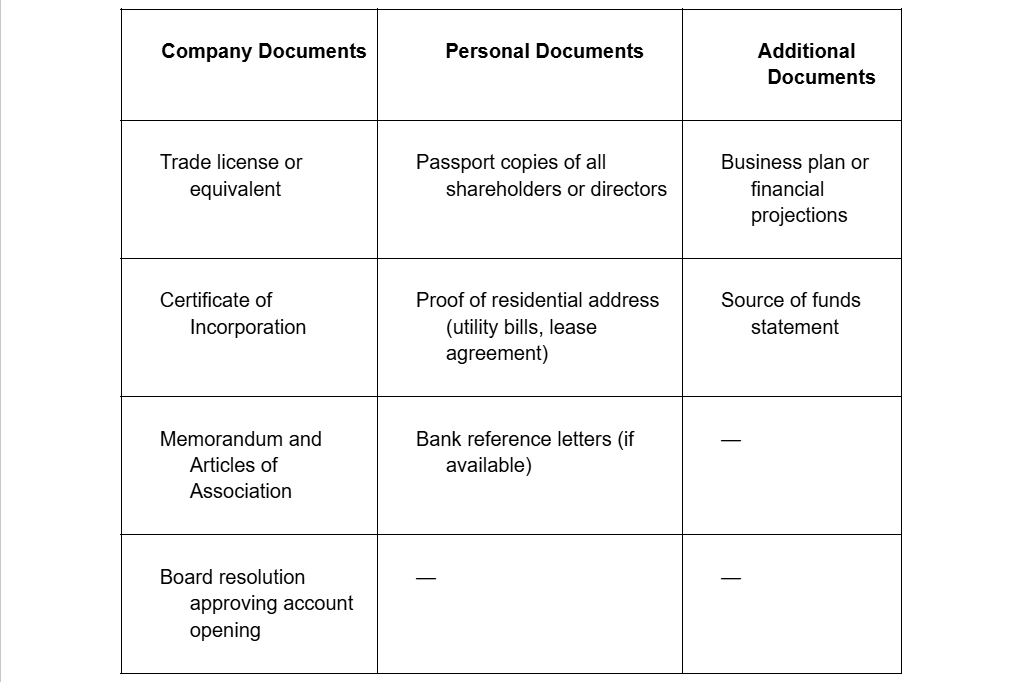
Expert tip: Always have documents notarized and attested. We’ve seen applications delayed for weeks because the client skipped notarization or used outdated documents.
Step-by-Step Process to Open a UAE Business Bank Account as a Non-Resident
Here’s a practical roadmap based on years of client experience:
Step 1: Choose the Right Bank
Local banks like Emirates NBD, ADCB, and Mashreq Bank offer comprehensive services, while international banks like HSBC UAE and Standard Chartered may be more flexible for non-residents. Compare fees, services, online banking tools, and multi-currency options.
Step 2: Confirm Eligibility
Not every bank accepts non-resident accounts, especially for mainland entities. Contact banks directly or use a UAE-based business consultant to verify.
Step 3: Prepare and Submit Documents
Ensure everything is up to date, notarized, and translated if needed. Include proof of company ownership, passport copies, and bank references.
Step 4: Complete Verification
Banks may request a video call, a physical visit, or additional clarifications. Respond promptly to avoid delays.
Step 5: Initial Deposit
Most non-resident accounts require an initial deposit, often AED 50,000–150,000 ($13,500 – $40,500), depending on the bank and company type.
Step 6: Account Activation
Once approved, set up online banking, debit/credit cards, and payment integrations.
Expert experience: A Singaporean offshore company faced delays with document notarization. By correcting missing attestations and providing a clear source-of-funds statement, the account was approved in three weeks. Attention to detail and upfront preparation save time and stress.
Common Challenges and How to Overcome Them
KYC Scrutiny
Banks want detailed info on ownership and funds. Be transparent and provide complete documentation.
Higher Minimum Deposits
Non-resident accounts often require larger deposits than resident accounts. Plan accordingly.
Limited Access to Credit
Some banks restrict loans or overdraft facilities for non-residents.
Approval Delays
Even fully prepared applications can take extra time due to internal compliance checks.
Expert tip: Engage a UAE banking consultant to streamline documentation and communication with banks. Based on our experience, this can save 2–3 weeks on approvals.
Tips for a Smooth Application
- Keep all documents recent and attested.
- Be transparent about your business operations and projected transactions.
- Start with a free zone or offshore entities for faster approvals.
- Avoid applying to multiple banks simultaneously, as it can appear suspicious to compliance teams.
How to Open a Business Bank Account in the UAE as a Non-Resident with RadiantBiz
Opening a UAE business bank account as a non-resident isn’t just about submitting documents, it’s about presenting your business in a way that meets the exacting standards of UAE banks. From our decade of experience at RadiantBiz, we know that many rejections happen long before the application reaches the bank’s compliance team.
Banks assess more than your trade license. They look at your transaction patterns, projected cash flow, revenue consistency, VAT reporting, and internal controls to ensure your business is credible and low-risk.
Even if your paperwork is complete, weak operational structures or unclear financial reporting can raise red flags during onboarding or enhanced due diligence.
At RadiantBiz, a trusted business setup consultancy in Dubai, we take a proactive approach. We review your operations to ensure they match your stated activity and projected transactions. Our team ensures your invoicing, accounting, and VAT records are structured clearly and transparently. We also prepare a comprehensive profile for your company that demonstrates credibility, scalability, and compliance readiness.
By addressing these operational and compliance factors upfront, our clients not only increase their chances of approval but also avoid delays, ongoing monitoring, or restrictions later. In short, we treat banking compliance as part of the infrastructure, not a paperwork afterthought.
Working with RadiantBiz means non-resident entrepreneurs can approach UAE banking with confidence, knowing that every step, from documentation to compliance alignment, is handled strategically to maximize approval success and long-term banking stability.
FAQs
Q1. Can I open a UAE business bank account as a non-resident without visiting the UAE?
Yes, many free zones and offshore banks allow remote account opening. Some banks require video verification or notarized documents.
Q2. What is the minimum deposit for non-resident accounts?
It varies by bank, typically AED 50,000–150,000 ($13,500 – $40,500). Some free zone accounts may accept lower deposits. Check the specific bank’s policies before applying.
Q3. Can a freelancer or sole proprietor open a UAE business account as a non-resident?
Usually not. Freelancers typically need a UAE residency visa to open an account. Non-resident accounts are easier for free zone or offshore companies than individual freelance licenses.
Your Next Steps to a UAE Business Bank Account Non-Resident
Opening a UAE business bank account for a non-resident is achievable with preparation, knowledge, and the right guidance. The key is knowing which type of account fits your business, preparing documents correctly, choosing the right bank, and anticipating compliance requirements.
Over our years of experience, we’ve seen clients save weeks, avoid mistakes, and gain international credibility by approaching the process strategically. Whether you’re invoicing overseas clients, managing suppliers, or establishing credibility with investors, a UAE corporate bank account is often your first step to smooth, efficient operations.
If you’re ready to start, gather your documents, select the right bank, and consider partnering with a UAE-based banking consultant to guide you. Proper planning ensures your account opening experience is fast, compliant, and stress-free.
Seek our professional on-the-ground guidance, contact us via mail at info@radiantbiz.com, WhatsApp, or call us at +971521322895!




With over 15 years of experience in the banking and business consulting sector, Rizwan Ansari leads RadiantBiz with a vision to simplify business setup in the UAE.


.avif)


.svg)


.svg)
.svg)
.svg)

