
.png)

.png)

2.avif)
Indians Setting Up a Company in Hong Kong (Complete Guide)

%20.webp)
Table of Contents
About the Author
Our business setup consultant writes this article with over a decade of experience helping entrepreneurs establish companies in Hong Kong and the UAE. Having worked with startups, SMEs, and international investors, they have guided businesses through jurisdiction selection, tax structuring, and banking strategies across both regions.
Key Takeaway:
- Opt for a private limited company rather than a branch office to protect assets and qualify for the India-Hong Kong tax treaty (DTAA).
- While incorporation is fast, securing a bank account requires proving "economic substance" (physical presence and real operations) to pass strict anti-money laundering checks.
- You must strictly adhere to both Hong Kong's annual audit/tax rules and India's FEMA/ODI reporting requirements to avoid penalties.
Why Indian Entrepreneurs Choose Hong Kong for Company Formation
A Mumbai exporter and a Bengaluru SaaS founder both ask the same first question: where do we incorporate so profits aren't taxed twice? For a growing number of Indian businesses, the answer is Hong Kong, and the reasons are concrete: a territorial tax system, a credible legal framework, and a treaty with India that keeps dividends from being taxed on both sides.
The primary advantage is the India–Hong Kong Double Taxation Avoidance Agreement (DTAA), which has been in force since 2018. It reduces withholding taxes on dividends, interest, and royalties.
On top of that, the two-tier profits tax, 8.25% on the first HKD 2 million ($257,000) of assessable profits and 16.5% above that, gives export-oriented businesses a real edge over domestic Indian rates.
The trade-off is complexity. Setting up a company in Hong Kong for Indians means navigating the Reserve Bank of India's Overseas Direct Investment (ODI) rules and the Hong Kong Monetary Authority's strict AML protocols.
Success takes more than filing documents. It demands a structured approach to corporate governance, banking compliance, and economic substance.
Note: All prices are estimates based on market rates at the time of publication. Actual costs may vary due to daily exchange rate fluctuations and potential bank transfer fees.
Subsidiary vs. Branch Office: Which Structure Should Indians Choose?
The vehicle you pick determines liability and tax efficiency. For 95% of Indian applicants, the Hong Kong private limited company (a subsidiary) is the optimal structure.
Liability isolation
A subsidiary is a distinct legal entity. If litigation or insolvency hits in Hong Kong, the Indian parent's assets stay protected.
Tax treatment
A subsidiary can claim India–HK DTAA benefits. A branch office is treated as an extension of the Indian parent, so profits are often taxed in India first, wiping out the lower Hong Kong rate.
Directorship
Hong Kong permits a foreign national as sole director and shareholder, with no resident director required. Every company must, however, appoint a local company secretary in Hong Kong, a resident or a licensed corporate services firm (a statutory requirement under the Companies Ordinance, Cap. 622).
Can an Indian Own 100% of a Hong Kong Company?
Yes. Hong Kong allows a single foreign national to act as the sole director and 100% shareholder. An Indian founder can fully own and control the company, the only mandatory local appointment is the company secretary.
Expert experience: A Mumbai SaaS firm opened a branch office to save on setup. Six months later, India's Income Tax Department argued the branch's profits were taxable in India regardless of where earned. They liquidated, reincorporated as a subsidiary, and lost a year of market entry.
Hong Kong Company Incorporation Process: Steps, Timeline & Documents
How long does Hong Kong Company Incorporation take?
Incorporation is fast. Through the Companies Registry e-Registry, the Certificate of Incorporation is usually issued within 24 to 48 hours of a complete application. The slower step isn't incorporation, it's the bank account.
Documents Required to Incorporate a Hong Kong Company
Indian applicants need a passport copy, proof of residential address dated within three months, the proposed company name, and the signed Memorandum and Articles of Association (MAA).
The steps:
- Name reservation
Search the Companies Registry to confirm the name is unique and clear of trademarks.
- Document submission
File the MAA with the certified director ID and address proof.
- Incorporation
Receive the Certificate of Incorporation and Business Certificate, which is your tax ID, and must be displayed at the premises.
- Statutory records
Maintain Records of Directors, Members, and People with Significant Control at the official office.
Expert insight: The "official office" must be a physical Hong Kong address — a P.O. box won't do. Virtual office services satisfy the legal requirement, but compliance officers increasingly prefer a physical lease for banking.
Opening a Hong Kong Business Bank Account for Non-Residents (AML & KYC)
The real bottleneck isn't incorporation, it's the bank account. Hong Kong banks run rigorous KYC and AML due diligence under the AML/CFT regime enforced by the HKMA, and they reject anything that looks like a shell company.
To meet the bank's economic substance requirements, prepare:
- Business plan: model, target market, and projected cash flows
- Proof of operations: client contracts, invoices, or a letter of intent from a partner
- Director profile: a CV showing relevant industry experience
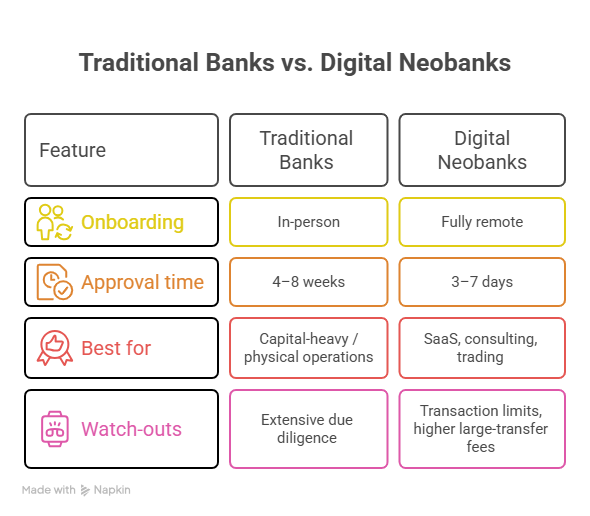
Do Indians Need to Visit Hong Kong to Open a Bank Account?
It depends on the bank. Neobanks allow fully remote onboarding. Traditional banks usually require the director in person, with rare exceptions for established relationships.
Expert experience: An Indian fintech founder was rejected by a traditional bank for "lack of substance." We resubmitted with three signed US client contracts and a Hong Kong distributor's letter of intent. Approved in 10 days.
FEMA, ODI & Hong Kong Tax Filing: Your Dual Compliance Obligations
Compliance runs on two tracks: Hong Kong law and Indian foreign-exchange rules.
Reserve Bank of India (FEMA):
Any Indian entity or individual investing overseas must follow ODI norms.
- ODI (Overseas Direct Investment) route: An investing Indian parent files Form FC (Foreign Commitment) with its Authorized Dealer bank. Total financial commitment must stay within 400% of net worth, capped at $1 billion per financial year, above which RBI approval is needed.
- Liberalised Remittance Scheme (LRS): Individuals can remit up to $250,000 per financial year.
- Reporting: File the Annual Performance Report (Form OI Part II) by 31 December and the FLA Return by 15 July, under the FEM (Overseas Investment) Rules, 2022.
Hong Kong tax obligations:
- Profits Tax Return: Issued annually by the IRD, even a nil return must be filed.
- Audit: Accounts must be audited by a Hong Kong-licensed CPA.
- Annual Return (Form NAR1): File with the Companies Registry within 42 days of the incorporation anniversary, alongside the statutory audit.
Missed returns trigger escalating penalties and possible delisting.
Repatriating Profits Back to India
Earning profit is one thing, getting it home efficiently is another. Hong Kong levies no withholding tax on dividends, so a subsidiary can distribute to its Indian parent without a Hong Kong-side deduction.
On the Indian side, that dividend is taxable, but the DTAA prevents double taxation. Keep the ODI reporting trail current, clean filings, and keep future remittances and disinvestment smooth.
Foreign-Sourced Income and the FSIE Regime (2026)
Hong Kong's territorial system is often summarized as "offshore income is tax-free." In 2026, that needs a caveat.
Under the Foreign-Sourced Income Exemption (FSIE) regime, certain foreign-sourced passive income, dividends, interest, IP income, and disposal gains are exempt only if the company meets an economic-substance test or the relevant nexus conditions.
For most active trading, consulting, or SaaS businesses, this is manageable: a real office, staff, or directors, and Hong Kong decision-making support both the substance test and bank onboarding. Offshore treatment must be claimed and documented, never assumed.
Common Pitfalls that Inflate Costs (and How to Avoid Them)
Ignoring economic substance
Banks may freeze accounts that look like shells. Keep a physical address and active trading records.
FEMA non-compliance
Unreported ODI invites penalties and legal action.
Underestimating annual costs
See below.
What are the Annual Maintenance Costs of a Hong Kong Company?
Beyond setup, budget for the annual audit (roughly HKD 10,000–20,000 ($1,285–$2,570)), company secretary fees, official-office fees, and BC renewal. Founders who budget only for incorporation are often caught off guard in year two.
Setting Up in Hong Kong with RadiantBiz
RadiantBiz turns a bureaucratic process into a strategic advantage.
Our business setup consultants pair deep knowledge of Hong Kong's Companies Registry and Inland Revenue protocols with hands-on command of India's FEMA and ODI rules, handling everything from name reservation and the MAA to your mandatory company secretary, so your entity is incorporated within 48 hours and structured around the DTAA.
On banking, the real pain point, RadiantBiz uses established relationships with traditional banks and neobanks to help you present a convincing economic-substance case and clear KYC/AML checks.
From RBI filings to annual audit coordination, they act as your dedicated compliance partner.
FAQs
1. What's the minimum paid-up capital?
None. Standard authorized capital is HKD 10,000 ($1,285), and paid-up capital can be as low as HKD 1 ($0.13), though HKD 50,000+ ($6,425) shows substance to banks.
2. Can I open the bank account remotely?
With neobanks, yes. Traditional banks usually need an in-person visit.
3. Is the India–Hong Kong DTAA still valid?
Yes, fully operational. It prevents the same income from being taxed twice. Hong Kong dividends to an Indian resident attract reduced treaty withholding. Always confirm current provisions with a tax professional.
Is Hong Kong Worth It? A Final Cost–Benefit View for Indian Founders
A Hong Kong presence gives Indian businesses real advantages in tax efficiency, legal protection, and market access.
But it rewards discipline. Get the structure, banking, and FEMA reporting right, and you have a global platform that holds up under scrutiny.
Ready to start? Seek our professional on-the-ground guidance, contact us via mail at info@radiantbiz.com, WhatsApp, or call us at +971521322895!



.webp)
With over 15 years of experience in the banking and business consulting sector, Rizwan Ansari leads RadiantBiz with a vision to simplify business setup in the UAE.

.avif)


.svg)


.svg)
.svg)
.svg)