.png)

.png)

2.png)
Singapore vs Dubai Company Formation: Which is Right for You? (2026)

.webp)
Table of Contents
About the Author
This article is written by our business setup consultant with over a decade of experience helping entrepreneurs establish companies in Singapore and the UAE. Having worked with startups, SMEs, and international investors, they have guided businesses through jurisdiction selection, tax structuring, and banking strategies across both regions.
Key Takeaway:
- Singapore is best suited for founders prioritizing credibility, investor trust, and structured growth, while Dubai offers tax efficiency, faster setup, and lifestyle advantages.
- Upfront costs and tax benefits are important, but long-term compliance, banking access, and market positioning should guide the decision to avoid costly restructuring later.
- Navigating regulations, banking requirements, and company structures in both Singapore and Dubai can be complex. Working with experienced consultants like RadiantBiz ensures a smooth setup aligned with your strategic goals.
Why this Comparison Matters in 2026
If you’re planning to start or expand a business internationally, you’ve likely come across two top choices: Singapore and Dubai.
After working for over a decade in the business setup consulting industry, we can tell you this: most founders don’t struggle with “where to start,” they struggle with choosing the right jurisdiction.
We’ve seen entrepreneurs save thousands in taxes by choosing Dubai, while others secured funding faster because they incorporated in Singapore. We’ve also seen the opposite: businesses choosing the wrong jurisdiction and having to restructure within a year.
In 2026, the stakes are higher. Banking is stricter, compliance is more closely monitored, and global expansion requires smarter structuring.
This guide on Singapore vs Dubai Company Formation will give you a practical, experience-backed comparison, so you can make a confident decision based on your goals, not guesswork.
Singapore vs Dubai — Quick Comparison Snapshot
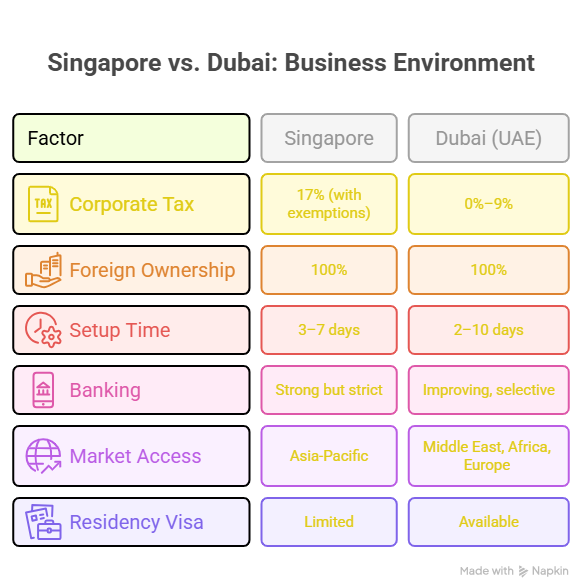
Expert insight: At a glance, Dubai offers tax and lifestyle advantages, while Singapore offers global credibility. But the right choice depends on how your business operates day-to-day.
Business Environment and Global Positioning
Singapore - Built for Global Expansion
Singapore is widely recognized as one of the most trusted financial hubs globally. Regulatory oversight is handled by the Accounting and Corporate Regulatory Authority (ACRA), which ensures transparency and compliance.
Based on our experience, Singapore works best for startups seeking venture capital, SaaS and fintech companies, and businesses expanding into Asia.
Expert experience: A fintech client we advised chose Singapore specifically because investors preferred a regulated and globally trusted jurisdiction. Within six months, they secured funding, something that may have been harder with a lesser-known setup.
Dubai — Built for Speed and Flexibility
Dubai has rapidly positioned itself as a global business hub, supported by entities like the Dubai Multi Commodities Centre (DMCC).
It’s particularly strong for trading and import/export businesses, consultants and freelancers, and entrepreneurs targeting the Middle East and Africa
Expert experience: We worked with a marketing consultant who set up in a Dubai free zone and started billing international clients within 5 days. That level of speed is difficult to replicate elsewhere.
Company Formation Process — What to Expect
Setting Up in Singapore
The process is structured and handled through ACRA:
- Company name approval
- Appointment of a resident director
- Corporate secretary (mandatory)
- Official office address
While incorporation can take just a few days, the local director requirement is often a challenge for foreign founders.
Expert insight: Many clients underestimate nominee director costs, which can range from $1,500 to 3,000 annually.
Setting Up in Dubai
Dubai offers multiple jurisdictions, including mainland, free zone, and offshore.
The process typically includes:
- Trade name approval
- License issuance
- Visa application (if required)
Authorities like the UAE Ministry of Economy oversee broader economic policies, while free zones manage licensing.
Expert insight: In many cases, you can have your business operational within 3–5 working days, especially in free zones.
Cost of Company Formation (2026 Updated)
Singapore Cost Components
- Incorporation and government fees
- Nominee director (if required)
- Corporate secretary
- Office address
Estimated total: $3,000 – 8,000+
Expert insight: Hidden costs include annual compliance, accounting, and director services, which can significantly increase long-term costs.
Dubai Cost Components
- License fees
- Visa costs
- Office or flexi-desk options
Estimated total: $4,000 – 12,000+
Expert experience: One client initially chose Singapore for lower setup costs but later shifted to Dubai due to rising compliance expenses and operational complexity.
Taxation — Where Will You Pay Less?
This is often the deciding factor in the Singapore vs Dubai Company Formation decision.
Singapore Tax System
Singapore imposes a 17% corporate tax rate, with partial exemptions for startups to support new businesses. There is no capital gains tax, making it an attractive jurisdiction for investors and entrepreneurs. The corporate tax framework is governed by the Inland Revenue Authority of Singapore (IRAS), ensuring a transparent and well-regulated system.
Dubai Tax System
Qualifying free zone businesses setup in the UAE enjoy 0% corporate tax, while a 9% corporate tax applies to profits above AED 375,000 ($102,000) outside the free zone. The UAE imposes no personal income tax and applies a 5% VAT to goods and services, making it a highly competitive, business-friendly environment.
Expert insight: From what we’ve seen in practice, a consultant earning $150,000 annually can legally retain significantly more income in Dubai, and a startup planning to raise funds may benefit more from Singapore’s structured tax system and investor trust.
Verdict: Dubai = tax efficiency, Singapore = credibility and structure
Banking, Visas, and Ease of Doing Business
Banking Reality
Singapore banks: Highly reputable but strict (2–4 weeks onboarding, detailed KYC)
Dubai banks: Increasingly accessible but typically require demonstrable business activity and compliance records for account approval.
Expert insight: Banking success depends more on your business activity than your jurisdiction.
Residency and Lifestyle
Dubai clearly stands out for entrepreneurs seeking both business and lifestyle advantages. It offers long-term investor visas ranging from 2 to 10 years, allows family sponsorship, and imposes no personal income tax, making it an attractive option for business owners and their families.
Singapore, on the other hand, provides a highly structured and credible environment with clear regulatory oversight, making it ideal for founders who prioritize investor trust, access to funding, and strong legal protection.
While Singapore requires an Employment Pass for foreign founders, which is not guaranteed, it also ensures that businesses operate within a stable and transparent framework, giving long-term confidence for growth and expansion.
Ease of Doing Business
When it comes to ease of doing business, Singapore and Dubai both perform strongly on international benchmarks, but in slightly different ways.
Singapore has long been recognized for its exceptionally business‑friendly regulatory environment, ranking among the top economies globally in the World Bank’s ease of doing business reports and often placing as high as 2nd worldwide, signaling clear strengths in starting a business, enforcing contracts, and trading across borders.
The UAE, which includes Dubai as one of its most dynamic cities, has also achieved a notable position by ranking 16th out of 190 economies in the ease of doing business index, reflecting the impact of ongoing reforms aimed at simplifying company setup, permitting, and compliance processes.
Singapore’s structured environment appeals to founders who prioritize regulatory rigor and predictability, while Dubai’s high ranking underscores its growing competitiveness and operational flexibility, making it attractive for entrepreneurs seeking faster procedures and fewer administrative hurdles.
Best Jurisdiction Based on Business Type
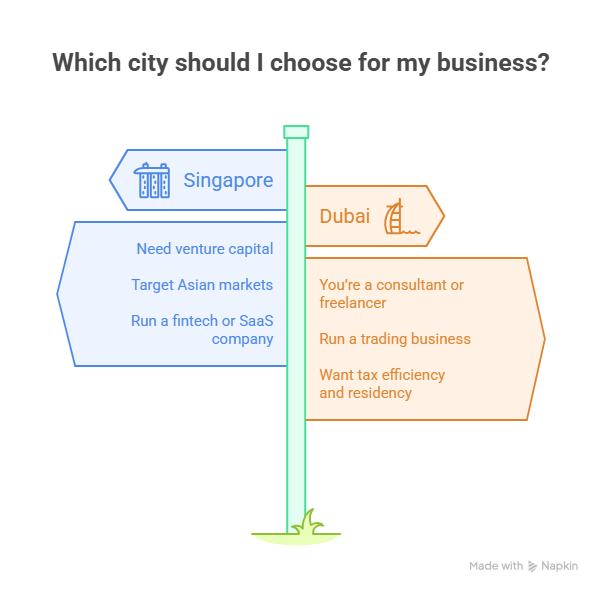
Real Case Studies: What Actually Works
Case Study 1: Fintech Startup (Singapore)
A startup targeting Southeast Asia chose Singapore to gain investor trust.
Result: Faster funding and smoother regulatory approvals.
Case Study 2: Consultant Business (Dubai)
A solo consultant serving global clients chose a Dubai free zone.
Result: 0% tax, residency visa, and profitability within months.
Case Study 3: Hybrid Structure
A high-net-worth client used a Singapore entity for credibility and a Dubai entity for operations.
Result: Balanced tax efficiency with global trust.
Singapore vs Dubai Company Formation: Which is Right for You with RadiantBiz
When it comes to Singapore vs Dubai Company Formation, making the right choice can be complex, but with the right guidance, it becomes much simpler.
At RadiantBiz, our business setup consultants help entrepreneurs and investors navigate both jurisdictions by providing tailored advice on company structure, licensing, tax planning, and banking.
Whether you’re seeking Singapore’s credibility and investor-friendly environment or Dubai’s tax efficiency and operational speed, our team combines local expertise with international experience to ensure your business is set up for long-term growth.
By working with us, you can avoid common pitfalls, save time, and make confident decisions that align with your strategic goals.
FAQs
1. Is Dubai completely tax-free in 2026?
No. While many free zone businesses benefit from 0% tax, a 9% corporate tax applies to profits above AED 375,000 ($102,000).
2. Can foreigners fully own companies in Singapore and Dubai?
Yes, both jurisdictions allow 100% foreign ownership. However, Singapore requires a resident director.
3. Which is better for long-term business growth?
Singapore is ideal for scaling and fundraising, while Dubai is better for profitability and operational flexibility.
Making the Right Choice in 2026
When comparing Singapore vs Dubai Company Formation, the right choice ultimately depends on your business goals and long-term strategy. Singapore is ideal for founders who prioritize credibility, access to funding, and structured growth within a transparent and reliable regulatory framework.
Dubai, on the other hand, is better suited for entrepreneurs seeking tax efficiency, faster setup, and lifestyle advantages, including residency benefits. One of the biggest mistakes we see is choosing a jurisdiction solely based on cost or tax incentives, without considering how it aligns with your long-term business objectives.
Selecting the right location is not just about starting a company, it’s about laying a foundation for sustainable growth. If you’re unsure which option best fits your business model, consulting an expert can help you avoid costly mistakes and ensure your company is structured for success from day one.
Seek our professional on-the-ground guidance, contact us via mail at info@radiantbiz.com, WhatsApp, or call us at +971521322895!

.webp)
%20.webp)

With over 15 years of experience in the banking and business consulting sector, Rizwan Ansari leads RadiantBiz with a vision to simplify business setup in the UAE.


.avif)


.svg)


.svg)
.svg)
.svg)

