.png)

.png)

2.png)
Singapore Pte Ltd vs. Branch Office vs. Rep Office: Which Structure Fits Your Strategy?


Table of Contents
About the Author
Our business setup consultant writes this article with over a decade of experience helping entrepreneurs establish companies in Singapore and the UAE. Having worked with startups, SMEs, and international investors, they have guided businesses through jurisdiction selection, tax structuring, and banking strategies across both regions.
Key Takeaway:
- Pte Ltd is the recommended structure for most businesses, offering limited liability protection and eligibility for tax exemptions (SUTE) that Branch Offices typically miss.
- Branch Offices carry unlimited liability for the parent company, making them suitable primarily for large MNCs seeking consolidated financial reporting rather than asset protection.
- Representative Offices are strictly for market research, prohibited from generating revenue, and limited to a maximum duration of three years before conversion is required.
The Critical Choice: Pte Ltd vs. Branch vs. Rep Office
The three main paths are the Private Limited Company (Pte Ltd), the Branch Office, and the Representative Office. They aren't just different names, they are fundamentally different legal animals with vastly different risks, tax bills, and capabilities.
In this guide, we'll walk you through the real-world implications of each. No fluff, no jargon just the hard truths we've learned from helping hundreds of companies through the process of setting up a company in Singapore.
The Big Picture: A Quick Reality Check
Before we dive into the weeds, let's clear the air. Many founders think a "Branch" and a "Subsidiary" (Pte Ltd) are the same thing because they both operate in Singapore. They are not.
Think of it this way:
- A Pte Ltd is like having a child. It's a separate person. It can own a house, get a job, and if it gets sued, the parents (shareholders) are generally safe.
- A Branch Office is like an arm. If the arm gets cut off or hurts someone, the body (parent company) feels the pain immediately.
- A Representative Office is like a scout. It can look around, talk to people, and report back, but it cannot buy, sell, or sign anything.
Here is the snapshot you need to keep in mind. Data sourced from Accounting and Corporate Regulatory Authority (ACRA) and Inland Revenue Authority of Singapore (IRAS) guidelines:

The Private Limited Company (Pte Ltd): The Gold Standard
If you are serious about building a business in Singapore, the Pte Ltd is almost always the right answer. In our years of practice, we'd estimate that 85% of the foreign clients we advise end up incorporating a Pte Ltd.
Why? Because it creates a firewall.
When you incorporate a Pte Ltd, you are creating a new legal person under the Companies Act 1967. If this company fails, goes bankrupt, or gets sued, the creditors can only go after the company's assets. They cannot touch your parent company's bank accounts or your personal assets. This "limited liability" is the single biggest reason why smart investors choose this route.
But the benefits go beyond safety. The Pte Ltd is the only structure that qualifies for Singapore's generous tax incentives. For the first three years, a new startup can enjoy significant tax exemptions on its first SGD 200,000 ($155,200) of chargeable income. A Branch Office? It doesn't get these breaks. It pays the full 17% rate from day one.
The one catch to keep in mind, a Pte Ltd must have at least one director who is "ordinarily resident" in Singapore (a citizen, Permanent Resident, or someone with an EntrePass/Employment Pass).
We hear the groan from overseas founders already: "But I don't live in Singapore!"
Don't worry. This is standard procedure. Most foreign companies hire a professional nominee director service. These are experienced locals who sit on the board to satisfy the law but have no say in your daily operations. It's a small cost for massive peace of mind.
Expert advice: If you plan to hire staff, sign contracts, sell products, or apply for government grants, skip the other options. Go straight for the Pte Ltd. It remains the most robust of the types of companies Singapore has to offer for long-term growth.
The Branch Office: The Direct Extension
So, when would you ever choose a branch office? It sounds risky with that unlimited liability, right?
It is risky, but for some massive Multi-National Corporations (MNCs), it makes sense.
A branch office is not a separate company. It is legally the same entity as your parent company. If your parent company is based in London, the Singapore branch is just "London, but in Singapore."
Who is this for? This structure works best for large, established firms with rock-solid balance sheets. If your parent company has billions in assets and a pristine credit rating, the risk of a local lawsuit wiping you out is negligible.
In fact, some MNCs prefer branches because they can consolidate their financial statements directly without the messy "transfer pricing" adjustments required between two separate companies (like a parent and a subsidiary).
However, there are downsides.
- No Tax Breaks: As mentioned, branch offices generally miss out on the Start-Up Tax Exemption.
- Reputation: Some local banks and vendors view a Branch as less "committed" than a Pte Ltd. They might ask for larger deposits or stricter terms.
- Complexity: If your parent company goes bankrupt, the Singapore branch dies instantly. There is no separation.
Expert experience: We worked with a German engineering firm that opened a branch to manage a specific, short-term infrastructure project. They knew the project was low-risk and would last only two years. They didn't want the hassle of setting up a whole new subsidiary. A branch was perfect for them. But if they had planned to stay for ten years and hire 50 locals? That would have been a disaster waiting to happen.
The Representative Office: The Market Scout
Let's be very clear about the Representative Office (RO). It is not a company. It is a temporary liaison.
You can set up an RO if you want to test the waters. You can meet clients, attend trade shows, and gather market intelligence. But, and this is a huge but, you cannot sign a contract, you cannot issue an invoice, and you cannot make a single dollar of profit in Singapore.
If you try to sell a product from an RO, ACRA will shut you down, and you could face heavy fines.
Why use it? The RO is a "try before you buy" option. It's cheap to set up and requires minimal paperwork. It's perfect for a company that wants to spend six months figuring out if the Singapore market is actually viable before committing to the cost of incorporation.
However, an RO is temporary. It can exist for a maximum of three years. After that, you must either close it or convert it into a Pte Ltd or a branch. You cannot renew an RO indefinitely.
Expert insight: We've seen too many companies get lazy with their RO. They start "facilitating" deals where the contract is signed by the parent company overseas, but the work happens in Singapore. Technically, this is fine, but if the line blurs and your local staff start negotiating prices or closing sales, you are crossing into illegal territory. If you are ready to trade, stop scouting and start incorporating.
Tax Implications: Where the Money Goes
Let's talk numbers, because this is where the choice matters most.
Singapore has a flat corporate tax rate of 17%. Sounds simple, right? Not quite.
If you incorporate a Pte Ltd, you are a "resident" company for tax purposes (if managed from Singapore). This unlocks the Start-Up Tax Exemption (SUTE), which for the first three years allows you to pay 0% tax on the first SGD 100,000 ($77,518) of profit, and only a 4.25% tax if profit exceeds SGD 100,000 ($77,518).
For a branch office, it is often treated as a "non-resident" entity for tax purposes unless the parent company is tax-resident in a country with a Double Taxation Agreement (DTA) that specifically covers branches. Even then, they rarely get the SUTE. They pay the full 17% on all profits.
Whereas for the RO, since it cannot make money, it pays no corporate tax. However, the parent company still has to fund the office's operating costs (rent, salaries), which come out of the parent's pocket.
Expert insight: If you expect to make a profit in your first three years, the Pte Ltd is mathematically superior. The tax savings alone can cover the cost of your nominee director and secretarial fees for years. For detailed tax guides, refer to the IRAS e-Tax Guide.
Compliance and the "Headache" Factor
Every business structure comes with paperwork. But the volume and complexity vary wildly.
Pte Ltd
You need a Company Secretary (mandatory within 6 months), you must hold an Annual General Meeting (AGM), and you must file annual returns with ACRA. You also need to prepare audited financial statements unless you qualify as a "small company."
Verdict: Moderate effort. Manageable with a good corporate service provider.
Branch Office
You don't need a local director, but you do need a local authorized representative. You must file the parent company's financial statements with ACRA every year. If your parent company changes its name or structure, you have to update the branch immediately.
Verdict: High effort. You are tethered to your parent company's compliance schedule.
Representative Office
You file an annual report with Enterprise Singapore (the agency that manages ROs). You don't need audited accounts.
Verdict: Low effort, but only for 3 years.
Expert insight: There’s a hidden trap, many founders think the branch structure is easier because they don't need a local director. But the requirement to file the parent company's financials (which might be in a different currency and language) often creates more work than simply setting up a local Pte Ltd.
Making the Final Call: A Decision Framework
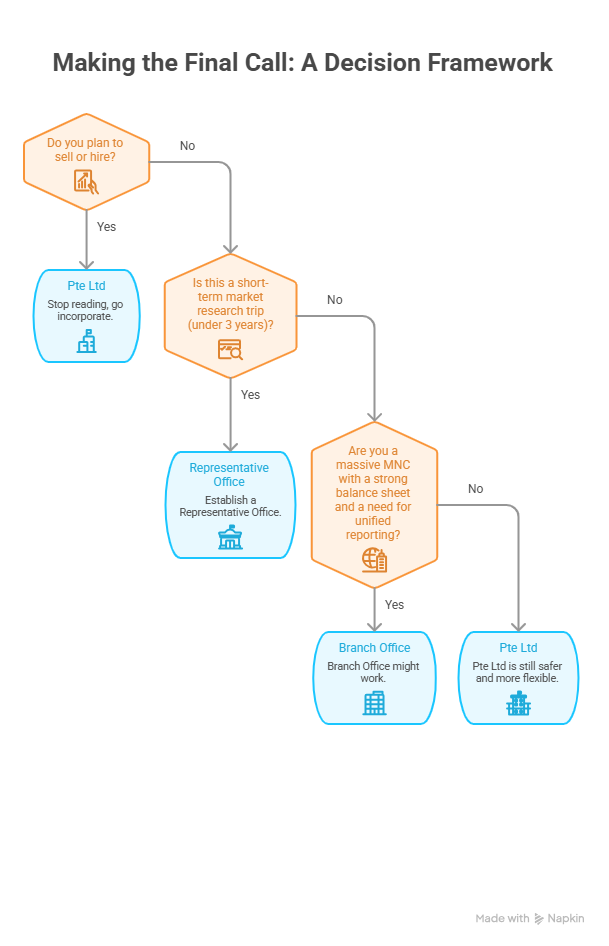
The "Safe Bet" Rule: If you are unsure, choose the Pte Ltd. It is the most versatile. You can start small, grow big, hire locals, get grants, and protect your assets. The only time a Pte Ltd is a bad choice is if you have zero intention of ever operating in Singapore and just want a mailbox, which is a different story entirely.
Understanding the types of companies in Singapore helps you choose the vehicle that best matches your destination.
Singapore Pte Ltd vs. Branch Office vs. Rep Office with RadiantBiz
At RadiantBiz, one of the leading business setup consultants in Dubai and Singapore, we don't believe in a "one-size-fits-all" approach to Singapore market entry. Our process begins with a deep-dive strategy session where we analyze your specific growth timeline, risk tolerance, and operational goals to determine whether a Pte Ltd, branch office, or representative office is the true fit for your business.
We then handle the entire lifecycle, from drafting the constitution and securing your resident director to navigating ACRA filings and IRAS tax filing, ensuring you launch with a structure that maximizes your tax efficiency and minimizes your liability.
Whether you're a startup testing the waters or an MNC establishing a regional hub, we turn the complexity of Singapore's types of companies into a clear, actionable roadmap for your success.
FAQs
1. Can I convert a Representative Office into a Pte Ltd later?
Yes. In fact, this is a very common strategy. Many companies start with an RO to test the market for 12–18 months. Once they confirm there is demand, they dissolve the RO and incorporate a Pte Ltd to begin actual trading.
2. Do I need a physical office address for a Pte Ltd in Singapore?
Yes, you must have a local address. However, this doesn't mean you need to rent a full office suite immediately. Many foreign companies use a "virtual office" or a serviced office space that provides a legitimate address and mail handling services. Just ensure the address is a physical location, not just a PO Box, as ACRA requires it.
3. How long does it take to set up a Pte Ltd compared to a Branch?
With the digital ACRA system, a Pte Ltd can be incorporated in as little as 1–2 days if all documents are in order. A branch office requires more scrutiny from the ACRA and can take 2–4 weeks, especially if the parent company documents need notarization or apostille certification.
Don't Let Structure Hold You Back
Choosing the right entity is the foundation of your Singapore success. Get it wrong, and you face unnecessary taxes, legal exposure, and compliance headaches. Get it right, and you unlock a stable, tax-efficient platform to dominate the Asian market.
Remember, the types of companies in Singapore are designed to fit different stages of growth. The Pte Ltd is the workhorse for serious businesses. The branch is a tool for specific MNC strategies. The Rep Office is a temporary scout.
Don't guess. Don't rely on forum advice from five years ago. The rules change, and the stakes are high. If you are ready to move forward, take a hard look at your 3-year plan. If you see revenue and hiring in that picture, the Pte Ltd is your path.
Don't let the paperwork slow you down. Whether you need help finding a local director, understanding the tax exemptions, or navigating the ACRA portal, you don't have to do it alone. Seek our professional on-the-ground guidance, contact us via mail at info@radiantbiz.com, WhatsApp, or call us at +971521322895!

.webp)
%20.webp)

With over 15 years of experience in the banking and business consulting sector, Rizwan Ansari leads RadiantBiz with a vision to simplify business setup in the UAE.


.avif)


.svg)


.svg)
.svg)
.svg)

