.png)

.png)

2.avif)
Understanding Different Company Licenses in Dubai: Mainland, Free Zone, Offshore


Table of Contents
About the Author
This article is written by a UAE business setup and compliance advisor with over a decade of experience advising mainland, free zone, and offshore companies on business licensing, regulatory compliance, and operational alignment. The author has worked closely with UAE licensing authorities and financial institutions, supporting startups, SMEs, and international investors.
Key Takeaway:
- Your license defines your legal boundaries. What you can do, where you can operate, who you can invoice, and even your banking outcome depend entirely on whether your license is mainland, free zone, or offshore, and the exact activities listed on it.
- Jurisdiction matters as much as the activity. The same business activity can carry very different permissions and restrictions across mainland, free zone, and offshore structures, making license selection a strategic compliance decision, not a formality.
- Most problems come from mismatched licensing, not setup. Common issues arise when businesses choose the wrong license type, the wrong free zone, or assume offshore structures allow operations, mistakes that usually surface later during banking, audits, or tax reviews.
Why Business Licenses Matter More Than People Think
Having spent over a decade advising businesses on setting up in Dubai, one thing is clear: most founders don’t fully understand what their license actually allows them to do.
People often assume that once they “have a company,” everything else falls into place. In reality, your business license defines your legal boundaries, what activities you can perform, where you can operate, who you can invoice, and even whether your bank account application gets approved.
Dubai offers multiple business jurisdictions, and each jurisdiction issues its own set of company licenses, governed by different authorities and rules. These are not interchangeable.
This guide explains the types of company licenses in Dubai across mainland, free zone, and offshore jurisdictions, based on real licensing practices, not theory. If you’re planning to set up a business in dubai, or you already have one and feel restricted, this article will help you understand why.
Business Licenses in Dubai: A Simple Overview
In Dubai, a company license is an official permission issued by a licensing authority that allows a business to carry out specific activities.
Each jurisdiction has its own license-issuing authority. Mainland licenses are issued by the Department of Economy and Tourism (DET), free zone licenses are issued by individual free zone authorities, and offshore licenses are issued by offshore registrars for non-operational purposes.
The UAE provides over 2000 business activities, and what many people don’t realise is that the same activity can be licensed differently depending on the jurisdiction, and the legal rights tied to that license can vary significantly.
Mainland Company Licenses: Activity-Based and Market-Focused
Mainland business licenses are designed for companies that want to operate directly within the UAE market. These licenses are issued by DET and are tightly linked to approved business activities.
Common Types of Mainland Licenses
The most commonly issued mainland licenses fall into these categories:
Commercial license
For trading activities such as general trading, import/export, retail, and wholesale.
Professional license
For service-based activities like consultancy, marketing services, IT services, education support, and technical services.
Industrial license
For manufacturing, processing, packaging, or industrial operations.
Each license lists specific activities, and operating outside those activities can result in penalties.
Expert Insight
A common mistake we’ve seen is businesses applying for a “consultancy” license while actually performing commercial activities, such as reselling software or equipment.
This mismatch often leads to bank account freezes, licensing penalties, and issues during audits. Mainland licenses are powerful, but they are strictly regulated.
What Mainland Licenses Allow
- Direct trade anywhere in the UAE
- Issuing invoices to individuals, companies, and government bodies
- Leasing office space and hiring staff
- Expanding activities with DET approval
Free Zone Company Licenses: Specialised and Activity-Specific
Free zone licenses are issued by individual free zone authorities, and each free zone controls what activities it allows. Unlike mainland licenses, free zone licenses are often more niche-focused.
Common Free Zone License Types
Across various free zones, the most common license categories include:
Service license
For consulting, advisory, digital services, design, and professional support services.
Trading license
For import/export or distribution activities, they are usually restricted to international trade or intra-free-zone operations.
Industrial license
Offered only in certain free zones with warehousing or manufacturing facilities.
Media / Technology / E-commerce Licenses
These are activity-labelled licenses, not broad commercial ones.
Important Reality Most Founders Learn Later
A free zone license is valid only within the scope defined by the free zone authority. The same business activity may be allowed in one free zone and restricted or prohibited in another.
We’ve personally dealt with cases where clients had to cancel and reapply for a license simply because the chosen free zone did not permit their exact activity wording.
What Free Zone Licenses Typically Allow
- 100% foreign ownership
- Activity-specific operations
- Office or flexi-desk usage within the free zone
- Visas based on a license package
Where Free Zone Licenses are Limited
- Direct mainland trade is restricted
- Activity expansion depends on free zone approval
- Banking depends heavily on license clarity and substance
Offshore Company Licenses: Non-Operational by Design
Offshore licenses are fundamentally different from mainland and free zone licenses.
An offshore company license is not meant for conducting business operations in the UAE. It exists primarily for ownership, holding, and international structuring purposes.
Typical Offshore License Uses
In real practice, offshore licenses are used for:
- Holding shares in other companies
- Property ownership
- International asset holding
- IP ownership
These licenses are intentionally limited.
What Offshore Licenses Do NOT Permit
- No business operations in the UAE
- No office leasing
- No employee visas
- No direct invoicing for services or goods
We’ve seen offshore companies run into serious issues when they attempt to operate like active businesses. Banks treat offshore licenses with a much higher level of scrutiny.
Comparing the Types of Company Licenses in Dubai by Jurisdiction
Understanding the types of company licenses in Dubai requires looking at what each jurisdiction is designed to support:
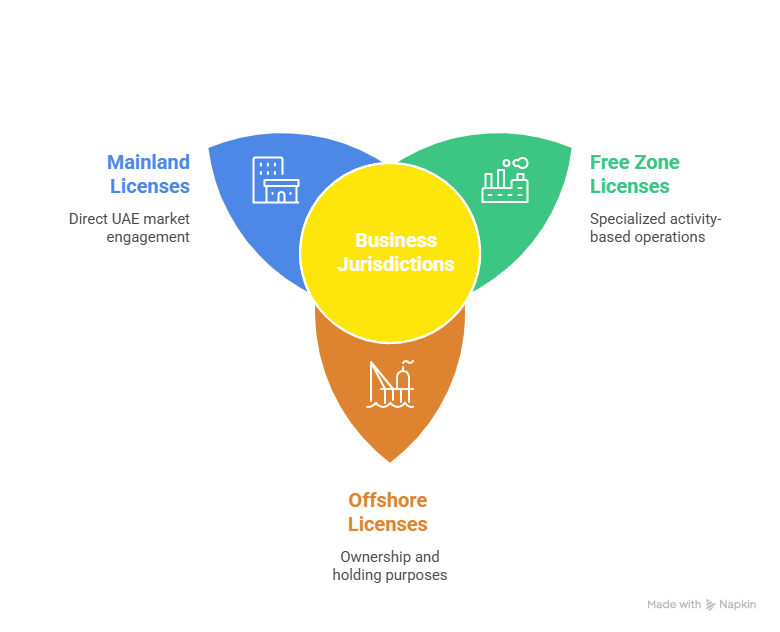
No license is universally “better.” Each serves a specific legal and commercial purpose.
Common Licensing Mistakes that Still Happen Today
Here are the licensing issues we encounter repeatedly:
- Choosing a trading license when the activity is actually service-based
- Selecting a free zone that doesn’t approve the required activity
- Assuming offshore licenses can be used for operations
- Adding unrelated activities “just in case”, which triggers bank rejection
Licensing mistakes are rarely obvious at setup, but they surface later during banking, audits, or tax reviews.
Licensing, Compliance, and Corporate Tax
Since corporate tax was introduced in the UAE, licenses have come under closer scrutiny.
Your license determines whether you qualify for exemptions, whether audits are required, and how income is classified. We now advise clients to treat licensing as a compliance decision, not just an administrative step.
Licensing rules and tax treatments may change, thus, professional advice should always be taken for business-specific situations.
Understanding Different Company Licenses in Dubai with RadiantBiz
At RadiantBiz, we often see complications arise not during the license application itself, but much earlier, at the stage where businesses choose the wrong jurisdiction or license type for how they actually plan to operate.
When advising clients on which license is most suitable, our process begins with a focused assessment. Our business setup consultants take the time to understand the business model, long-term objectives, visa requirements, operational footprint, and target market before recommending any license or even a jurisdiction. This ensures the license selected reflects the reality of the business, not just its initial setup phase.
If a free zone licence is the right fit, we don’t rely on a standard recommendation. Dubai has multiple free zones, each with its own approved activities, visa frameworks, and operational limitations. We assess which free zone genuinely aligns with the client’s specific activity and growth plans, rather than applying a generic solution.
Once the jurisdiction is defined, the client is supported by a dedicated specialist business setup consultant who reviews the approved business activities within that jurisdiction and aligns them precisely with the client’s operations.
That specialist then works closely with the client to confirm the correct business activity, license category, and jurisdiction-appropriate structure, coordinating directly with the relevant authorities.
The objective is to establish a setup that remains compliant and adaptable over time, so the business does not need to revisit or restructure its license due to early-stage decision mismatches.
FAQs
1. Can the same business activity be licensed in the mainland and the free zone?
Yes, but the permissions, restrictions, and operational rights will differ depending on the jurisdiction.
2. Can I add multiple activities to one license?
Yes, but all activities must be approved by the licensing authority and aligned with the license category.
3. Can I change my license type later?
Yes, but it often involves amendments, approvals, and additional costs, planning correctly from the start is easier.
Choose a License that Matches What You Actually Do
Dubai offers one of the most structured business environments in the region, but only if your license reflects the reality.
The types of company licenses in Dubai differ not just by name, but by legal authority, jurisdiction, and permitted activity. Choosing the wrong one can limit growth, delay banking, and create compliance risks.
After a decade of hands-on experience, our advice is simple: Choose the license that supports your business activity today and still works when you grow tomorrow.
Seek our professional on-the-ground guidance, contact us via mail at info@radiantbiz.com, WhatsApp, or call us at +971521322895!


.webp)

Anjali Jawahar ensures the seamless execution of business setup processes, making compliance and licensing effortless for clients. Her keen attention to operational efficiency helps the RadiantBiz businesses establish themselves smoothly in the UAE.

.avif)


.svg)


.svg)
.svg)
.svg)