.png)

.png)

2.png)
UAE Industry-Wise Business Growth Insights: Best Sectors to Start a Business

.webp)
Table of Contents
About the Author
The author is a UAE business setup and compliance consultant with over a decade of experience advising startups, SMEs, and international trading companies. Having worked closely with free zone authorities, banks regulated by the UAE Central Bank, and corporate compliance teams, the author specializes in trade licensing, corporate structuring, and long-term market entry strategy.
Key Takeaway:
- Four high-growth sectors dominate UAE opportunities: fintech (one of the fastest-growing fintech markets globally), AI and advanced tech (backed by national strategy and major infrastructure investment), logistics (fueled by the e-commerce boom and the UAE's position as a global trade hub), and digital consumer platforms (driven by near-universal internet penetration and high digital adoption).
- Foreign ownership barriers have dropped significantly. The 2021 Commercial Companies Law amendments now allow 100% foreign ownership on the mainland for most activities, plus 0% corporate tax under QFZP status for qualifying free zone income and Golden Visa eligibility with AED 2 million ($544,588) business investment.
- Major government infrastructure commitments across AI, renewable energy, and transport create sustained demand for companies entering priority sectors.
UAE Business Growth: The Numbers Behind the Opportunity
The UAE is rewriting its economic playbook. Non-oil sectors now account for 79.4% of GDP as of Q1 2026, up from 78% in 2025 (Emirates 24|7). The non-hydrocarbon economy expanded 6.8% in 2025 to reach AED 1.5 trillion ($408 billion), helping push total GDP to AED 1.9 trillion ($517.2 billion) (The National).
If you are thinking about setting up or expanding here, the opportunity is real, you just need to know where to look.
We have spent the last decade watching businesses enter this market. Some succeed spectacularly, others struggle to find their footing. The difference usually comes down to picking the right sector at the right time and structuring the entry correctly.
Here are the sectors with the strongest structural momentum.
Note: The AED is pegged to the USD, all prices are estimates based on this peg and current market rates. Actual amounts may differ due to bank transfer fees.
Fintech and Digital Financial Services
The UAE fintech market is estimated at $52.07 billion in 2026, growing from $46.67 billion in 2025, and is projected to reach $90.06 billion by 2031 at an 11.58% CAGR (Mordor Intelligence). Digital payments account for 56.88% of market share, and the country is pursuing a target of 90% cashless transactions (Mordor Intelligence).
What is driving this? Open finance frameworks, mobile banking adoption, and growing demand for SME credit tools. The Central Bank's Financial Infrastructure Transformation (FIT) program and the Digital Dirham project are reshaping how money moves in the UAE. Smartphone penetration above 96% has accelerated mobile-first payment adoption (Mordor Intelligence).
UAE startup funding reached $678 million in Q1 2025 alone, reflecting strong investor confidence in the sector (Digital Dubai AI).
We have helped founders complete free zone company formation for payment gateways, RegTech solutions, and AI-powered advisory platforms.
Expert insight: If you are in payments, lending, or compliance tech, the structural opportunity is strong. Incumbent banks are forming technology partnerships, and funding continues to flow to early-stage players. Dubai leads with a 59.68% market share, leveraging DIFC infrastructure and VARA crypto regulations (Mordor Intelligence).
The regulatory infrastructure is maturing, which means the market rewards compliant, well-structured entrants.
Which free zone is best for a fintech startup in Dubai?
DIFC is generally the strongest fit for regulated fintech activity, since it runs its own common-law framework and financial regulator, the DFSA. Lighter-touch fintech and RegTech ventures that do not need a full regulatory license often move faster and cheaper through DMCC or Dubai Internet City.
AI and Advanced Tech Services
The UAE is not just talking about AI, it is building for it. Stargate UAE, announced in May 2025, is a planned 5-gigawatt AI data center campus in Abu Dhabi, developed through a partnership among G42, OpenAI, Oracle, NVIDIA, Cisco, and SoftBank. The first 200-megawatt phase is targeted to come online in 2026 (ValueAddVC) (Reuters via AOL).
Abu Dhabi's MGX, the country's dedicated AI investment vehicle established in 2024 by Mubadala and G42, aims to manage up to $100 billion in assets, making it one of the world's largest capital platforms dedicated to AI infrastructure investment (Innovation Library).
MGX is a founding partner of the Stargate Project, a $500 billion public-private initiative across the US and UAE, and has taken positions in major AI ventures including Databricks ($10 billion funding round) and xAI ($6 billion Series A) (Innovation Library).
Under a US–UAE AI Acceleration Partnership announced in May 2025, the UAE can import up to 500,000 of NVIDIA's most advanced AI chips per year (ValueAddVC). Microsoft has committed $15.2 billion to the UAE since 2023, including $5.5 billion for AI and cloud infrastructure (Data Center World Middle East).
The infrastructure is being built faster than the applications that will run on it. That gap is the opportunity.
The UAE ICT market was projected at $52.22 billion in 2025, growing to $94.02 billion by 2031 at a 10.29% CAGR (Mordor Intelligence). The National AI Strategy 2031 targets AED 335 billion ($91.2 billion) in annual AI economic impact (Mordor Intelligence).
The government appointed a Minister of State for AI in 2017 and has been executing the National Strategy for Artificial Intelligence 2031 since then, this is long-term national policy, not a trend.
We have watched founders build AI consultancies, enterprise automation tools, and predictive analytics platforms here with remarkable speed. For companies building AI-native products, the combination of infrastructure investment, government policy alignment, and a growing talent pool creates a structural advantage that few other markets can match.
Logistics and Smart Supply Chain
The UAE freight and logistics market was valued at $21.63 billion in 2025 and is estimated to reach $31.63 billion by 2031, growing at a CAGR of 6.55% (Mordor Intelligence). Courier, express, and parcel services are forecast as the fastest-growing segment at a 7.52% CAGR through 2031 (Mordor Intelligence).
Why? The UAE e-commerce market is valued at $12.42 billion as of 2026 (GrabOnUAE), and last-mile delivery has emerged as one of the highest-growth sub-sectors. Companies like Lalamove have scaled from single-emirate operations to nationwide networks, reflecting the depth of demand.
AI-driven warehousing, blockchain supply chain platforms, and smart last-mile delivery are all in high demand as businesses prioritize efficiency and cost control. UAE non-oil foreign trade reached AED 3.8 trillion ($1.03 trillion) in 2025, a 27% year-on-year increase and nearly double the value recorded in 2021, surpassing the "We the UAE 2031" target five years ahead of schedule (WAM via TradeArabia).
In H1 2026, non-oil trade hit AED 1.937 trillion ($527 billion), up 13.1% year-on-year, with non-oil exports surging 23.9% to AED 452.8 billion ($123 billion) (Gulf News). Jebel Ali port connects more than 150 ports through over 80 weekly services, and DXB processed 2.2 million tonnes of cargo in 2024, up 20.5% year-on-year (Ken Research). The logistics opportunity is genuinely large and structurally supported by the country's position as a global trade hub.
E-Commerce and Digital Consumer Platforms
Internet penetration in the UAE stands at 99%, with 11.04 million online shoppers, equivalent to 96% of the population (DataReportal via GrabOnUAE). The UAE hosts over 45,000 active e-commerce websites (GrabOnUAE).
Social commerce is growing rapidly, valued at $13.87 billion in 2025 and projected to reach $23.19 billion by 2031 at an 8.5% CAGR (Research and Markets). The UAE has approximately 11 million active social media users, reaching close to 99% of the population (DataReportal). Product discovery increasingly starts on social feeds, with content and commerce converging especially in fashion and beauty categories.
The UAE e-commerce market reached AED 32.3 billion ($8.8 billion) in 2024 and is projected to surpass AED 50.6 billion ($13.8 billion) by 2029, according to EZDubai/Euromonitor data (CortexDM). E-commerce contributed 12% of Dubai's non-oil GDP in 2024 (Mordor Intelligence).
The UAE consumer is sophisticated, digitally native, and willing to adopt new platforms quickly, which means founders can build and scale faster here than in many other markets. The catch is getting local relevance right. What works in the US or Europe may not translate directly.
Do I need a local UAE partner to own 100% of my e-commerce business?
No, under the UAE Commercial Companies Law amendments, most mainland activities now allow 100% foreign ownership without a local Emirati partner, and free zone companies have always permitted full foreign ownership. A local agent may still be required for certain regulated or professional activities.
Corporate Tax and the QFZP Regime
UAE Corporate Tax applies a standard 9% rate above AED 375,000 ($102,110) in taxable income, with 0% below it. Free zone companies that qualify as a Qualifying Free Zone Person, or QFZP, can keep paying 0% on qualifying income, provided they meet substance requirements and keep qualifying and non-qualifying income properly separated.
For founders weighing mainland versus free zone, this is often the deciding factor. Getting QFZP status wrong, or missing a filing deadline, can mean losing the 0% rate for that tax period. We recommend confirming QFZP eligibility before choosing a license type, not after.
Golden Visa Eligibility through Business Setup
Company formation is now one of the more direct routes to a 10-year UAE Golden Visa. The minimum investment required remains AED 2,000,000 ($545,000) in approved real estate or a UAE-licensed investment fund (ICP Federal Authority).
A major 2026 reform removed the old requirement to have paid 50% upfront, meaning mortgaged and off-plan properties now qualify once the certified valuation reaches AED 2,000,000 ($545,000).
Dubai issued 100,286 real-estate-investor family Golden Visas from 2021 to early 2026, and the UAE attracted a record net inflow of 9,800 millionaires in 2025, the highest of any country globally (Gulf News).
Golden Visa holders do not need a local sponsor, can stay outside the UAE for extended periods without losing residency, and can sponsor family and domestic staff. If you are planning a long-term base here rather than a short-term venture, it is worth factoring Golden Visa eligibility into your company structure from day one.
Lessons for UAE Business Setups
Over the years in this market, we have learned that UAE growth is not sector-specific, it is economy-wide, driven by connectivity, diversification, and technology adoption.
The authorities have committed to ambitious long-term agendas: "We the UAE 2031," Dubai's D33 agenda, Abu Dhabi's Economic Vision 2030, backed by major infrastructure projects spanning AI, renewable energy, and national transport networks.
Government capital spending remains well above historical averages, creating sustained demand across priority sectors. The UAE's GDP grew 6.2% in 2025, the fastest pace since 2022 (WAM via Enterprise).
The practical playbook:
Scale smart
Free zones offer 100% foreign ownership, streamlined licensing, and cost efficiency that preserves capital for product development. We have seen founders extend their runway significantly by choosing the right structure.
Think infrastructure
The UAE is building AI, logistics, and fintech infrastructure at a pace that creates windows of opportunity. With $15.2 billion committed by Microsoft alone, a 5GW Stargate campus under construction, and $100 billion in MGX's AI fund pipeline, companies that establish themselves now grow alongside the buildout.
Align with government priorities
Businesses that align with national economic strategies, like the National AI Strategy 2031 targeting AED 335 billion ($91.2 billion) in annual economic impact, get access to support, procurement, and scale that others do not.
How RadiantBiz Supports UAE Company Formation and Corporate Banking
Over the past decade, we have worked with founders across every major sector in the UAE: securing VARA licensing for virtual asset exchanges, handling trade license renewal for growing SMEs, and managing corporate tax enrollment through the new tax regime.
The free zone structure remains the most efficient entry point for many foreign investors, offering 100% foreign ownership, 0% corporate tax on most activities, and 100% profit repatriation, though mainland company licensing suits businesses that need direct access to the local UAE market. Over 30 free zones specialise by sector:
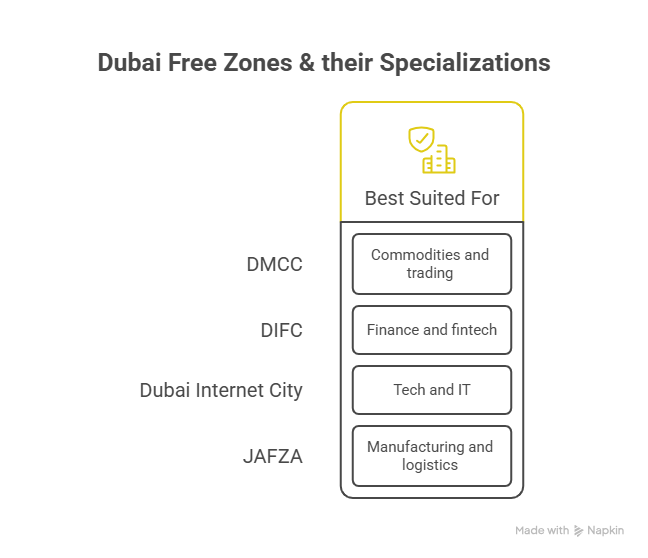
Each issues its own commercial license tailored to the activity. Our clients who succeed share one trait: they partner with people who understand the regulatory nuances of each free zone and the mainland, whether that means navigating corporate tax brackets, meeting employment diversification quotas, staying current on UBO compliance, or securing approvals from authorities like VARA.
We have guided enterprises from initial trade name reservation to corporate bank account opening and visa processing, getting them operational within weeks rather than months.
How long does it take to set up a company in Dubai?
Most free zone companies can be licensed within 3 to 7 working days once documents are in order. Corporate bank account opening typically adds another 2 to 4 weeks, and mainland setups involving external approvals can take longer.
FAQs
1. What is the fastest-growing industry in the UAE right now?
Construction led sectoral growth in 2025 at 11.1%, followed by finance and insurance at 10.4%, real estate at 7.9%, and transport and storage at 7.8% (The National). Financial and insurance activities were the fastest-growing sector in Q1 2026 at 17.3% (The National).
For long-term potential, fintech (11.58% CAGR to $90.06 billion by 2031) and AI/ICT (10.29% CAGR to $94.02 billion by 2031) show the strongest structural trajectories.
2. What is the minimum investment needed to start a business in the UAE?
Free zone business setup costs start as low as AED 12,000 to 50,000 ($3,267 to $13,614), depending on jurisdiction and license type. Mainland setups and regulated activities generally cost more due to additional approvals.
3. Is the UAE a good place for a tech startup?
Yes, free zones offer 100% foreign ownership, internet penetration stands at 99%, the ICT market is projected at $52.22 billion in 2025, growing to $94.02 billion by 2031 (Mordor Intelligence), and the country can now import up to 500,000 advanced NVIDIA AI chips annually under the US–UAE AI Acceleration Partnership (ValueAddVC).
Should You Set Up a Business in the UAE?
The UAE is a working case study in economic transformation. Whether you are a founder, investor, or corporate strategist, the structural case for being here is strong, 100% foreign ownership, tax efficiency, world-class infrastructure, and a government that actively backs the sectors it wants to grow.
Total GDP reached AED 1.9 trillion ($517.2 billion) in 2025, non-oil trade exceeded $1 trillion, and the country attracted record foreign direct investment of $48.24 billion (The National).
At RadiantBiz, we have helped hundreds of businesses make that move. Our end-to-end support, from initial consultation and license procurement to banking, investor visas, and regulatory compliance, lets you focus on growth while we handle the rest.
Seek our professional on-the-ground guidance, contact us via mail at info@radiantbiz.com, WhatsApp, or call us at +971521322895!

.webp)
%20.webp)
With over 15 years of experience in the banking and business consulting sector, Rizwan Ansari leads RadiantBiz with a vision to simplify business setup in the UAE.


.avif)


.svg)


.svg)
.svg)
.svg)

