.png)

.png)

2.avif)
How to Get an Educational License in Dubai: Tutoring Centers, Training Institutes, and Online Academies

.webp)
Table of Contents
About the Author
The author is a business setup consultant specializing in educational licensing, KHDA compliance, and institutional formation in the UAE. With over a decade of experience advising local and international clients, the author has helped more than 15,000 entrepreneurs and organisations navigate trade licensing, regulatory approvals, and operational planning for training institutes, tutoring centres, schools, and e-learning platforms across Dubai's mainland and free zone jurisdictions.
Key Takeaway:
- KHDA approval must come before your trade license. A DET trade license alone doesn't authorize you to teach, you need the KHDA Educational Services Permit first, and the sequence matters.
- Costs range from AED 15,000 to AED 400,000+. Free zone setups start as low as AED 15,000 ($4,090), while mainland training institutes require AED 400,000+ ($109,000) in first-year costs, including lease, permits, and attestation.
- Start teacher attestation immediately. Credential verification takes the longest and is the #1 cause of delays, don't wait until your facility is ready to begin the process.
What Type of Educational License Do You Need in Dubai? (KHDA vs. DET Explained)
Dubai issued over 3,000 new education-related trade licenses between 2023 and 2025, and the number keeps climbing. But a trade license alone doesn't authorize you to teach, that's where most first-time applicants get tripped up. Most education businesses in Dubai fall under specific activity codes that determine which license you need.
For training institutes, the KHDA fee structure is based on the number of activities you offer:
- 1–2 activities: AED 15,020 ($4,090)
- 3–4 activities: AED 18,020 ($4,910)
- 5–6 activities: AED 20,020 ($5,455)
- More than seven activities: AED 25,020 ($6,815)
These fees reflect the importance of getting your activity mix right from the start. Language training centres, for example, operate under trade license activity code 8549.89, which covers non-degree language instruction delivered in a vocational or continuing education context. Technical and occupational skills training falls under code 8549.92.
The key distinction: you need a commercial license from the Department of Economy and Tourism (DET) or a free zone authority, plus an Educational Services Permit from the Knowledge and Human Development Authority (KHDA).
The KHDA permit is what authorizes you to deliver courses and issue certificates. A trade license naming a training activity is not the operating authorization. Under Dubai education sector regulations, Executive Council Resolution No. 50 of 2015 applies to any person delivering paid training in Dubai, and its scope explicitly includes free zones and the Dubai International Financial Centre.
Note: While the AED is pegged to the USD, all prices are estimates based on current market rates. Actual charges may differ due to bank transfer fees.
Training Institute vs. Tutoring Centre: What's the Difference in Dubai?
In Dubai, a training institute typically offers vocational, professional, or corporate training programmes under specific KHDA activity codes (such as 8549.89 for language training or 8549.92 for technical skills).
A tutoring centre focuses on academic support for school students. Both require a DET or free zone trade license plus a KHDA Educational Services Permit, but the academic plan requirements and fee structures differ based on the number and type of activities offered.
How to Get an Educational License in Dubai: 5-Step KHDA Approval Process
Step 1: Reserve Your Trade Name and Apply for KHDA Initial Approval
This is where most people trip up. You need to reserve a trade name that complies with KHDA naming guidelines, they're stricter than you'd think. Submit your application through the DET portal for a mainland setup, or your chosen free zone portal. You'll also need initial approval, which gives you a six-month window to complete the rest of the process.
Expert experience: One client arrived with a finalised DET trade license carrying a training activity, a signed lease, and two instructors on offer letters, believing licensing was done. KHDA Initial Approval had never been applied for, and the educational approval has to exist before the trade license is finalised for a regulated training activity. Rebuilding the sequence cost them a quarter. Get the sequence right from the start.
KHDA's Digital Platform and Smart Services Updates for 2026
KHDA has progressively moved its application and renewal processes to digital platforms, reducing paperwork and shortening turnaround times for standard submissions.
As of 2026, most initial approval applications, course amendment requests, and permit renewals can be submitted through KHDA's online portal. Document uploads, fee payments, and inspection scheduling are handled digitally. This means applicants outside the UAE can begin the approval process remotely before arriving in Dubai.
However, facility inspection still requires a physical visit, and original attested documents may be requested at the final approval stage. Check KHDA's portal for the latest submission requirements, as digital process updates are rolled out periodically.
Step 2: Prepare a KHDA-Compliant Academic Plan
This is the heart of your application and where KHDA scrutiny is toughest. You need a detailed academic plan including mission, objectives, course lists with learning outcomes, delivery hours, and assessment methods.
For schools, this means a full curriculum framework, for training institutes, it's detailed course outlines for each activity.
For schools, the initial approval process alone requires a 22-working-day review phase after submission. The academic plan must be developed specifically for your institution, KHDA explicitly states it cannot be copied, transferred, or derived from other academic plans.
Expert insight: Each course needs individual KHDA approval. Adding courses later costs AED 100 ($27) per course amendment and AED 2,500 ($680) per programme addition. One client budgeted AED 50,000 ($13,625) for course approvals based on a blog that priced every addition at AED 2,500 ($680), but those were twenty individual courses, not programmes.
Courses are an AED 100 ($27) amendment. The plan had already gone to two investors with that number in it. Know which fee line your addition sits on before it reaches somebody else's spreadsheet.
What Documents Does KHDA Require for Training Institute Approval?
KHDA requires a detailed academic plan covering your institution's mission, course lists with learning outcomes, delivery hours, and assessment methods.
For each instructor, you must submit a passport copy or UAE ID, an attested university degree with transcript, CV, Certificate of Good Conduct, and experience certificates.
Facility documentation includes proof of Ejari certification and Civil Defence compliance. Each course needs individual KHDA approval before it can be offered.
Step 3: Teacher Credential Verification and UAE Attestation
This is the number one cause of delays. Every instructor must be individually verified and approved by KHDA. Credentials from outside the UAE must go through a formal attestation chain: the issuing institution, the relevant foreign ministry, the UAE embassy in the issuing country, and finally the UAE Ministry of Foreign Affairs.
KHDA requires the following documents for each instructor:
- Passport copy or UAE ID
- Attested university degree showing main specialization, with official transcript
- CV
- Certificate of Good Conduct from the issuing authority
- Experience certificates from inside or outside the UAE
Expert advice: Start this process the moment you identify your initial teaching team. Don't wait until your facility is ready. We've seen centers sit empty for weeks waiting for teacher approvals that should have been processed months earlier.
Step 4: KHDA Facility Inspection and Civil Defense Compliance
KHDA sends an inspection team to verify your premises meet educational facility standards.
Inspectors assess:
- Classroom size and layout
- Fire safety and Dubai Civil Defence compliance
- Student accessibility provisions
- Quality and availability of instructional resources
- Overall suitability of the learning environment
Common failure points:
- Insufficient classroom dimensions (approximately 20 sq m per 10 students is the benchmark)
- Missing or non-compliant fire safety equipment
- Inadequate separation between different functional areas
Walk through the KHDA facility checklist with someone who knows the inspection criteria before the inspector visits.
Expert experience: One client of ours failed inspection because of a blocked emergency exit, an AED 100 ($27) fix that cost them three weeks of delay.
Step 5: KHDA Final Approval and Educational License Issuance
Once KHDA approves your documents and passes the inspection, you receive your KHDA Educational Services Permit, the document that formally authorizes you to operate.
For training institutes with well-prepared applications, the process from submission to final approval typically takes between four and eight weeks. School approvals involving curriculum reviews and facility compliance checks can take 3 to 6 months. Free zone setups can be faster, as quick as 3 to 5 working days.
How Long Does KHDA Approval Take for a Training Centre in Dubai?
For training institutes with well-prepared applications, the KHDA approval process takes four to eight weeks from submission to final permit issuance. School approvals run longer, three to six months, because of curriculum review and facility compliance checks.
Free zone education licenses can be issued in as few as three to five working days. The most common delay is teacher credential verification, which should be started months before the facility is ready.
Mainland vs. Free Zone for an Education Business in Dubai: Cost and Setup Compared
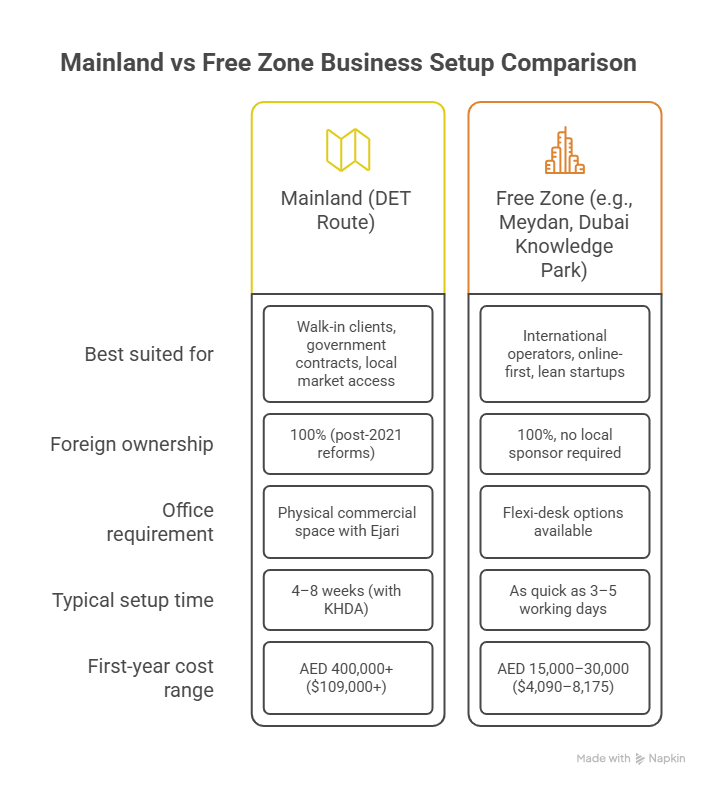
Mainland (DET route): Best if you want direct access to the local market, government contracts, and walk-in corporate clients. Requires a physical commercial space with Ejari registration. A mainland DET license with KHDA approval typically takes 4–8 weeks. This route allows the center to operate retail-facing premises and serve walk-in clients directly.
Free Zone (e.g., Meydan Free Zone, Dubai Knowledge Park): Suits international operators, online-first businesses, and lean startups. Offers 100% foreign ownership in the UAE without a local sponsor, plus flexi-desk options. Free zone setups work well for online-first or B2B corporate training models where instruction is delivered off-site at client facilities.
Cost breakdown (mainland training institute):
- KHDA permit: AED 15,000–25,000 ($4,090–6,810) depending on activities
- DET trade license: AED 12,000–20,000 ($3,270–5,450)
- Facility lease: AED 30,000–120,000 ($8,175–32,700) per year
- Civil Defense compliance: AED 2,000–8,000 ($545–2,180)
- Teacher credential attestation: AED 1,500–4,000 ($410–1,090) per teacher
- Total first-year education business setup cost in Dubai: Plan from AED 400,000 ($109,000) upward for a realistic mainland launch
For free zone setups, typical costs range from AED 15,000 to AED 30,000 ($4,090–8,175) depending on visa allocation and office type. The lower overhead makes free zones attractive for solo founders and online academies.
VAT consideration: VAT enrollment becomes mandatory once annual taxable turnover exceeds AED 375,000 ($102,000). Certain educational services may qualify for zero-rating under specific conditions.
How Much Does it Cost to Open a Training Institute in Dubai?
A mainland training institute in Dubai typically requires AED 400,000 ($109,000) or more in first-year costs. This covers the KHDA permit (AED 15,000–25,000 / $4,090–6,810), DET trade license (AED 12,000–20,000 / $3,270–5,450), facility lease (AED 30,000–120,000 / $8,175–32,700 per year), Civil Defense compliance, and teacher credential attestation.
Free zone setups start lower, from AED 15,000 to AED 30,000 ($4,090–8,175), making them attractive for solo founders and online-first models. Budget for course amendment fees (AED 100 / $27 per course, AED 2,500 / $680 per programme) if you plan to expand your offering after launch.
UAE Corporate Tax Obligations for New Education Businesses
Education businesses established in Dubai are subject to UAE Corporate Tax at 9% on taxable income exceeding AED 375,000 ($102,000), effective from financial years starting on or after 1 June 2023.
Free zone education companies may qualify for the 0% qualifying free zone rate if they meet economic substance requirements and earn qualifying income, but this depends on the nature of the revenue and the free zone entity's structure.
Mainland education businesses are taxed under the standard regime. Enroll for corporate tax with the Federal Tax Authority within the prescribed timeline after incorporation. Factor this into your financial projections from day one.
Do Online Academies and E-Learning Platforms Need KHDA Approval?
If your online academy operates from Dubai and issues certificates, you need KHDA approval. E-learning platforms must clearly define course delivery methods, assessment processes, and certification formats. Even if classes are virtual, regulatory oversight applies.
There's nuance here: if you're purely online with no UAE-based students, you might not need KHDA oversight. But the moment you market to UAE residents or issue certificates, you're on KHDA's radar. Free zone structures work well for online-first models where instruction is delivered remotely.
Can I Run an Online Academy from Dubai Without KHDA?
If your online academy operates from Dubai and issues certificates or markets courses to UAE residents, KHDA approval is required. The exception is a purely international operation with no UAE-based students and no certificates marketed within the country.
In practice, most Dubai-based e-learning businesses fall within KHDA's scope once they begin advertising locally or enrolling UAE residents. Free zone structures work well for online-first models, but the KHDA permit obligation still applies.
Can Education Investors Qualify for the UAE Golden Visa?
Education investors, licensed school leaders, and principals operating under KHDA-approved institutions may be eligible for the UAE Golden Visa, a 10-year renewable residency independent of employer sponsorship.
For an entrepreneur who has invested in setting up a KHDA-licensed training centre, the Golden Visa, or a linked investor visa in the UAE, represents a meaningful addition to the value of that investment.
It provides long-term residential stability for the investor and their family, removes dependency on any visa sponsorship chain, and signals the UAE government's recognition of education investors as a valued category of long-term resident.
Eligibility criteria are tied to the investment scale and the specific residency category being applied for, confirming eligibility is worth exploring at the planning stage, not as an afterthought.
How RadiantBiz Simplifies KHDA Licensing and Education Business Setup
With over a decade of experience in Dubai business setup and more than 15,000 entrepreneurs assisted, RadiantBiz is uniquely positioned to guide you through the KHDA licensing process. Our banking background means we understand the regulatory process from both the business and compliance sides.
We help clients shorten KHDA processing time through our PRO services team, ensuring every document is correctly formatted, every form is accurately completed, and every submission undergoes pre-inspection checks.
Our services include trade licensing, KHDA approval, corporate banking assistance, compliance support, and visa services.
Whether you're opening a training institute, a tutoring center, or an online academy, we help you select the correct activity codes, prepare a KHDA-compliant academic plan, navigate the teacher attestation process, ensure your facility meets inspection standards, coordinate between DET and KHDA, and handle corporate tax enrollment correctly from day one.
FAQs
1. Can a foreigner own 100% of an education business in Dubai?
Yes, 100% foreign ownership is available both on the mainland (post-2021 reforms) and in free zones. This removed one of the biggest historical barriers for foreign founders.
2. How much does KHDA approval cost for a training institute?
The KHDA Educational Services Permit ranges from AED 15,000 to AED 25,000 ($4,090–6,810) depending on the number of activities you offer (1–2 activities: AED 15,020 / $4,090; 7+ activities: AED 25,020 / $6,815). Add DET trade license fees (AED 12,000–20,000 / $3,270–5,450), facility costs, and teacher attestation fees for the total investment.
3. How long does it take to get an educational license in Dubai?
For training institutes with well-prepared applications, the process takes 4–8 weeks. Free zone education licenses can be issued faster, as quick as 3–5 working days. School approvals take longer, 3 to 6 months, with the initial approval phase alone requiring 22 working days for review.
Essential Checklist Before Applying for a Dubai Educational License
Getting an educational license in Dubai is achievable if you follow the process correctly and in the right sequence.
Based on our decade of experience guiding education businesses through KHDA approval, here are the recommendations that matter most:
- Start teacher attestation early, it's the most common cause of delays. Credential verification from outside the UAE requires multiple steps, and waiting until your facility is ready means weeks of idle time while permits sit unused.
- Build a complete course list upfront, adding courses later costs AED 100 ($27) per amendment and AED 2,500 ($680) per new programme. Understand the difference between courses and programmes before you submit your budget to investors.
Secure compliant premises, confirm your space meets KHDA standards, including minimum classroom dimensions and Civil Defense requirements, before signing a lease. A failed inspection means costly remediation and weeks of delay.
- Get the sequence right, KHDA Initial Approval must be obtained before the trade license is finalised for a regulated training activity. A trade license naming a training activity does not authorise you to operate.
- Work with experienced partners, a setup consultant who knows KHDA expectations reduces rejection rates. With RadiantBiz's 15,000+ clients and 95% renewal rate, we've built our reputation on getting these applications right the first time.
Dubai's education market is booming, the government actively supports the sector through initiatives like the Knowledge Fund Establishment's AED 1 billion+ ($272 million+) investment portfolio, and the regulatory framework offers substantial flexibility.
With preparation and the right guidance, you can join the ranks of successful education entrepreneurs in this city. Seek our professional on-the-ground guidance, contact us via mail at info@radiantbiz.com, WhatsApp, or call us at +971521322895!
.webp)

Anjali Jawahar ensures the seamless execution of business setup processes, making compliance and licensing effortless for clients. Her keen attention to operational efficiency helps the RadiantBiz businesses establish themselves smoothly in the UAE.

.avif)


.svg)


.svg)
.svg)
.svg)