.png)

.png)

2.png)
Singapore Company Formation Cost Breakdown (2026): Every Fee Explained

%20Every%20Fee%20Explained.webp)
Table of Contents
About the Author
This article is written by our business setup consultant with over a decade of experience helping entrepreneurs establish companies in Singapore and the UAE. Having worked with startups, SMEs, and international investors, they have guided businesses through jurisdiction selection, tax structuring, and banking strategies across both regions.
Why Nobody Gives You a Straight Answer on Singapore Company Formation Cost (And How to Fix That)
If you’re reading this, you’re likely an entrepreneur, a startup founder, or a foreign business owner looking to set up shop in Singapore. And you’ve probably already noticed something frustrating: nobody wants to give you a straight answer on price.
One firm tells you that incorporation costs $500. Another quotes $4,000. And buried in the fine print are fees for things you didn’t even know existed, like a “nominee director” or an “official address.”
We’ve been in the business consultancy field for over a decade now. From our first incorporation to our very recent one, we have learnt a lesson that we carry into every engagement since: transparency isn’t just good service; it’s a fiduciary responsibility.
We’ve assisted over 15,000 companies, from solo founders in Jakarta to venture-backed startups in Silicon Valley, in navigating the incorporation process. And to be honest, the Singapore company formation cost in 2026 isn’t a single number.
It’s a combination of government fees, professional services, and hidden operational expenses that catch most people off guard.
By the end of this guide, you’ll know exactly what you’re paying for, what’s optional, and, more importantly, where to avoid getting overcharged.
Note: All prices are estimates based on market rates at the time of publication. Actual costs may vary due to daily exchange rate fluctuations and potential bank transfer fees.
What Actually Makes Up the Singapore Company Formation Cost?
Before we give you any numbers, let’s get one thing straight: the legal minimum to incorporate a company in Singapore is shockingly low.
According to the Accounting and Corporate Regulatory Authority (ACRA)’s official fee schedule, you can set up a company for just a few hundred dollars if you’re a resident handling everything yourself through the government BizFile+ portal.
But for most business owners, especially foreigners, the real Singapore company formation cost includes mandatory services you simply cannot skip.
Here’s a high-level breakdown of what you’re paying for, based on the actual invoices we’ve processed for clients:
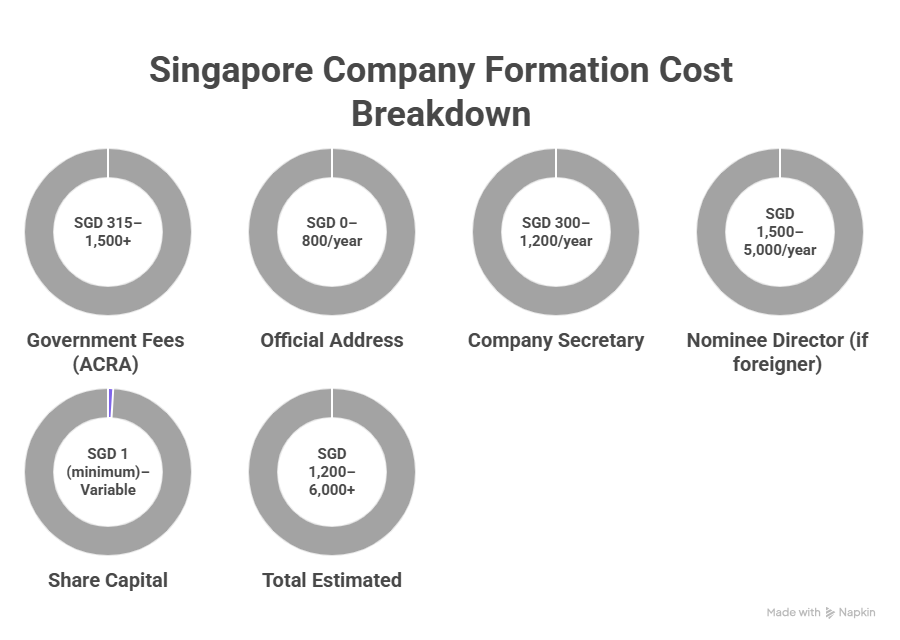
The wide range isn’t because firms are randomly guessing. It’s because your specific situation, citizenship, business activity, and long-term plans change the equation entirely.
Let us walk you through each component, the way we explain it to our own clients.
Government Fees: The One Non-Negotiable Cost (With Real ACRA References)
Let’s start with the part you have to pay regardless of who you hire: ACRA fees.
These are published directly on the ACRA website under the “Fees and Charges” section, and we always encourage clients to verify them themselves, transparency builds trust.
Name Application Fee
$15 for instant approval / $40 for a reserved name.
Expert experience: We’ve had clients who wanted to hold a name for six months while they finalized their business plan, the $40 option is worth it in that case.
Company Incorporation Fee
$300 for a standard company limited by shares. This is fixed, no negotiation, no discount.
Business Profile (Bizfile)
$33 for a digital copy.
Expert tip: We tell every client to download at least three copies. You’ll need one for the bank, one for your corporate records, and one as a backup.
We’ve seen banks reject applications because the profile was watermarked “specimen” from a screenshot.
Stamp Duty
This is the variable. Under Section 4 of the Stamp Duties Act, if your company’s authorized share capital exceeds SGD 500,000 ($390,495), you’ll pay stamp duty on the excess. Most small businesses keep it under that threshold to avoid this.
Expert insight: In our practice, we’ve only had to handle stamp duty filings for about 5% of clients, usually those raising venture capital from day one.
So the absolute baseline Singapore company formation cost from the government side is $315 if you’re keeping things simple.
But here’s the catch: you can’t pay ACRA directly unless you have a SingPass account, which foreigners don’t have. That means you’ll need a local corporate service provider firm to file on your behalf, which brings us to the professional fees.
Professional Service Fees: Where Most People Get Confused (And How We’ve Seen It Go Wrong)
This is where pricing gets messy. Corporate firms bundle different services, and unless you know what to look for, it’s easy to pay for things you don’t need or miss things you absolutely do.
Let us examine a practical example. A fintech founder from Hong Kong paid $500 for a whole package of incorporating a budget firm. Six months later, he couldn’t open a bank account because he wasn’t provided certified true copies of his incorporation documents. His nominee director was based in Johor Bahru and refused to travel to Singapore for the bank signing. He ended up redoing everything, paying twice.
Here’s what you should actually expect.
Corporate Secretary
Under Section 171 of the Companies Act 1967, every Singapore company must appoint a qualified company secretary within six months of incorporation. It’s not optional.
If you’re a local director handling things yourself, you can hire a basic secretary for $300 to $500 per year. That usually covers annual filings and statutory compliance.
But if you’re a foreign entrepreneur, you’ll likely want a “full-service” secretary that also handles compliance reminders, Annual General Meeting (AGM) filings, and liaises with your bank. This would cost around $800 to $1,500 per year.
Based on our practice, we offer both tiers, and we always explain the trade-off: a basic secretary files what you tell them to file, a full-service secretary proactively ensures you never miss a deadline.
Expert experience: We’ve seen clients try to save money by going with the cheapest option, only to get slapped with late filing penalties from ACRA, $300 per late filing, because they missed a deadline. A good secretary pays for itself the first time it prevents a penalty.
Official Address
Your company needs a physical address in Singapore. Section 142 of the Companies Act requires an official office address that is accessible to the public during ordinary business hours. A P.O. Box won’t cut it.
If you’re renting an office space, this cost is already covered. If you’re working from home or overseas, you’ll need to rent an official address from your service provider. Expect to pay $200 to $800 per year.
Expert advice: Check whether your provider actually forwards physical mail. Some just hold it and expect you to collect it. If you’re abroad, that’s a problem. We’ve had a client miss a court summons because his mail sat uncollected for three months. That’s not a scenario you want to find yourself in.
The Nominee Director Fee: The Biggest Cost for Foreign Entrepreneurs (And Why Cheap Options Fail)
If you’re a foreigner and you plan to be the sole director and shareholder of your Singapore company, you must legally appoint a local director.
This person must be a Singapore Citizen, Permanent Resident, or EntrePass/Employment Pass holder. This requirement comes from Section 145(1) of the Companies Act, which mandates that every company must have at least one director who is ordinarily resident in Singapore.
This is the single largest line item in the Singapore company formation for foreign business owners.
Based on our experience, reliable nominee director services cost $1,500 to $5,000 per year. Why such a wide range? Let us tell you what we’ve seen on the ground.
Expert experience: We had a client from Vietnam who went with a firm charging $800 annually for a nominee director. When he tried to open a corporate bank account with DBS, the bank flagged the director’s name. Turns out, the same individual was acting as a nominee director for 400+ companies.
Banks now view that as a high-risk structure under the Monetary Authority of Singapore (MAS) Notice 626 on Prevention of Money Laundering. His application was rejected. He had to pay for a replacement director and restart the entire process.
In 2026, ACRA and the MAS tightened enforcement. Under the Corporate Service Providers Act 2024 (amended), nominee director arrangements now require formal service agreements and enhanced due diligence.
Reputable firms are now charging more, often $3,000 or more annually, because they’re actually doing proper KYC and providing real oversight. A cheap nominee director is a red flag, not a bargain.
We personally maintain a small panel of nominee directors, all Singapore citizens with clean compliance records, and we limit each to no more than 30 active appointments.
This ensures they can actually pay attention to each client’s needs. It costs more, but we’ve never had a bank reject a client because of director quality.
Share Capital: How Much Do You Really Need? (A Banker’s Perspective)
The law says you can incorporate with SGD 1 in paid-up capital. Section 23 of the Companies Act sets no minimum, it’s one of the most business-friendly provisions globally.
But here’s what the law doesn’t tell you: banks hate it.
We’ve sat in meetings with relationship managers at DBS, OCBC, and UOB. According to internal risk assessment frameworks commonly used by these banks, a paid-up capital of SGD 1 ($0.75) paired with a foreign director tends to signal a lack of operational commitment or familiarity with local requirements.
When banks see SGD 1($0.75) in capital, they flag it immediately. You’ll likely face additional scrutiny, delayed account opening, or outright rejection.
For most of our clients, we recommend starting with SGD 10,000-50,000 ($7,500–37,500) in paid-up capital. It’s not a legal requirement, but it signals to banks, suppliers, and potential investors that you’re serious.
The capital can be used for operating expenses, so it’s not “lost” money, it’s just parked in the company account. We’ve had clients who followed this advice open accounts in under two weeks, those who insisted on SGD 1($0.75 capital often waited two months or more.
Hidden Costs That Catch First-Time Founders (From My Case Files)
After a decade in this industry, we’ve seen the same surprises come up again and again. Here are the costs that never make it into the initial quote, drawn from actual client situations we’ve managed.
Audit Fees
Not every company needs an audit. Under Section 205C of the Companies Act, you’re exempt if you meet two out of three criteria: annual revenue under SGD 10 million ($7,810,791), total assets under SGD 10 million ($7,810,791), and fewer than 50 employees.
But if you exceed those thresholds, or if your shareholders insist on an audit, fees start at $2,000 and can easily reach $10,000+ annually.
Expert experience: We worked with a SaaS startup that grew from $2 million to $12 million in revenue within 18 months. They hadn’t budgeted for the audit requirement and were caught off guard with a $9,000 bill from their auditor. We now flag this for any client with aggressive growth projections.
Bank Account Opening Facilitation
Opening a corporate bank account as a foreign-owned entity has become significantly harder over the last three years. Since the 1MDB money laundering scandal, MAS has imposed stricter KYC requirements on all financial institutions.
We’ve had banks request everything from source-of-funds documentation to personal tax returns from directors’ home countries.
Some corporate firms charge $500 – $1,000 to facilitate the bank introduction and prepare the paperwork. It’s an optional service, but based on our experience, clients who skip it often end up facing long delays or rejections.
Last quarter alone, we had three clients who tried to open accounts on their own, got rejected, and came back to us for help, ultimately paying more in delayed business than the facilitation fee would have cost.
GST Application
If your business expects to hit SGD 1 million ($781,641) in annual revenue, you must apply for the Goods and Services Tax (GST) under Section 31 of the GST Act.
The application itself isn’t expensive, but the compliance work, quarterly filings, and accounting adjustments add ongoing cost. Many service providers charge $500 – $1,200 per year just for GST filing.
We’ve also seen clients accidentally trigger mandatory application by hitting the SGD 1 million threshold mid-year and not realizing they had 30 days to apply. Late application penalties from IRAS can hit 10% of the tax due plus interest. That’s a painful way to learn the rules.
Singapore Company Formation Cost Breakdown (2026): Every Fee Explained with RadiantBiz
At RadiantBiz, our process for breaking down the Singapore company formation cost starts with a simple principle: no surprises. When you engage us, we don't hand you a generic price list.
Instead, we sit down with you, whether in person or over a call, to understand your exact structure: Are you a foreign founder needing a nominee director? Do you have a local partner? What's your projected revenue for year one?
From there, we build a line-by-line proposal that separates government fees from professional services and clearly outlines every recurring cost, including corporate secretary, official address, and nominee director arrangements. We also walk you through ACRA's actual fee schedule so you know exactly what goes to the government versus what goes to us. Once you're comfortable with the breakdown, we handle the entire incorporation process, from name application to bank account introduction, keeping you updated at every step.
FAQs
1. Can I incorporate a Singapore company entirely on my own without hiring a firm?
If you are a Singapore Citizen or Permanent Resident with a SingPass account, yes, you can do it yourself through ACRA’s BizFile+ portal for just the government fees. If you are a foreigner, no.
2. Is the Singapore company formation cost cheaper in 2026 compared to previous years?
Government fees have remained stable, the $300 incorporation fee hasn’t changed since 2015. However, professional service costs, particularly nominee director services, have risen significantly.
3. What is the cheapest way to get a nominee director?
The most affordable approach is to appoint a local business partner, an employee holding an Employment Pass, or a co-founder who is a Singapore resident. If you don’t have that, you will need to engage a professional nominee director service.
Don't Chase the Cheapest Quote: What to Look for Instead
If you take away one thing from this guide, let it be this: the legal minimum Singapore company formation cost is around $315 in government fees. But a company that’s actually ready to operate with a bank account, compliant structure, and no surprises will cost a foreign entrepreneur anywhere from $2,500 to $5,000 in the first year.
The key is not to chase the lowest quote. We’ve cleaned up too many messes from founders who went with the cheapest option only to find their nominee director wouldn’t sign bank forms, or their secretary missed the AGM filing deadline, or they were hit with a surprise resignation fee when they tried to switch providers.
Instead, look for a firm that gives you a clear breakdown of government fees, professional services, and ongoing costs, before you pay a cent. Ask about renewal rates. Get the nominee director’s arrangement in writing. Verify their license with ACRA.
If you’re planning to incorporate in 2026 and want a no-surprises breakdown tailored to your specific business structure, seek our professional on-the-ground guidance, contact us via mail at info@radiantbiz.com, WhatsApp, or call us at +971521322895!
%20.webp)

.webp)
With over 15 years of experience in the banking and business consulting sector, Rizwan Ansari leads RadiantBiz with a vision to simplify business setup in the UAE.


.avif)


.svg)


.svg)
.svg)
.svg)

