.png)

.png)

2.avif)
UAE Tax Residency Certificate (TRC) 2026: Full Eligibility, Cost & Application Guide

%202026%20Full%20Eligibility%2C%20Cost%20%26%20Application%20Guide.webp)
Table of Contents
About the Author
The author is a tax consultant with over a decade of experience helping international entrepreneurs and SMEs navigate UAE Corporate Tax compliance, VAT, and regulatory frameworks. Having guided clients across Europe, Asia, and the Middle East through free zone setups, offshore structures, and corporate banking, understanding the full regulatory ecosystem businesses operate in, ensuring tax filing aligns with broader compliance obligations.
Key Takeaway:
- A UAE residence visa does NOT equal tax residency. The TRC is a separate document issued by the FTA that proves your tax status to foreign authorities. Choosing between a DTA-purpose TRC (for treaty benefits) and a domestic-purpose TRC (for local banking) is critical, the wrong choice means rejection and wasted fees.
- You can qualify with as few as 90 days in the UAE. Under the 90-day rule with qualifying ties (residence visa, permanent home, or employment/business in the UAE), you don't need to spend 183 days here. Golden Visa holders qualify automatically for the visa tie. From October 2024, you can apply as soon as you meet the criteria, without waiting for year-end.
- Getting your documents right is non-negotiable. The number 1 reason for rejection is a mismatched ICP entry-exit report that doesn't align with your claimed 12-month period. From 2026, companies must have a valid Corporate Tax TRN to apply. Since TRC fees became non-refundable in October 2025, submitting a clean file the first time saves both money and time.
Are You a UAE Tax Resident or Just a Visa Holder? The 2026 TRC Reality Check
Over 70,500 new companies joined the Dubai Chamber of Commerce in 2024 alone, and a surprising number of their owners still confuse a UAE residence visa with actual tax residency (Media Office).
The visa satisfies UAE residence visa requirements, it proves you can live here. The Tax Residency Certificate (TRC) proves to foreign tax authorities that you are genuinely based here. Those are two entirely different things, and getting them mixed up can cost you treaty benefits worth far more than the application fee.
This guide covers the rules established by Cabinet Decision No. 85 of 2022, the clarifications from Ministerial Decision No. 27 of 2023, and what you actually need for a successful application in 2026.
Note: While the AED is pegged to the USD, all prices are estimates based on current market rates. Actual charges may differ due to bank transfer fees.
What is a UAE Tax Residency Certificate (TRC) and Why Does It Matter for DTAA Claims?
A Tax Residency Certificate is an official document issued by the Federal Tax Authority (FTA) that confirms you or your company is a UAE tax resident for a specific 12-month period. It is the primary document required to claim double taxation relief under the UAE's network of 137 Double Taxation Avoidance Agreements (DTAAs).
There are two distinct types of TRCs, and choosing the wrong one is one of the most common reasons for rejection:
- DTA-purpose (Treaty) TRC: This is what you need for claiming benefits under a specific double taxation agreement. You select the treaty partner country when applying.
- Domestic-purpose TRC: This confirms your UAE tax residency for local purposes like banking. Foreign tax authorities will not accept this for treaty benefits.
DTA-Purpose vs Domestic-Purpose TRC: Which One Do You Need?
If you need to claim tax treaty benefits with a foreign country, for example, reduced withholding tax on dividends from India, you need a DTA-purpose TRC issued for that specific treaty partner. A domestic-purpose TRC only confirms your UAE residency for local purposes like corporate banking and will be rejected by foreign tax authorities. Choosing the wrong type is one of the most common reasons for application failure.
Without a valid TRC, most treaty claims will be rejected outright by foreign tax authorities. The TRC provides the UAE-side documentation that foreign authorities accept, but the outcome depends on whether your home country has a Double Taxation Agreement with the UAE and what the treaty's tie-breaker rules specify.
Who Qualifies for a UAE Tax Residency Certificate in 2026?
UAE TRC Eligibility for Individuals: The Three Residency Tests
Under Cabinet Decision No. 85 of 2022, an individual qualifies as a UAE tax resident if they meet any one of three conditions.
1. The 183-Day Rule: The simplest path. You qualify if you were physically present in the UAE for 183 days or more during any consecutive 12-month period. Part-days count as full days, and they do not need to be consecutive.
2. The 90-Day Rule with Qualifying Ties: You can still qualify if you spent at least 90 days in the UAE and meet at least one of these additional conditions:
- Hold a UAE residence visa
- Have a permanent place of residence in the UAE (an Ejari-certified tenancy contract qualifies)
- Work or conduct business in the UAE
3. The Centre of Financial and Personal Interests Test: This test applies where the UAE is clearly the individual's main base of life, even if day-count thresholds are not met. The FTA looks for converging evidence such as a long-term residential lease, immediate family residing in the UAE, core business operations located in the UAE, and UAE-based banking used for day-to-day living. This test is evidence-heavy and works best where the individual has genuinely relocated their life, not just their visa.
Important 2026 Update: From October 2024, individuals can now apply for a TRC as soon as they meet the eligibility criteria, rather than waiting for the end of the tax year.
Can You Get a UAE TRC Without a Residence Visa?
Not under the standard routes. The 183-day rule requires physical presence but also assumes lawful residency, and the 90-day rule explicitly lists a UAE residence visa as one of the qualifying ties. The centre-of-interests test requires evidence of genuine relocation, which in practice means a visa, a lease, and UAE-based banking. Tourists and visit-visa holders do not qualify.
Can a Golden Visa Holder Get a UAE Tax Residency Certificate?
Yes, Golden Visa holders meet the residence visa requirement automatically, which satisfies one of the qualifying ties under the 90-day rule. If you hold a 10-year Golden Visa and spend at least 90 days in the UAE during a 12-month period, you are eligible under the second test. Alternatively, if you spend 183 days or more, you qualify under the first test regardless of visa type.
The Golden Visa does not grant automatic TRC status, you still need to apply through the FTA and provide the standard documentation, including an ICP entry-exit report covering the relevant period. However, the Golden Visa strengthens your case under the centre-of-interests test because it signals a long-term commitment to the UAE.
UAE TRC Eligibility for Companies and Free Zone Entities
The rules for companies differ from those for individuals. A company generally qualifies for a TRC if:
- It has been established and holding an active trade license for at least 12 months
- It has genuine operations, management, and decision-making in the UAE, consistent with the economic substance regulations UAE authorities enforce
- It holds a valid UAE Corporate Tax Number (TRN), obtaining this is now compulsory for company TRC applications from 2026
Any company incorporated or legally recognized in the UAE is treated as a UAE tax resident under domestic law, including mainland companies and free zone companies. Branches of foreign companies do not qualify, as they are treated as a permanent establishment of the parent entity rather than a separate UAE tax resident.
Can Offshore Companies Get a UAE Tax Residency Certificate?
Offshore entities licensed with RAK ICC or JAFZA Offshore typically cannot obtain a TRC. These structures lack the physical presence and economic substance the FTA requires. If your business is currently set up as an offshore company and you need a TRC, you may need to restructure as a mainland or free zone LLC.
Do Free Zone Companies Qualify for a UAE TRC?
Yes, any company incorporated or legally recognized in the UAE is treated as a UAE tax resident under domestic law, and that includes free zone companies. The company must hold an active trade license for at least 12 months, have genuine operations and management in the UAE, and hold a valid Corporate Tax TRN. The key requirement is real economic substance, a shelf company with no employees or office space will face additional scrutiny.
UAE Tax Residency Certificate Cost and FTA Fee Structure in 2026
The cost depends on who you are and whether you have a Corporate Tax TRN. Here is the breakdown based on the updated 2026 fee structure:
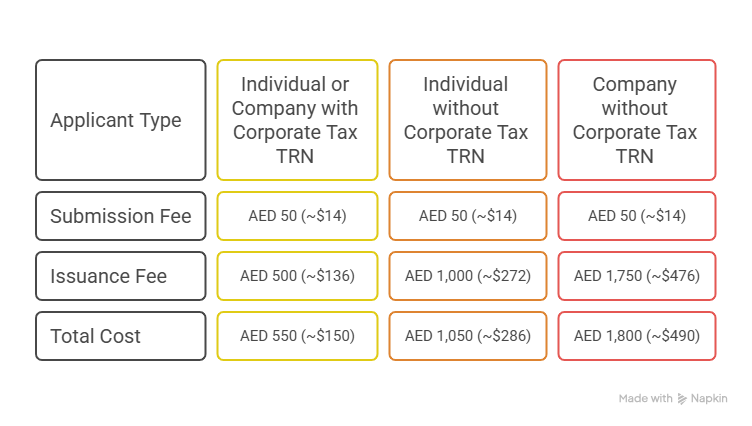
Expert insight: An additional AED 250 (~$68) applies for a stamped physical copy, which some foreign tax authorities (notably India) require.
The fee structure clearly incentivises businesses to complete their Corporate Tax enrollment before applying for a TRC, saving up to AED 1,250 (~$340) in fees and simplifying ongoing FTA tax compliance. Having a TRN also tends to reduce FTA scrutiny on the application.
How UAE Corporate Tax Enrollment Affect Your TRC Application
Since the UAE Corporate Tax came into effect in June 2023, the FTA has tightened the link between Corporate Tax enrollment and the TRC process. From 2026, a valid Corporate Tax TRN is compulsory for company TRC applications.
Beyond the fee savings, up to AED 1,250 (~$340) less with a TRN, enrolling for Corporate Tax signals to the FTA that your company is compliant with its broader tax obligations. Companies that have not yet enrolled should do so before submitting a TRC application.
The enrollment itself is free and completed through the EmaraTax portal, but it requires your trade license, Memorandum of Association, and details of your financial year-end.
Required Documents for a UAE TRC Application in 2026
The success of the UAE tax residency application process depends entirely on the quality of your documentation. The requirements differ significantly between individuals and companies, here is a side-by-side comparison:
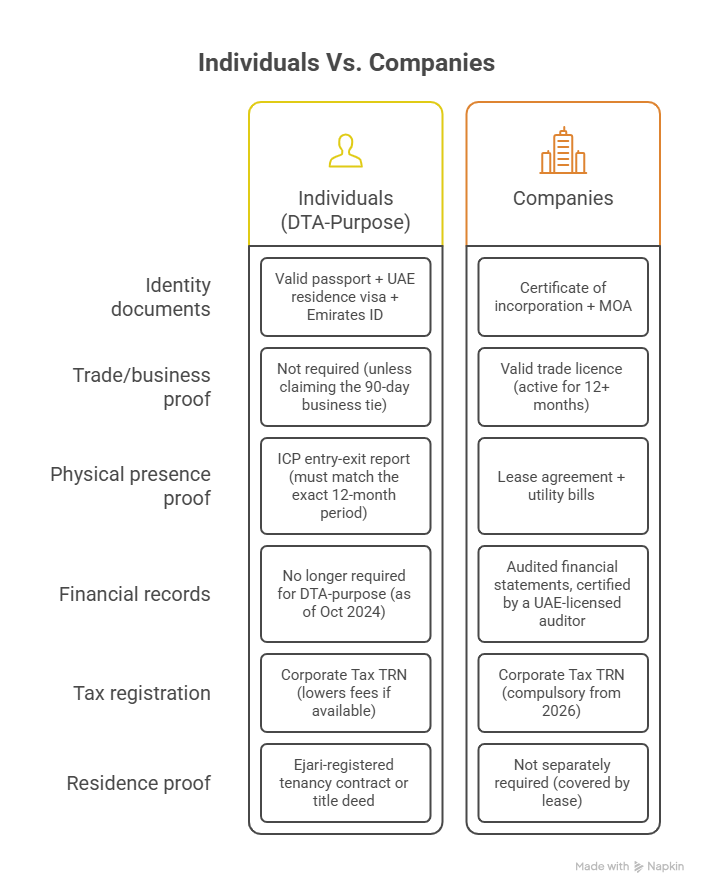
Document Checklist for Individual TRC Applications (DTA-Purpose)
The FTA typically requires:
- Valid passport copy
- Valid UAE residence visa copy
- Valid Emirates ID
- ICP entry-exit report, your official proof of physical presence in the UAE, this is the single most critical document, and a report covering a different period will trigger a query or rejection
- Ejari-certified tenancy contract or property title deed
Key 2026 Update: As of the October 2024 FTA guide, bank statements are no longer a mandatory requirement for DTA-purpose TRC applications. This simplifies the process significantly and removes one of the most common obstacles in the application process.
Document Checklist for Company TRC Applications
- Valid trade license
- Certificate of incorporation
- Memorandum of Association (MOA)
- Audited financial statements for the relevant period, certified by a UAE-licensed auditor
- Proof of physical UAE presence (lease agreement, utility bills)
- Corporate Tax Number (TRN) confirmation
EmaraTax TRC Application Walkthrough: How to Apply Step by Step
The application runs entirely through the FTA's EmaraTax portal. Here is what the process looks like screen by screen:
Step 1 — Log in to EmaraTax
Complete your EmaraTax portal signup and log in using your UAE Pass. If you do not have a UAE Pass, you will need to sign-up for one first through the UAE Pass app.
Step 2 — Navigate to the TRC service
From the EmaraTax dashboard, select "Other Services" from the left sidebar, then click "Tax Residency Certificate." This opens the application form.
Step 3 — Enter your Corporate Tax TRN
If you have one, enter it here. This lowers the issuance fee and auto-populates some company details, reducing manual input errors.
Step 4 — Choose the certificate type
Select DTA-purpose for treaty benefits, and pick your specific treaty country from the dropdown. A certificate issued for India will not work for Germany, you need a separate application for each country.
Step 5 — Select the 12-month period
Choose the exact period your application covers. This must match your ICP entry-exit report dates precisely. You cannot apply for a future period that has not yet started.
Step 6 — Upload your documents
Attach all required files. The portal accepts PDF format. Name your files clearly, "Passport_JohnSmith.pdf" is processed faster than "scan123.pdf."
Step 7 — Pay the submission fee
Pay the non-refundable AED 50 (~$14) submission fee via credit card or bank transfer.
Step 8 — Submit and track your application
You can monitor the status under "My Requests" in EmaraTax. If the FTA queries anything, the status changes and you will receive an email notification.
Step 9 — Download your TRC
Once approved, download the digital certificate from EmaraTax. The certificate includes a QR code for verification.
Exert tip: Take screenshots of each step as you go. If the FTA queries your application, having a record of exactly what you submitted and when avoids confusion.
How Long Does the UAE TRC Application Take?
The FTA typically issues a digital TRC within 5 business days when the application file is complete and all documents match. During peak filing season, January through March, processing can stretch to 7–10 business days.
Expert insight: Incomplete applications are queried rather than rejected outright, but each query resets the clock. Submitting a clean file with a matching ICP entry-exit report is the single biggest factor in avoiding delays.
Why UAE TRC Applications Get Rejected: Common Mistakes to Avoid
The FTA does not reject TRC applications arbitrarily. In our experience, the same handful of mistakes account for the vast majority of failed applications. Here are the ones we see most often:
Mismatched ICP entry-exit report dates
This is the number one reason for queries and rejections. If your application covers January to December 2025 but your entry-exit report shows March 2025 to March 2026, the FTA will flag it. The dates must align exactly with the 12-month period you are claiming.
Wrong certificate type selected
Choosing a domestic-purpose TRC when you need a DTA-purpose TRC, or vice versa, results in a certificate that your foreign tax authority will not accept. This wastes both the fee and the processing time.
Expired documents at the time of submission
An expired passport, residence visa, or Emirates ID triggers automatic rejection. Check the expiry dates on everything before you upload.
Inconsistent details across documents
A tenancy contract address that does not match the trade license, or a passport name that differs from the Emirates ID transliteration, will trigger a query, even if all substantive conditions are met.
Applying for a future period
The FTA does not issue TRCs for periods that have not yet started. You can apply three months into the current tax period at the earliest, or after the period has ended.
No Corporate Tax TRN for company applications
From 2026, this is compulsory. Submitting without one means automatic rejection for companies.
Expert advice: Since TRC fees became non-refundable in October 2025, each of these mistakes now costs real money on top of the delay. Getting the file right before you submit is no longer optional, it is the only financially sensible approach.
TRC Renewal Process: What Changes After Your First Certificate
A UAE TRC is valid for one specific 12-month period only. There is no auto-renewal, when the period ends, your certificate expires and you need to start a fresh application for the next period.
What Stays the Same
The renewal process itself is identical to the first application. You log into the EmaraTax portal, select "Tax Residency Certificate," choose your period, upload documents, and pay the same fees:
- AED 550 (~$150) with a Corporate Tax TRN
- AED 1,050 (~$286) for individuals without a TRN
- AED 1,800 (~$490) for companies without a TRN
What You Need to Update
Every renewal requires fresh documentation for the new period. You cannot reuse last year's files:
- Individuals: A new ICP entry-exit report covering the new 12-month period, plus updated copies of your passport and visa if they have been renewed since your last application
- Companies: Updated audited financial statements for the new period, a current trade license (renewed, not expired), and confirmation that your Corporate Tax TRN is still active
- Both: If your address, business activity, or residency status changed between periods, the renewal documentation must reflect the current situation, not what was true last year
When to Apply for Renewal
You can apply as soon as three months into the new period. Do not wait until a foreign tax authority asks for the certificate, by then, peak-season processing delays may push your timeline past the filing deadline in the other country. The best practice is to apply for your new TRC in the first quarter of each financial year so it is ready when you need it.
Expert insight: Foreign tax authorities typically require a current-year TRC for DTAA claims. An expired certificate from a previous period will not be accepted, so annual renewal is not optional if you rely on treaty benefits.
What a UAE TRC Does and Does Not Do for Foreign Tax Obligations
A UAE TRC does not automatically prevent your home country from taxing you. It provides the UAE-side documentation that foreign authorities may accept, but the outcome depends on treaty tie-breaker rules and your home country's domestic tax law.
For example, the India-UAE DTAA includes a "tie-breaker" article for individuals who are tax resident in both countries simultaneously. The tie-breaker examines (in order): where your permanent home is, where your centre of vital interests lies, where you habitually reside, and your nationality. The TRC supports your position under the first two criteria but does not override the entire tie-breaker analysis.
The UAE does not have a DTAA with every country. Notably, the United States does not have a comprehensive DTAA with the UAE. US citizens are taxed on worldwide income regardless of residency and cannot use a UAE TRC to escape US tax obligations.
For British expats, the UK's Statutory Residence Test operates independently from the UAE TRC, spending as few as 45 days in the UK can trigger UK tax residency depending on your personal ties.
How RadiantBiz Helps with Your TRC Application
At RadiantBiz, we have helped hundreds of individuals and businesses navigate the UAE tax residency application process successfully.
Our team of tax consultants understands the nuances of the FTA's requirements, from ensuring your ICP entry-exit report covers the exact 12-month period to preparing the right evidence for the "centre of interests" test.
We identify the correct eligibility route for your situation, prepare comprehensive documentation packages to avoid common rejection reasons, and manage the application through the EmaraTax portal.
For clients with cross-border tax situations involving India, the UK, or other jurisdictions, we coordinate with tax advisors in those countries to ensure the TRC works effectively for treaty claims.
If you want to avoid the delays and rejections that come from incomplete or inconsistent documentation, we can handle the entire process for you.
FAQs
1. Can I Apply for a TRC if My Company is Less than 12 Months Old?
Newly incorporated companies generally need to be established for at least 12 months before applying, though the FTA's 2024 guidance now allows applications during the tax period (after three months from the start of the relevant tax period). Applying too early results in rejection.
2. Can I Get a TRC if I Spend Less than 183 Days in the UAE?
Yes, under the 90-day rule with qualifying ties or the centre of financial and personal interests test. You can qualify with fewer days in the country if you meet the additional conditions.
3. Is a UAE TRC Valid for Multiple Years?
No, the FTA issues each TRC for a specific 12-month period only. You cannot obtain a TRC covering future periods, and a certificate from a previous year does not carry over. If you need ongoing treaty protection, you must reapply annually with updated documentation, including a fresh ICP entry-exit report covering the new period.
Avoid Common UAE TRC Mistakes: Get Your Application Right
The UAE Tax Residency Certificate application process has plenty of traps for the unwary. The wrong certificate type, a mismatched entry-exit report, or an expired visa can delay your application for weeks.
If you are managing cross-border income tax, receiving international payments, or want to protect your foreign earnings, getting your TRC sorted should be a priority for 2026.
The savings are real, the process is manageable, and proper tax planning in the UAE costs far less than fixing mistakes after the fact.
Seek our professional on-the-ground guidance by contacting us via mail at info@radiantbiz.com, WhatsApp, or call us at +971521322895!

.webp)

.webp)
With a PhD in Microfinance and a deep understanding of market trends, Salman Ansari drives business development at RadiantBiz. He specializes in helping entrepreneurs and corporations make strategic business moves in the UAE.

.avif)


.svg)


.svg)
.svg)
.svg)