.png)

.png)

2.png)
Construction Company License in Dubai: Requirements, Approvals, and Timeline

Table of Contents
About the Author
The author is a business consultant specializing in regulatory compliance, corporate setup, and operational planning across multiple UAE sectors. With over a decade of experience advising local and international clients, we've helped more than 15,000 companies navigate licensing, regulatory compliance, and operational frameworks, including numerous construction companies.
Key Takeaway:
- A DET trade license alone is NOT enough. You must also obtain Dubai Municipality contractor classification through the DEQS portal. Without it, you cannot legally start any construction project.
- New 2026 regulations are coming. Law No. 7 of 2025 takes effect on 15 January 2026 with a one-year grace period. Non-compliance can result in fines up to AED 200,000, licence suspension, or revocation.
- Budget AED 100,000–500,000 and allow 2–4 weeks. Base licensing costs start around AED 28,272, but total investment with office, staff, and equipment is significantly higher. The full process takes 2–4 weeks, with delays often caused by incomplete Ejari enrolment or missing the 30-day DET payment window.
Why a Trade License Alone Doesn't Authorize Construction Work in Dubai
A $767 billion project pipeline. An airport expansion valued at AED 128 billion ($34.8 billion). Roughly 75% of all UAE construction contract awards flowing through a single emirate. Dubai's construction sector isn't slowing down, and new investors want in.
For investors and entrepreneurs looking to enter this market, we have a crucial warning: a Department of Economy and Tourism (DET) trade license alone does NOT authorize you to operate as a building contractor in Dubai.
You need a separate certification from Dubai Municipality called contractor classification. Without it, you cannot legally break ground on any project, regardless of what your trade license states.
This is where we see most first-time investors get stuck. The dual-track system catches even experienced business owners off guard.
There has been a key 2026 update: Law No. 7 of 2025 (effective 15 January 2026) introduces a unified enrollment and classification system across all of Dubai, including free zones and special development zones. Contractors have a one-year grace period to comply, meaning full implementation by January 2027.
In this guide, we'll walk you through every requirement, approval, and timeline consideration so you can get your construction company license in Dubai the right way.
Note: While the AED is pegged to the USD, all prices are estimates based on current market rates. Actual charges may differ due to bank transfer fees.
Dubai's Two-Track Enrollment System: Trade License vs Contractor Classification
The most important concept in getting a construction company license in Dubai is the dual-track framework:
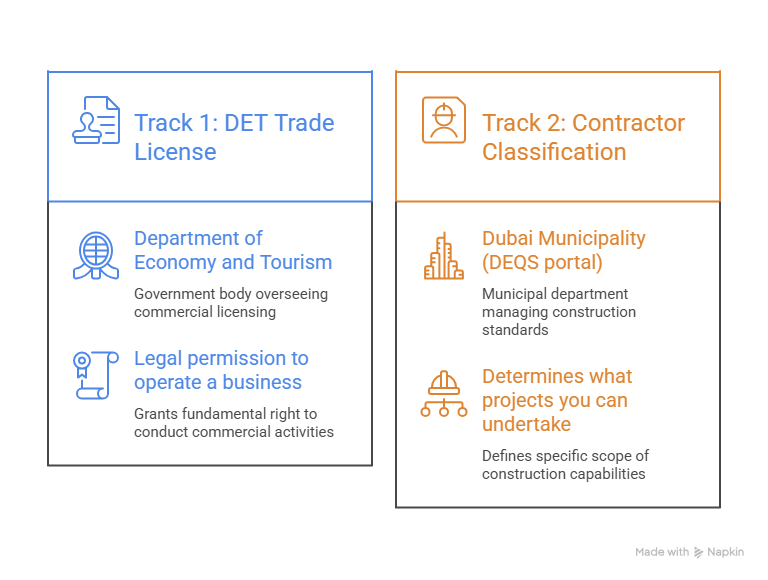
These tracks run in parallel with separate fees, timelines, and document requirements. You must plan for both.
What is Contractor Classification and Why Does it Matter?
Contractor classification is a grading system operated by Dubai Municipality through its DEQS portal.
It evaluates your company's financial capacity, technical staffing, and equipment to assign a category from "Special" (mega-projects) down to "Sixth" (entry-level works).
Without this classification, your DET trade license alone does not authorise you to break ground on any construction project in Dubai.
Trade License vs Contractor Classification: What's the Difference?
A DET trade license gives your company legal permission to operate a business in Dubai. Contractor classification, issued by Dubai Municipality through the DEQS portal, determines what type and scale of construction projects you're authorized to undertake.
You need both, the trade license alone does not permit you to begin construction work. Think of the trade license as your business identity and the classification as your operational clearance.
What's new under Law No. 7/2025: The law establishes a central Contractor Record maintained by Dubai Municipality. All contractors must be enrolled and classified based on financial strength, technical capacity, and workforce qualifications. Activities will be limited to the contractor's recorded scope.
Step 1: Choose Your Construction Activity Codes in Dubai
Dubai does not issue a generic "construction" license. You must select specific activities from the DET list. Activity selection determines your license type, legal form, and every government approval you'll need.
Key construction activity codes include:
- 4100002: Building Contracting
- 4100003: Metal Structures Contracting
- 4210001: Main Roads and Streets Contracting
- 4220904: Electrical Works for Building Services
- 7110202: Architectural Engineering Consultancy
Expert advice: Only list activities your company will actively perform. Each additional activity may require separate government approval, adding cost and timeline complexity.
Step 2: Mainland vs Free Zone - Which Jurisdiction Suits a Construction Company?
This decision shapes everything about your business structure. Here's our practical guidance:
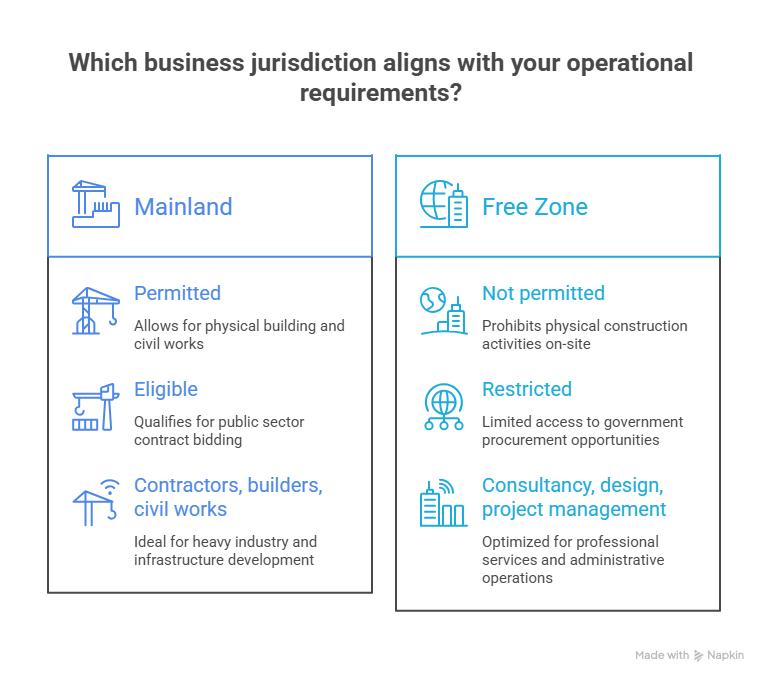
Expert experience: Free zone contractors wanting mainland work typically need a dual license arrangement or a separate mainland branch. For most contractors whose primary business is UAE mainland construction, a mainland license is the recommended starting point.
The 2025 CCL amendment introduced re-domiciliation, allowing a company to migrate from a free zone to the mainland without disrupting its legal personality.
Can a Foreigner Own a Construction Company in Dubai?
Yes, since the 2020 amendments to the UAE Commercial Companies Law, foreign nationals can hold 100% foreign ownership under UAE law of a mainland construction company without requiring an Emirati partner. A Local Service Agent (LSA) agreement is still needed for certain government-facing procedures, but this does not involve any share transfer. Free zone entities offer full foreign ownership by default.
Step 3: The Complete Stages for a Construction License in Dubai
Here are the complete stages based on official UAE government guidance and our practical experience:
Stage 1: Identify Business Activity and Legal Form
Match your activities with the right structure. For most construction companies, that's an LLC.
Stage 2: Reserve Your Trade Name
Must include the legal form acronym (LLC, EST, PJSC) and cannot replicate existing names. Trade name reservation is separate from trademark application, which is handled by the Ministry of Economy.
Stage 3: Apply for DET Initial Approval via Bashr
For eligible activities, approval can come in approximately 15 minutes through the integrated Bashr platform.
Stage 4: Reserve Your Trade Name
Confirm your trade name is reserved and approved by DET.
Stage 5: Obtain Initial Approval from DET
Foreign investors, including those applying for an investor visa linked to a construction business, need GDRFA approval at this stage. Some construction activities require pre-approval from specific authorities before DET initial approval.
Stage 6: Draft and Attest the Memorandum of Association (MOA)
With the 2025 CCL amendment now in effect, we recommend including:
- Different share classes with differential rights
- Drag-along and tag-along provisions for JV partners
- Share transfer rules upon a shareholder's death
This is particularly useful for multi-investor construction joint ventures.
Stage 7: Secure Physical Location and Enroll with Ejari
All mainland businesses must have an official address. The tenancy contract must be enrolled with Ejari before submitting your Dubai Municipality NOC application, a step many first-time applicants overlook. Getting this sequence wrong is a common cause of delays.
Stage 8: Obtain Dubai Municipality Contractor Classification
This is mandatory and separate from your trade license. Through the DEQS portal enrollment process, you'll be classified into one of seven categories, from "Special" (major projects) down to "Sixth" (entry-level).
What determines your classification: Financial capability, technical staff qualifications, equipment and machinery, track record, and office facilities.
What are the Seven Contractor Classification Categories?
Dubai Municipality assigns contractors to one of seven categories: Special, First, Second, Third, Fourth, Fifth, and Sixth. "Special" category contractors can take on the largest, most complex projects, while "Sixth" is the entry-level tier.
Your category is determined by financial capability, qualified technical staff, equipment holdings, and track record. New contractors entering Dubai for the first time are typically placed in the lowest category until they build a local portfolio.
Important note for 2026: Contractors licensed for the first time in Dubai may initially be placed in the lowest category until they demonstrate their capabilities to be classified higher.
Step 9: Submit All Documents and Pay Fees Within 30 Days
If you miss the 30-day DET payment window, your application is automatically cancelled, and you restart the full process.
How Long Does the Construction License Process Take in Dubai?
The DET trade license can be issued within 1–3 business days once all documents and payments are submitted.
However, the full process, including Dubai Municipality contractor classification, Ejari enrollment, and any authority-specific NOCs, typically takes 2–4 weeks.
Delays most often occur when the Ejari enrollment is incomplete before the Municipality NOC application, or when the 30-day DET payment window is missed, forcing a restart.
Required Documents for a Dubai Construction Company License
Based on official Dubai Municipality requirements:
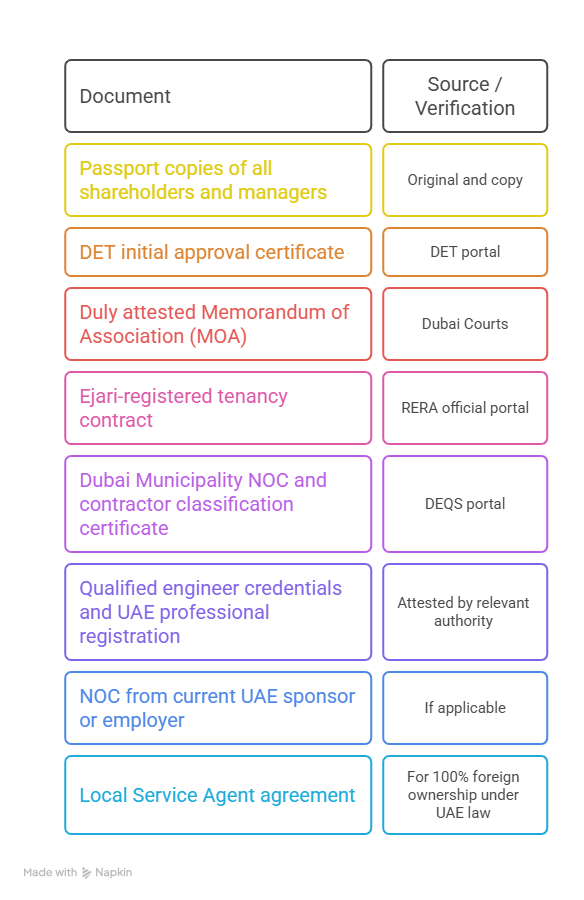
Do You Need a Qualified Engineer on Staff?
Yes, Dubai Municipality requires that construction companies employ at least one qualified engineer with UAE professional certification. The engineer's credentials must be attested by the relevant authority, and their qualifications directly affect your contractor classification category. Without an official engineer on your team, your Municipality NOC application will not be processed.
Expert tip: All documents issued from outside the UAE must be attested by the Ministry of Foreign Affairs.
Construction Company Setup Costs in Dubai (2026 Breakdown)
Based on recent setup data, the base construction trade license cost comes to approximately AED 28,272 ($7,700):
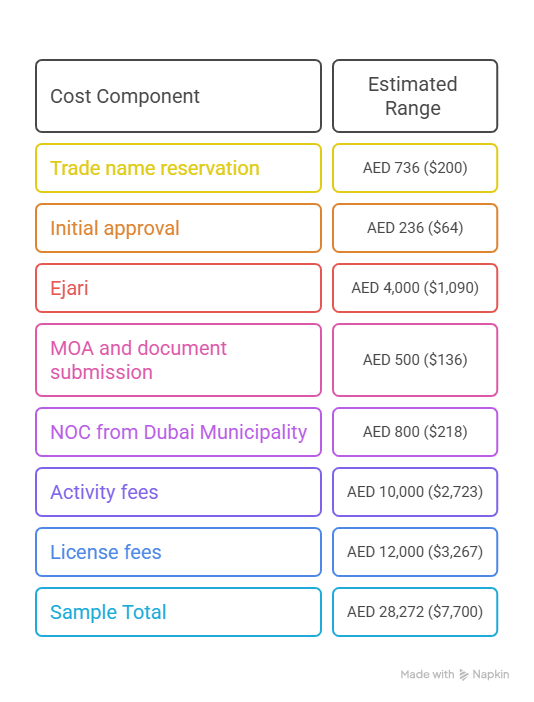
Additional setup considerations beyond the base license fees:
- Office lease and fit-out: AED 20,000–80,000 ($5,450–$21,800)
- Technical staff recruitment: AED 30,000–100,000 ($8,170–$27,225)
- Equipment and machinery: AED 50,000–200,000 ($13,612–$54,450)
- Working capital reserves: AED 50,000–300,000+ ($13,612–$81,675+)
Total investment typically ranges from AED 100,000 to AED 500,000 ($27,225–$136,125), depending on company size and specialisation.
Recurring annual costs to budget for:
- License renewal in Dubai
- Office rent and utilities
- Visa renewals for staff and investors
- Accounting and audit fees
- Insurance renewals
- DEWA contractor classification renewal
Tax thresholds:
- VAT Enrollment: Mandatory when taxable turnover exceeds AED 375,000 ($102,100)
- UAE Corporate Tax: 9% on net profits exceeding AED 375,000 ($102,100)
Golden Visa Eligibility through a Construction Business in Dubai
Investors who establish a construction company in Dubai may qualify for the UAE's 10-year Golden Visa, provided their total investment meets the AED 2 million ($544,500) threshold.
This includes capital invested in the business, equipment, and operational infrastructure. The Golden Visa offers long-term residency without the need for a national sponsor, along with the ability to sponsor family members.
For construction entrepreneurs planning a significant capital outlay, which most contracting businesses require, the Golden Visa pathway is worth factoring into your setup strategy from day one.
Economic Substance and UBO Requirements for Construction Companies
Construction companies operating in the UAE must comply with Economic Substance Regulations (ESR) if they carry out any "relevant activity" as defined by Cabinet Resolution No. 57 of 2020.
While pure contracting may not always trigger ESR, companies with holding, distribution, or headquarters functions should assess their obligations carefully. Additionally, all UAE companies must file Ultimate Beneficial Owner (UBO) declarations, identifying individuals who hold 25% or more ownership or exercise significant control.
Non-compliance with UBO filing can result in fines ranging from AED 50,000 to AED 500,000 ($13,612–$136,125). Ensure your corporate structure is UBO-compliant before or during the licensing process.
How RadiantBiz Simplifies Your Construction Company Setup in Dubai
RadiantBiz has been helping construction companies with company formation in Dubai for years, serving thousands of clients from more than 64 countries.
Our team of business setup consultants and PRO services specialists handles the entire journey, from trade license application and Ejari enrollment to Dubai Municipality contractor classification and DEQS enrollment.
What sets RadiantBiz apart is their end-to-end service approach. They don't just get you a trade license, they ensure you understand the contractor classification requirements under the new Law No. 7 of 2025 and help you navigate the DEQS portal's corporate services.
With dedicated account managers who maintain direct communication throughout the process, RadiantBiz has helped clients complete FZE enrollments, trade license renewals, and ongoing compliance management.
Our team handles government paperwork across Steps 2–6 of the setup process, making it particularly valuable when coordinating multiple authority approvals simultaneously.
Whether you're setting up a mainland contracting company or a free zone consultancy, RadiantBiz provides the expertise needed to avoid common setup pitfalls, including missing the 30-day DET payment window or failing to secure Dubai Municipality classification before starting operations.
FAQs
1. What approvals do I need before starting work on a construction site?
You need a valid trade license, building permit, relevant NOCs from DEWA and RTA, insurance coverage, and site HSE arrangements. The exact combination depends on the project and authority. Dubai Municipality's Dubai BPs app now allows building owners to view land plot information, find expert consultants and contractors, and track building license transactions.
2. Can a free zone construction company work on mainland projects?
Free zone entities typically cannot execute works directly on the mainland without proper contractual arrangements. Many investors use a mainland contracting entity for execution, coupled with a free zone company for consultancy or project management.
Under the 2025 CCL amendment, free zone companies can now establish mainland branches under the dual license regime, provided their free zone's own legislation permits it.
3. How does the new Law No. 7 of 2025 affect existing contractors?
The law takes effect on 15 January 2026, with a one-year grace period for compliance (until 14 January 2027). Violations may result in fines of AED 1,000–100,000 ($272–$27,225), with repeat offences subject to doubled penalties up to AED 200,000 ($54,450).
Additional sanctions include suspension, license revocation, or downgrading of contractor classification. Contractors must also retain project documents for 10 years from the date of the completion certificate or contract termination.
Your Construction License Checklist: Key Takeaways for 2026
Getting a construction company license in Dubai requires navigating a more complex regulatory environment than most new investors expect.
The dual-track system of DET trade license plus Dubai Municipality contractor classification is non-negotiable, and the new Law No. 7 of 2025 is adding more layers of compliance.
Here’s our curated checklist:
- Don't assume the DET trade license is enough — you need contractor classification from Dubai Municipality through DEQS
- Choose activities carefully — each activity may require separate government approvals, adding cost and timeline complexity
- Budget for all approvals — factor in DET, Municipality, Civil Defence, DEWA, RTA, and other authority costs
- Don't miss the 30-day DET payment window — automatic cancellation of your application
- Allow 2–4 weeks minimum for setup — Municipality approvals can extend timelines significantly
Dubai's construction sector offers enormous opportunities with a $767 billion project pipeline. With the right planning, professional guidance, and this roadmap, you can successfully establish your company and start winning projects in 2026.
Seek our professional on-the-ground guidance, contact us via mail at info@radiantbiz.com, WhatsApp, or call us at +971521322895!
.webp)

.webp)
Anjali Jawahar ensures the seamless execution of business setup processes, making compliance and licensing effortless for clients. Her keen attention to operational efficiency helps the RadiantBiz businesses establish themselves smoothly in the UAE.


.avif)


.svg)


.svg)
.svg)
.svg)

