.png)

.png)

2.png)
DMCC vs IFZA: Which Free Zone is Better for Business Setup?

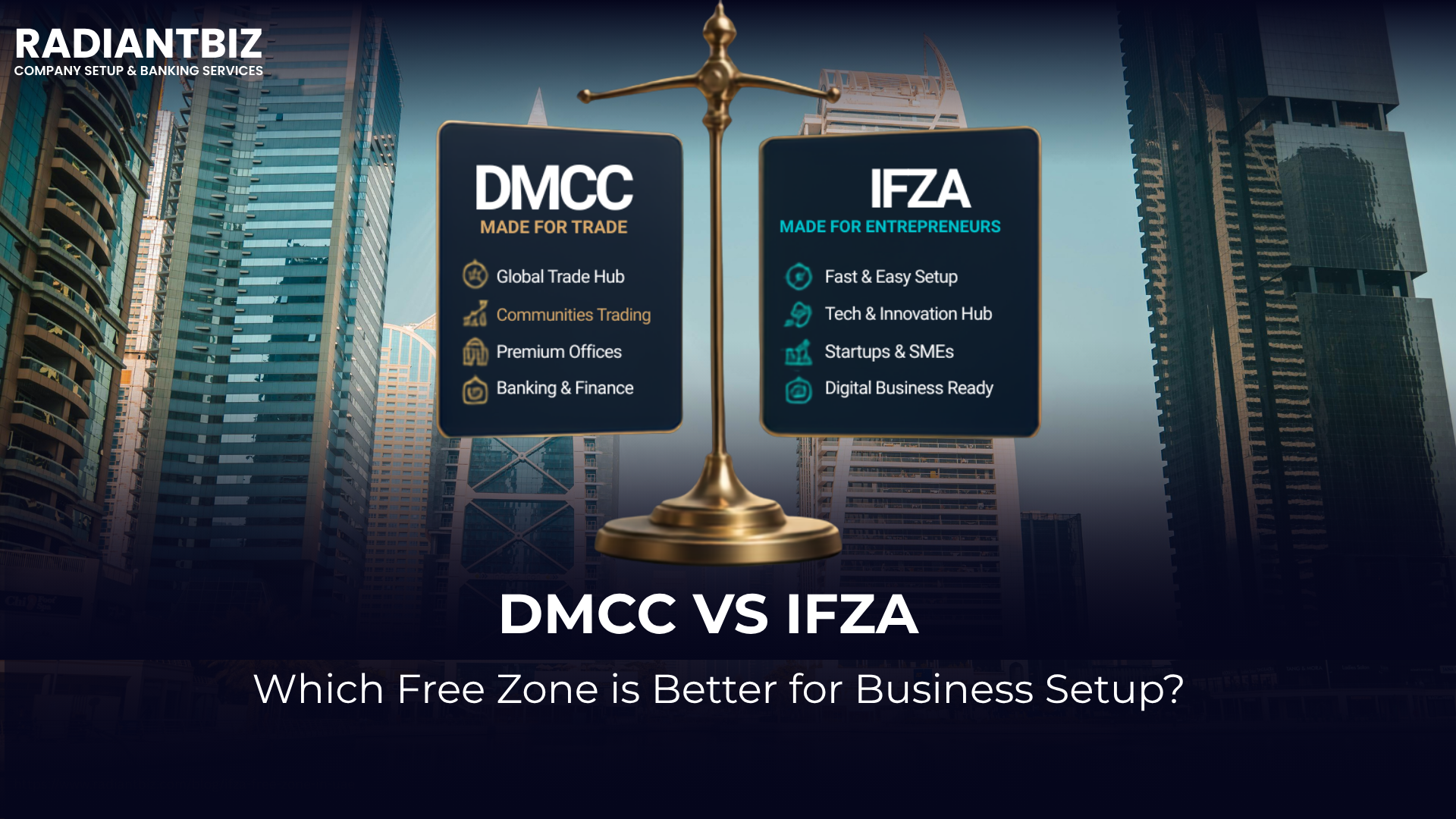
Table of Contents
About the Author
The author is a business setup consultant with over a decade of experience specializing in free zone business setups, guiding startups, SMEs, and corporates across the UAE’s 40+ free zone jurisdictions, including DMCC, DIFC, IFZA, and JAFZA, while optimizing costs, compliance, and growth strategies.
Key Takeaway:
- Choose based on your business stage and needs, not brand name alone.
DMCC is best for commodities, enterprise B2B, and businesses requiring Tier-1 banking and global credibility, but it has higher costs and a longer setup. IFZA is ideal for e-commerce, SaaS, consultants, and bootstrapped founders, offering lower costs, virtual desk options, and setup in 5–7 days. - Banking success depends on documentation, not just the zone. DMCC achieves a 90%+ first-submission approval rate with Tier-1 banks. IFZA has a 74% first-submission rate (rising to 88% with a complete file), but requires stronger proof of funds, contracts, and business plans. Digital banks like Wio work well for IFZA setups.
- Avoid common costly mistakes: hidden fees, banking rumors, activity codes, and scalability. Always request the total 3-year cost of ownership, verify your exact trade license activity codes before paying, don’t assume IFZA can’t bank (it can, with better preparation), and check visa quotas early. DMCC ties visas to office size, while IFZA allows package-based bundling.
DMCC or IFZA? How to Choose Without Costly Mistakes
Over 15,000 UAE company formations later, and the question that still lands in our inbox every single week is: "DMCC or IFZA, which one should we choose?"
We have never once given the same answer twice. The right zone depends entirely on what you are building, how fast you need banking, and how much overhead you can carry in year one.
Choosing incorrectly can cost you thousands in unnecessary overhead or, worse, stall your banking approvals for months.
This guide cuts through marketing claims and presents real-world differences based on our direct experience handling setups for crypto startups, commodity trading firms, e-commerce brands, and professional service practices.
Note: All prices are estimates based on market rates at the time of publication. Actual costs may vary due to daily exchange rate fluctuations and potential bank transfer fees.
How Dubai Free Zone Company Formation Works: Regulations, Tax, and Ownership Rules
Since the introduction of Corporate Tax in June 2023, including mainland vs free zone company Dubai implications, the nuances between zones matter more than ever.
While all Qualifying Free Zone Persons benefit from 100% foreign ownership and 0% tax on Qualifying Income, the operational realities of each zone differ substantially.
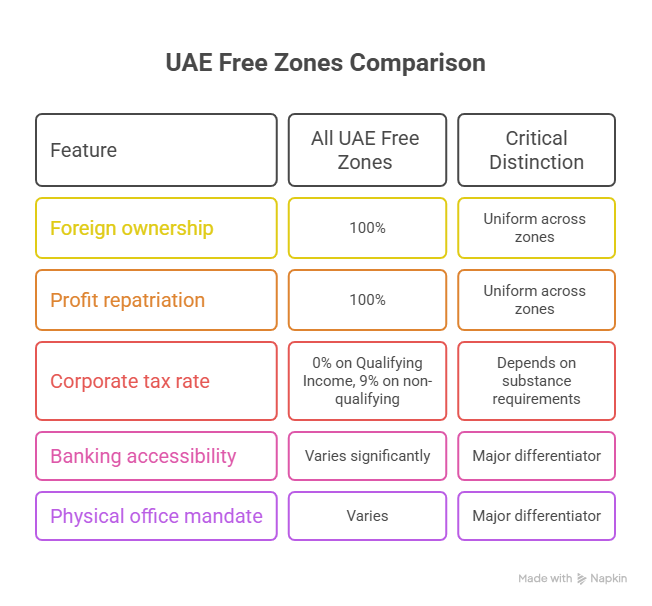
How Do DMCC and IFZA Differ for UAE Corporate Tax Compliance?
Both are designated free zones under Cabinet Decision No. 55 of 2023, meaning both can access the 0% corporate tax rate on Qualifying Income. The practical difference is in how the substance is satisfied.
DMCC's mandatory physical office requirement automatically checks the box for adequate presence. IFZA virtual setups need additional documentation, board meeting minutes, a UAE-based director, and audited financials to demonstrate genuine economic substance.
For founders operating remotely, this extra compliance layer is manageable but should not be an afterthought.
A pattern we keep seeing: founders burn six figures, forcing a square peg into a round hole. They select a premium zone for its brand name, only to discover their service-based business cannot justify the physical office requirements. The goal is not merely to obtain a license, it is to build sustainable, audit-proof infrastructure.
DMCC Free Zone License: Costs, Activities, and Why it Leads Global Trade Rankings
DMCC Regulatory Authority, Location, and Global Standing
- Established: 2002
- Location: Jumeirah Lakes Towers (JLT), Dubai
- Global Ranking: #1 free zone globally (Financial Times fDi rankings, 2015–2024)
- Active Companies: 24,000+
- Annual Trade Volume: Over $100 billion in commodities alone
DMCC carries institutional weight that shows up in real transactions. When you present a DMCC trade license to a counterparty in London or New York, the compliance questions get shorter.
Expert experience: A client's gold trading division secured a $5 million credit line within three weeks of DMCC incorporation, a process that had stalled for four months under a lower-tier free zone license.
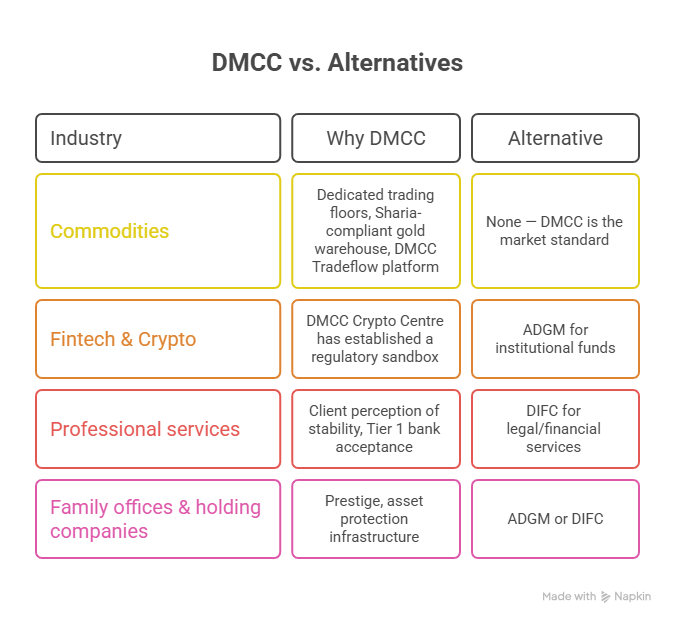
Which Business Types and Industries are Best Suited for DMCC?
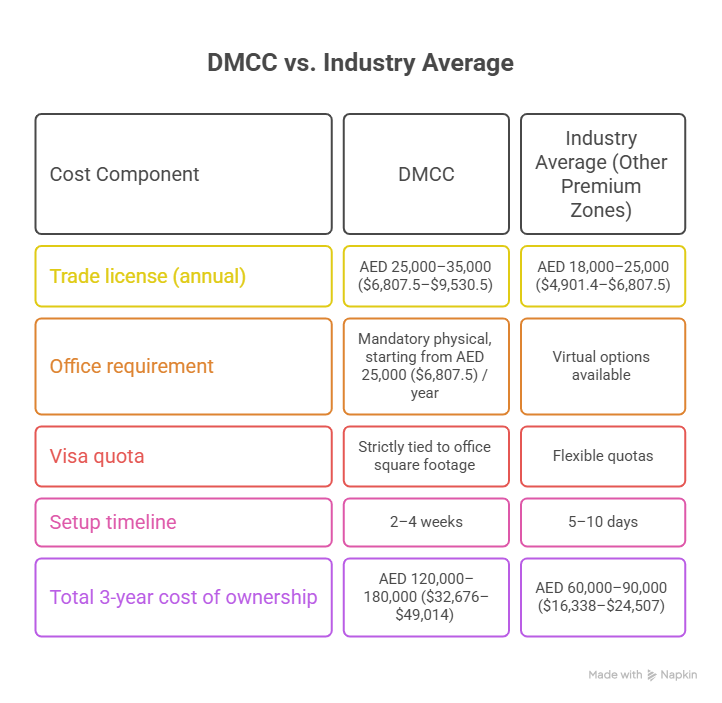
DMCC License Fees and Setup Costs in 2026
Expert experience: A family office needed to establish a gold trading division. Their international refiners required audited financials, physical inventory storage, and regulatory compliance history. DMCC was the only viable option. Total setup cost: AED 95,000 ($25,868.5) in year one (license, flexi-desk, 3 visas). Banking: approved with Emirates NBD within 10 days.
IFZA Free Zone License: Setup Costs, Activities, and Who it's Built For
Is IFZA Cheaper than DMCC to Set Up?
On paper, significantly. IFZA's entry-level trade license starts at AED 12,500 ($3,403.75) versus DMCC's AED 25,000 ($6,807.5) minimum, and IFZA permits a virtual desk at AED 5,500–7,500 ($1,497.65–$2,042.25) per year, where DMCC mandates a physical flexi-desk from AED 25,000 ($6,807.5).
Over three years, the gap widens: IFZA's total cost of ownership runs AED 55,000–75,000 ($14,976.5–$20,422.5) against DMCC's AED 120,000–180,000 ($32,676–$49,014).
However, cheaper upfront does not always mean cheaper overall. IFZA setups that require DMCC-tier banking or commodity trading infrastructure may end up migrating within 18 months, adding AED 15,000–25,000 ($4,084.5–$6,807.5) in transfer costs.
IFZA Regulatory Authority, Location, and Growth
- Established: 2018
- Location: Dubai Silicon Oasis (licensing authority, with physical presence across multiple Emirates)
- Active Companies: 25,000+ (rapid growth since 2020)
- Regulatory Status: Fully approved by the UAE Central Bank and the Ministry of Economy
IFZA entered the market with a clear philosophy: speed, transparency, and as little friction as possible. Unlike legacy zones that grew organically, it was built for the remote-work era from day one.
We have completed many IFZA setups to date. Average time from proposal to license issue: 6.5 working days.
Which Business Types and Industries are Best Suited for IFZA?
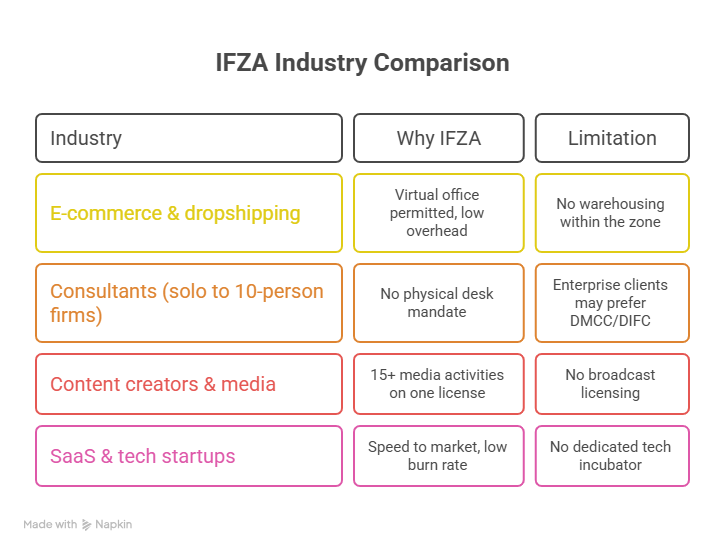
IFZA License Fees and Annual Costs in 2026
Cost Component
IFZA
Industry Average (Budget Zones)
Trade license (annual)
AED 12,500–17,500 ($3,403.75–$4,765.25)
AED 10,000–15,000 ($2,723–$4,084.50)
Office requirement
Virtual desk (AED 5,500–7,500 ($1,497.65–$2,042.25)/year) or flexi-desk
Virtual permitted
Visa quota
Package-based (3–10 visas without physical expansion)
Similar
Setup timeline
5–7 working days
7–14 days
Total 3-year cost of ownership
AED 55,000–75,000 ($14,976.50–$20,422.50)
AED 50,000–70,000 ($13,615–$19,061)
Expert experience: A B2B SaaS founder needed a UAE incorporation to serve regional clients. Pre-revenue, bootstrapped, remote team of one. We completed the IFZA setup in 6 days. License cost: AED 14,500 ($3,948.35). Visa: AED 4,500 ($1,225.35). Banking: opened with Wio in 3 days. Twelve months later, the company raised AED 2 million ($544,600) in seed funding, still on IFZA with no pressure to upgrade.
DMCC vs IFZA: Full Head-to-Head Comparison of Fees, Visas, and Banking (2026)
How Long Does Company Setup Take in DMCC vs IFZA?
IFZA consistently issues licenses within 5–7 working days of document submission. DMCC takes 2–4 weeks for standard applications, with activity-specific approvals (crypto, financial services, food commodities) adding further time.
If your business launch has a hard deadline, a client contract, an investor round, or a visa expiry, IFZA's speed advantage is real. DMCC's slower timeline reflects more rigorous due diligence, which is part of why its banking approval rate is higher.
UAE Corporate Bank Account Opening: DMCC vs IFZA Success Rates Compared
Can You Open a UAE Corporate Bank Account with an IFZA License?
Yes, but the bar for documentation is higher than with DMCC. Based on our 2024–2025 submissions, IFZA entities achieved a 74% first-submission approval rate, rising to 88% with a complete banking file.
Emirates NBD, Mashreq, Wio, and RAKBANK all accept IFZA-licensed companies. Digital banks like Wio have a notably lower rejection rate for early-stage IFZA setups.
DMCC entities qualify for an Emirates NBD business account, as well as accounts at Mashreq, ADCB, RAKBANK, Commercial Bank of Dubai, and HSBC, at a 90%+ first-submission rate. Average approval: 10–14 days.
IFZA entities are approved at 74% first-submission (rising to 88% with our checklist). Rejections typically occur for:
- Unclear source of funds documentation
- Business activities flagged as high-risk (crypto, certain trading categories)
- Solo founder with no prior trading history
Our banking preparation checklist:
- 6 months of personal bank statements for the founding shareholder
- Signed contracts or letters of intent - minimum three
- Business plan with a 12-month financial projection
- Notarized source of funds declaration
- CVs for all authorized signatories
If you require a Tier 1 banking relationship immediately (letters of credit, corporate credit cards, multi-currency accounts), DMCC reduces friction significantly. If you can start with a digital bank like Wio and upgrade later, IFZA works well.
Which Free Zone is Right for Your Industry? Recommendations from 500+ UAE Company Formations
Commodities and Physical Trading → DMCC
Average first-year operating cost: AED 65,000+ ($17,699.5)
E-commerce and Dropshipping → IFZA
Average first-year operating cost: AED 28,000 ($7,624.4)
Consulting and Professional Services → Depends on billing model:
Billing Model
Recommendation
Rationale
Hourly/solo (< AED 500k revenue ($136,150))
IFZA
Low overhead preserves margins
Enterprise retainer (> AED 1M ($272,300) revenue)
DMCC
Client procurement teams expect the premium zone
Government contracts
DMCC
Mandatory for many RFP responses
Fintech and Crypto → Consult Specialists. The UAE's virtual assets regulatory landscape is governed by VARA. Neither DMCC nor IFZA can overrule VARA requirements. Regulations change monthly, book a paid consultation for crypto-specific setups.
Holding Companies and IP Management → DMCC or DIFC. IFZA does not offer the legal infrastructure for complex holding structures.
Common Free Zone Setup Mistakes that Cost UAE Founders Thousands
Pitfall #1: Chasing the Lowest Initial Quote
A license quoted at AED 9,900 ($2,695.77) often requires mandatory add-ons: AED 3,000 ($816.9) for an immigration card, AED 2,500 ($680.75) for an establishment card, and AED 1,500 ($408.45) for stamping fees. Always request a "Total Cost of Ownership" for years 1–3 before signing.
Pitfall #2: Believing Banking Rumors
"You cannot open a bank account with IFZA" is false. IFZA applicants must present a stronger file, that is the real story. DMCC applicants face simpler checks because the zone itself is a known entity.
Pitfall #3: Ignoring UAE Trade License Activities
Each free zone publishes an approved list of UAE trade license activities, but not all listed activities are available on all license packages.
Expert insight: We’ve spent six weeks rescoping a client's application after discovering IFZA's standard package did not include their specific consulting sub-code. Verify your exact activity codes before paying any deposit.
Pitfall #4: Forgetting Scalability
Verify your free zone visa quota before signing anything, as some zones force a costly lease upgrade to increase headcount.
IFZA allows visa bundling (e.g., 10 visas on a flexi-desk package). DMCC requires physical expansion, and the associated lease upgrade also determines your investor visa Dubai quota.
A 20-person office in JLT costs AED 180,000–300,000 ($49,014–$81,690) annually.
How RadiantBiz Helps You Choose Between DMCC and IFZA Free Zone
When comparing DMCC vs IFZA, RadiantBiz's business setup consultants in Dubai apply a straightforward rule: DMCC for credibility and commodities, IFZA for speed and savings.
DMCC suits gold trading, fintech, family offices, and enterprise-facing consultancies, businesses that need Tier-1 banking, global brand recognition, and physical office presence. The higher UAE company formation cost is justified by institutional trust and regulatory infrastructure.
IFZA suits e-commerce, SaaS startups, and solo consultants. Lower license fees, virtual desk options, and 5–7 day setup times make it ideal for bootstrapped founders testing the market.
RadiantBiz's "split strategy" for multi-line founders: incorporate your trading entity under DMCC, your service entity under IFZA. Prestige where it pays, overhead is low everywhere else. We have executed this structure for many clients to date, with 100% banking approval.
FAQs
1. Can we switch from IFZA to DMCC after our business grows?
Yes, the IFZA-to-DMCC migration is possible, with document attestation and PRO services needed by UAE authorities for license transfer. Most clients start lean with IFZA and migrate after securing funding or enterprise contracts.
2. Do both free zones allow 100% foreign ownership and profit repatriation?
Yes, both guarantee 100% foreign ownership that UAE founders rely on, along with full repatriation of profits and capital under Federal Law No. 8 of 2018.
3. Does IFZA qualify for 0% Corporate Tax?
Yes, for Qualifying Income. IFZA is a designated free zone under Cabinet Decision No. 55 of 2023. However, you must satisfy the economic substance requirements UAE authorities enforce.
DMCC or IFZA? A 2026 Decision Framework for UAE Business Setup
Choose DMCC if:
- You operate in commodities, physical trading, or enterprise B2B services
- Your counterparties require audited financials and institutional credibility
- You have a minimum of AED 100,000 ($27,230) for the first year's all-in costs
- You need Tier 1 banking relationships immediately
- You plan to hire 10+ employees in a physical office
Choose IFZA if:
- You run an e-commerce, consulting, media, or SaaS business
- You are bootstrapping or testing the UAE market
- You operate remotely or with a small distributed team
- You need to be operational in under 10 days
- Your annual revenue is under AED 1 million ($272,300)
The Split Strategy: For founders with multiple business lines, incorporate your trading entity under DMCC and your service entity under IFZA.
Seek our professional on-the-ground guidance, contact us via mail at info@radiantbiz.com, WhatsApp, or call us at +971521322895!
.webp)
Anjali Jawahar ensures the seamless execution of business setup processes, making compliance and licensing effortless for clients. Her keen attention to operational efficiency helps the RadiantBiz businesses establish themselves smoothly in the UAE.


.avif)


.svg)


.svg)
.svg)
.svg)

