.png)

.png)

2.png)
Documents Required for UAE TRC: Individuals vs Companies

Table of Contents
About the Author
The author is a tax consultant with over a decade of experience helping international entrepreneurs and SMEs navigate UAE Corporate Tax compliance, VAT, and regulatory frameworks. Having guided clients across Europe, Asia, and the Middle East through free zone setups, offshore structures, and corporate banking, understanding the full regulatory ecosystem businesses operate in, ensuring tax filing aligns with broader compliance obligations.
Key Takeaway:
- For individuals, consistency is everything. The most common reasons for rejection are name mismatches across documents and entry/exit reports that don't cover the claimed period. Bank statements are no longer mandatory for the 183-day route (October 2024 update), but your passport, Emirates ID, visa, and ICP entry/exit report must all align perfectly.
- For companies, substance trumps paperwork. The FTA requires proof of genuine UAE operations, physical office space, audited financials from UAE-accredited firms, board resolutions, and UAE-resident authorized signatories. A trade license alone won't secure approval. Free zone companies are eligible, but they need operating history (generally 12 months) and a valid Corporate Tax TRN (mandatory from 2026).
- Choose the right TRC type and fee category. DTA-purpose certificates are for treaty-based withholding tax relief (required by jurisdictions like India and the UK); domestic-purpose certificates are for local banking or regulatory use. Processing fees vary based on whether you have a Corporate Tax TRN or not, getting your TRN in place before applying saves both time and money.
What Documents are Required for a UAE Tax Residency Certificate in 2026?
The documents required for a UAE Tax Residency Certificate are only half the story. How you prepare and submit them through the EmaraTax portal determines whether you clear FTA processing in five business days or face weeks of delays.
The FTA introduced significant changes in October 2024, removing bank statements from the mandatory document list for individual applicants filing through the EmaraTax portal (FTA).
That's not a minor tweak, it signals what the FTA actually prioritises. In this guide, we cover exactly what documents you need, whether you're an individual claiming DTAA benefits or a company establishing UAE tax residency, and the mistakes we see applicants repeat.
Note: While the AED is pegged to the USD, all prices are estimates based on current market rates. Actual charges may differ due to bank transfer fees.
Individual vs Company TRC Applications: Two Different Document Paths
The documents required for UAE TRC vary depending on whether you're an individual or a company. For individuals, it's about physical presence and your centre of interests under Cabinet Decision No. 85 of 2022, you qualify via the 183-day rule, the 90-day rule, or the centre of interests test (FTA).
For companies, the bar is different. Your company must be incorporated in the UAE, mainland, free zone, DIFC, or ADGM, and demonstrate that key management decisions are made here.
Without a valid TRC, treaty partners won't grant withholding tax reductions on cross-border payments. Submit the wrong category of evidence, and your application won't progress.
DTA-Purpose vs Domestic-Purpose TRC: Which Do You Need?
The FTA issues two types of TRC. A DTA-purpose certificate is tied to a specific treaty country and used to claim reduced withholding tax rates on cross-border income. A domestic-purpose certificate confirms UAE tax residency under local law and is used for banking compliance or regulatory filings where no specific treaty applies. Many foreign tax authorities, particularly India's Income Tax Department and HMRC, only accept the DTA version for withholding tax relief. Confirm what the requesting jurisdiction needs before you start.
UAE Tax Residency Certificate Cost and FTA Fee Structure in 2026
All TRC applications go through the FTA's EmaraTax portal. Every submission carries a non-refundable AED 50 ($14) application fee.
On approval, the processing fee varies:
- AED 500 ($136) for applicants with a Corporate Tax TRN
- AED 1,000 ($272) for individuals without a TRN
- AED 1,750 ($476) for companies without a TRN
Physical stamped certificates cost AED 250 ($68) per copy, some jurisdictions, notably India, require hard copies. Payment must be completed within 30 business days of approval.
How Long Does FTA Processing Take for a TRC Application?
The FTA estimates five to seven business days when documents are complete. Incomplete or mismatched submissions routinely extend this to three to four weeks.
UAE TRC Documents for Individual Applicants
183-Day Physical Presence Test: Required Documents
If you've been physically present in the UAE for 183 days or more in a consecutive 12-month period, the required documents are straightforward:
- Valid passport copy, ensure the name format matches all other documents. Name mismatches are the most common cause of rejection.
- UAE residence visa copy must be valid for the claimed period.
- Emirates ID, front and back copies.
- Entry and exit report from ICP Smart Services or GDRFA Dubai portal. This is the single most important document. If the report covers a different period than the one you're claiming, the application will be rejected.
October 2024 update: Bank statements are no longer required for treaty-purpose TRC applications.
90-Day Rule for UAE Tax Residency: Additional Documents Needed
If you've been in the UAE for 90–182 days, you qualify only if you have a permanent place of residence and are carrying on a business or employment here. You'll need all the above, plus:
- Proof of employment, salary certificate or employment contract
- Proof of business, trade license with evidence of active operations
- Proof of permanent residence, Ejari-certified tenancy contract or property title deed
Expert experience: A client submitted a holiday rental contract for a three-month stay, assuming it would establish residence. The FTA rejected it, the accommodation wasn't permanent. We resubmitted with a proper Ejari contract and secured approval.
Centre of Financial and Personal Interests Route: What Evidence Does the FTA Accept?
This route applies when you haven't met the day-count thresholds, but the UAE is clearly your main base. You'll need all standard identity documents, a written explanation of your situation, and converging evidence:
- Long-term lease or owned property in the UAE
- Family members residing in the UAE
- UAE-based banking used for daily living
- Active business operations or senior employment based here
Expert experience: A client who spent only 120 days in the UAE secured approval because his family, business headquarters, and primary banking were all here, the converging evidence told a clear story.
UAE TRC Documents for Company Applicants: Proving Economic Substance
Companies face a stricter documentation burden. The FTA wants proof of genuine UAE operations, not just a shell with a trade license.
Core Corporate TRC Documents: Trade License, MOA, and TRN
- Valid trade license must be current, not expired
- Certificate of Incorporation
- Memorandum & Articles of Association (MOA/AOA)
- Corporate Tax Number (TRN) mandatory for company applications from 2026
How Companies Prove Effective Management and Control in the UAE
- Office lease agreement, not a flexi-desk. The FTA looks for physical space where management happens.
- Audited financial statements from a UAE-accredited audit firm.
- Board resolutions, meeting minutes showing decisions made in the UAE, and UAE-resident authorized signatories.
How Long Must a UAE Company Operate Before Applying for a TRC?
Companies generally need 12 months of operating history, though 2024 FTA guidance now allows applications after three months from the start of the relevant tax period.
Expert experience: An IFZA company billing over AED 700,000 ($190,600) annually to an Indian client had its TRC rejected: no UAE office, no staff, no board minutes. India applied GAAR and ignored the TRC entirely.
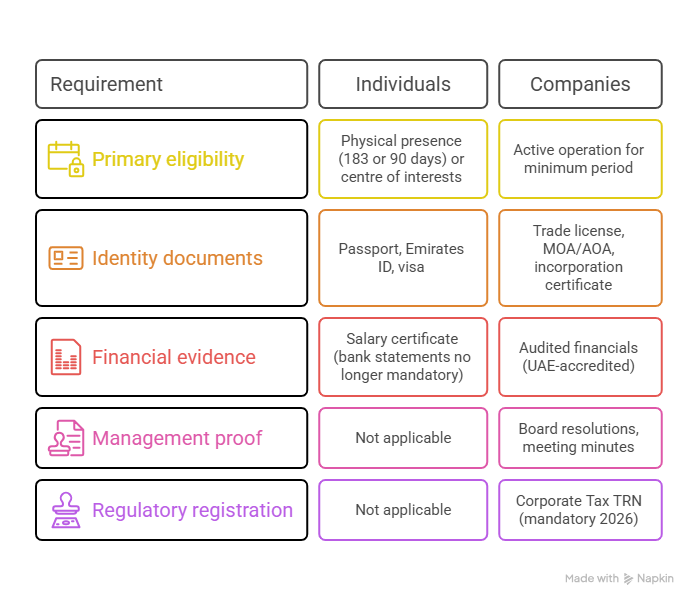
TRC Document Requirements: Individuals vs Companies Comparison
Why Businesses Trust RadiantBiz for UAE TRC Applications
RadiantBiz has been helping clients navigate UAE tax compliance for years. Our team of tax consultants brings deep expertise, having supported over 15,000 businesses across 160+ nationalities. We work with the FTA daily, understanding how applications are actually assessed.
The FTA doesn't correct or complete forms on your behalf. We help make sure that responsibility isn't a burden you carry alone.
FAQs
1. Do I need bank statements for my individual TRC application in 2026?
No, bank statements are no longer a standard requirement for treaty-purpose TRCs following the October 2024 FTA update. The FTA may still request them case-by-case, particularly under the centre-of-interests route.
2. Can a newly incorporated free zone company apply for a TRC?
Yes, free zone companies are fully eligible, there's no mainland license requirement. Each TRC covers a single 12-month period and must be renewed annually. Your company generally needs 12 months of operating history, though 2024 guidance allows applications after three months from the start of the relevant tax period.
3. What's the most common reason for TRC rejection?
Based on our experience and FTA clarification, the most common reasons are:
- Entry/exit report mismatch: the report doesn't cover the claimed period
- Name inconsistencies: passport, Emirates ID, and other documents show different name formats
- International form errors: the country listed doesn't match the TRC application, periods differ, or forms are incomplete, unsigned, or unstamped
- Insufficient days: if you applied under the 183-day test but your report shows fewer days, the application is rejected, there's no rounding up
Avoid UAE TRC Rejection: Get Your Documents Right the First Time
The documents required for a UAE TRC (also called a tax domicile certificate) have evolved with recent FTA updates. For individuals, the key is consistency: name formats, dates on entry/exit reports, and valid residency documentation. Bank statements are no longer mandatory for the 183-day route, but don't let that make you careless.
For companies, substance is everything. The FTA wants to see a real business making real decisions from the UAE, not just a shell with a trade license and a PO box.
Our advice is to run a consistency check before you submit anything. Match your documents, verify your dates, and make sure your application tells one coherent story.
Seek our professional on-the-ground guidance, contact us via mail at info@radiantbiz.com, WhatsApp, or call us at +971521322895!
.webp)


Anjali Jawahar ensures the seamless execution of business setup processes, making compliance and licensing effortless for clients. Her keen attention to operational efficiency helps the RadiantBiz businesses establish themselves smoothly in the UAE.


.avif)


.svg)


.svg)
.svg)
.svg)

