.png)

.png)

2.avif)
Hong Kong Vs UAE Company Formation: A Side-by-Side Comparison

Table of Contents
About the Author
This article is written by our business setup consultant with over a decade of experience helping entrepreneurs establish companies in Hong Kong and the UAE. Having worked with startups, SMEs, and international investors, they have guided businesses through jurisdiction selection, tax structuring, and banking strategies across both regions.
Key Takeaway:
- Hong Kong is the better choice for businesses targeting Asian markets and needing Common Law credibility, while the UAE suits companies focused on MENASA/Europe markets and those seeking personal tax-free residency with investor visas.
- Incorporation is fast in both jurisdictions (1–3 days for Hong Kong, 5–10 days for UAE free zones), but corporate bank account approval can take 3–6 months in either location, with the UAE currently having a slight edge for digital and crypto businesses.
- Hong Kong's 0% territorial tax on foreign-sourced income requires rigorous proof of where income originates, while UAE Free Zone 0% rates now demand real economic substance and compliance with the 9% federal corporate tax on mainland transactions.
Hong Kong vs UAE Company Formation in 2026: A Founder's Decision Guide
Two clients. Same SaaS product. One picked Hong Kong, one picked Dubai, and three years later, only one of them still has a working corporate bank account.
The choice between Hong Kong and UAE company formation isn't about which jurisdiction is "better." It's about which one matches your customer base, your tax exposure, and where you actually want to live.
This guide skips the marketing fluff. It compares setup costs, the new UAE corporate tax regime, banking realities, and visa pathways so you can pick the right structure the first time.
Note: All prices are estimates based on market rates at the time of publication. Actual costs may vary due to daily exchange rate fluctuations and potential bank transfer fees.
Asian Gateway vs MENASA Hub: Strategic Positioning Compared
Hong Kong and the UAE solve different strategic problems.
Hong Kong is the gateway to Asia. Its Common Law system is familiar to Western investors, and its integration with mainland China makes it indispensable for trade. You choose Hong Kong for credibility, deep banking rails, and a territorial tax system that has stayed consistent for decades.
The UAE is a convergence hub for the MENASA region (Middle East, Africa, and South Asia). Free zones permit 100% foreign ownership, residency visas come with the package, and the digital business environment moves fast. UAE company formation is the play for lifestyle, personal tax efficiency, and reach into Riyadh, Cairo, and London.
If your primary market is Shanghai or Tokyo, Hong Kong wins. If it's Riyadh, Cairo, or a global digital audience, and you want to actually live there, the UAE is the better fit.
Can a Foreigner Own 100% of a Company in Dubai?
Yes. Every UAE free zone allows 100% foreign ownership with no local sponsor required.
Since the 2021 Commercial Companies Law reform, most mainland activities also permit full foreign ownership, only a few strategic sectors still require Emirati participation.
Hong Kong has always allowed 100% foreign shareholding for private limited companies.
Company Formation Cost in Dubai vs Hong Kong: Setup and Annual Fees
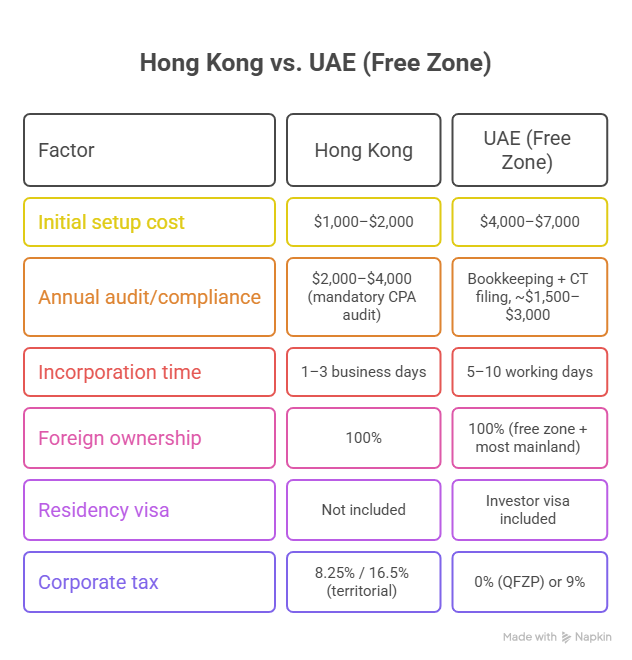
Hong Kong wins on day one. UAE free zone wins on bundled value once you need a visa and office.
Is it Cheaper to Set Up a Company in Hong Kong or Dubai?
Hong Kong is cheaper to incorporate, but the mandatory annual audit narrows the gap fast. Over three years, the total cost of ownership usually evens out. Pick based on visa needs and tax exposure, not the cheapest sticker price.
How Long Does Incorporation Take in Each Jurisdiction?
Hong Kong issues a Certificate of Incorporation in 1–3 business days for electronic submissions. UAE free zone setup runs 5–10 working days.
UAE Mainland takes 2–4 weeks once the Department of Economic Development (DED) and immigration approvals are factored in.
Expert experience: A client tried to save $3,000 by picking a low-cost UAE free zone that didn't match his business activity. Six months later, his bank froze the account because his trade license activity didn't match his transaction flow. We dissolved the entity and re-incorporated in a premium zone, double the original cost. The license activity has to match your revenue stream.
UAE Corporate Tax vs Hong Kong Territorial Tax: What You Actually Pay
Tax efficiency drives most decisions here, and most founders get it wrong.
Hong Kong runs a territorial tax system. Profits are taxed only if generated in Hong Kong. A company incorporated there but serving US clients with German servers may qualify for 0% tax.
The statutory rates are 8.25% on the first HKD 2 million ($256,400) and 16.5% above that. Claiming the 0% rate requires hard proof that income is "foreign-sourced." Skip the documentation, and the Inland Revenue Department (IRD) will tax you.
The UAE Federal Tax Authority (FTA) introduced corporate tax in June 2023 at 9% on taxable profits above AED 375,000 ($102,000). A Qualifying Free Zone Person (QFZP) still pays 0% on Qualifying Income, but selling to mainland UAE customers triggers the 9% rate.
UAE Corporate Tax in 2026: What Changed Since Launch
The 9% corporate tax has been live for nearly three years, and FTA guidance is now substantial. QFZP status requires real economic substance, qualified employees, operational expenditure, and decisions made inside the zone.
Transfer pricing documentation is mandatory for groups above AED 200 million ($54.5 million) in revenue. The Domestic Minimum Top-up Tax (DMTT) of 15% applies to large multinationals under OECD Pillar Two. If you're incorporating in 2026, build compliance from day one.
What if You Operate Companies in Both Jurisdictions?
Each entity is taxed under its own jurisdiction's rules. The UAE–Hong Kong Double Taxation Agreement, in force since 2015, prevents the same income from being taxed twice and reduces withholding on dividends, interest, and royalties.
Corporate Bank Account Opening: UAE vs Hong Kong Compared
The hardest part of going international isn't incorporation. It's banking.
Hong Kong banks are world-class but conservative. HSBC and Standard Chartered run strict compliance on non-resident directors. Incorporation takes three days, the bank account can take six months, with demands for office proof, supplier contracts, and in-person interviews.
The UAE is more receptive. Digital banks like Wio and Mashreq NeoBiz have shortened account opening for free zone entities, and Dubai banks are more open to crypto and digital service businesses. Enhanced due diligence still applies to high-risk sectors.
Budget three to four months for banking either way. If speed matters, the UAE has the edge right now.
Investor Visa and Residency: UAE Golden Visa vs Hong Kong Pathways
Hong Kong company formation does not grant residency. You'd need to hire local staff or qualify for the Quality Migrant Admission Scheme. You can run the company from anywhere, but you won't get a Hong Kong Identity Card (HKID) just by incorporating.
The UAE was built to attract talent. A free zone company qualifies you for an investor visa, 2 to 10 years, with the right to sponsor family.
Golden Visa Through Company Formation
A standard investor visa runs 2–3 years. Founders investing AED 2 million+ ($544,600) in a UAE business may qualify for the 10-year Golden Visa, which allows family sponsorship, domestic staff, and extended absences without losing residency.
Hong Kong's nearest equivalent, the Capital Investment Entrant Scheme, requires HKD 30 million ($3,846,000) in qualifying assets.
How RadiantBiz Helps
As a UAE business setup consultant, RadiantBiz has guided multiple founders through offshore company setup and jurisdiction selection.
We don't just incorporate companies, our business setup consultants structure them around your tax exposure, banking risk, and visa goals.
Our banking relationships speed up corporate account approvals, and we manage the full lifecycle from licensing to annual compliance.
Dubai vs Hong Kong Business: How to Choose the Right Jurisdiction
Choose Hong Kong if your market is Asia or China, you need Common Law credibility, you accept mandatory audits for lower upfront costs, and residency isn't a priority.
Choose UAE if you target MENASA or Europe, you want personal tax-free residency, you operate in digital, crypto, or trading, and you need fast access to corporate banking.
Don't pick on "zero tax" promises. Pick on customer base and lifestyle.
Seek our professional on-the-ground guidance, contact us via mail at info@radiantbiz.com, WhatsApp, or call us at +971521322895!

.webp)

.webp)
With over 15 years of experience in the banking and business consulting sector, Rizwan Ansari leads RadiantBiz with a vision to simplify business setup in the UAE.

.avif)


.svg)


.svg)
.svg)
.svg)