.png)

.png)

2.avif)
How to Close or Delist a Singapore Company: Options and Process


Table of Contents
About the Author
Our business setup consultant writes this article with over a decade of experience helping entrepreneurs establish companies in Singapore and the UAE. Having worked with startups, SMEs, and international investors, they have guided businesses through jurisdiction selection, tax structuring, and banking strategies across both regions.
Key Takeaway:
- You must choose between striking off and voluntary winding up strictly according to your company's assets and liabilities, striking off is only permissible for completely dormant entities with zero debts and assets, while any company holding funds, owing money, or facing legal issues must undergo the formal, liquidator-led winding-up process.
- A frequent cause of rejection is overlooking dormant bank accounts, even a negligible balance legally counts as an asset, which immediately disqualifies the company from the fast-track strike-off and forces a much more expensive and time-consuming liquidation.
- Simply ceasing operations does not dissolve a company and instead triggers a cycle of accumulating penalties, potential director disqualification, and personal liability for unpaid taxes, whereas a compliant, structured closure provides legal protection against future claims.
Why Most Company Closure Applications Fail: The Two Legal Paths to Delisting
Every year, thousands of Singapore companies are struck off ACRA's record, and a surprising number of those applications get rejected on the first try.
Closing a company here isn't about quietly switching off the lights, it's a formal legal process under the Companies Act 1967 and the Insolvency, Restructuring and Dissolution Act 2018 (IRDA).
A company stays a distinct legal entity until the Accounting and Corporate Regulatory Authority (ACRA) formally dissolves it.
Skip the statutory process and the company doesn't vanish. What you get instead is accumulating penalties, possible director disqualification, and personal liability for unpaid debts and taxes.
In practice, there are only two valid pathways: Striking Off (administrative removal) and Voluntary Winding Up (formal liquidation). This guide covers the requirements, eligibility criteria and steps for ACRA record removal so you can delist a Singapore company correctly.
Note: All prices are estimates based on market rates at the time of publication. Actual costs may vary due to daily exchange rate fluctuations and potential bank transfer fees.
Striking Off vs. Voluntary Winding Up: Which Route Fits Your Company?
The route you take is dictated by the company's financial status, not the director's preference. Misjudging it is the single biggest cause of failed dissolution applications.
What's the Difference Between Striking Off and Winding Up?
Striking off is an administrative removal for dormant, solvent companies with no assets or debts.
Winding up is a formal process led by a licensed liquidator, used when a company has assets to distribute or debts to settle.
Striking off (Section 252, Companies Act) is the fastest, cheapest route, but it requires a clean slate. The company must have no assets, no liabilities, and no pending legal action, and you apply directly to ACRA via BizFile+.
Voluntary winding up (IRDA) is the formal path. It involves a licensed liquidator (a licensed insolvency practitioner) and is mandatory if the company holds assets, owes money to creditors including IRAS, or has a complex share structure.
Expert insight: In our practice, roughly 30% of first-time strike-off applications are rejected because directors don't realise that a dormant bank account with a $50 balance counts as an "asset", which alone makes the company ineligible.
The ACRA Strike-Off Process: Eligibility, BizFile+ Steps and Timeline
To delist a Singapore company this way, you must meet strict criteria, verified by ACRA.
Eligibility Checklist
- Ceased operations: No business carried on for at least six months.
- No assets: All bank accounts closed, no physical or intangible assets remain.
- No liabilities: Nothing owed to creditors, suppliers or employees.
- Tax clearance: All filings with IRAS up to date, with no tax owing.
- No legal proceedings: The company is not party to any court case.
Step-by-Step Procedure
- Board resolution: Directors pass a resolution approving the application, with full consent.
- Settle obligations: Close all bank accounts, complete GST disenrollment if enrolled, and settle every outstanding tax liability.
- Submit application: File the strike-off application through ACRA's BizFile+ portal. (Verify current fee.)
- First Gazette: ACRA publishes a First Gazette Notification, starting a roughly 60-day objection period for creditors and agencies.
- Final Gazette & dissolution: If no objection stands, ACRA publishes the Final Gazette Notification and the company dissolution is complete.
How Much Does it Cost to Strike Off a Singapore Company?
A voluntary strike-off is the cheapest closure route.
You pay a nominal ACRA filing fee through BizFile+, plus corporate secretarial or accounting fees to finalise accounts and obtain IRAS tax clearance.
There are no liquidator fees, which is why striking off costs a fraction of a winding up.
Expert experience: A tech startup ceased operations in 2023 but left a corporate bank account open with SGD 120 in it, then applied to strike off. ACRA rejected the application immediately, citing outstanding assets.
To fix it, we had to reactivate the company, close the bank account, transfer the funds to shareholders (which triggered a tax event), and re-file for strike-off.
That added four months and extra accounting fees. The lesson is blunt: zero assets means literally zero. Any balance, however small, disqualifies you.
Voluntary Liquidation in Singapore: MVL vs. CVL Explained
When a company has assets, debts or a complicated history, winding up is the only compliant route. It's governed by the IRDA and requires a licensed liquidator.
- Members' Voluntary Liquidation (MVL): For solvent companies, where directors sign a Declaration of Solvency confirming all debts can be repaid within 12 months.
- Creditors' Voluntary Liquidation (CVL): For insolvent companies, where liabilities exceed assets.
The workflow includes shareholders passing a special resolution (75% approval) to wind up, a licensed insolvency practitioner is appointed and directors lose their powers, the liquidator notifies ACRA, IRAS and known creditors within 14 days, assets are realised and distributed in statutory order, final tax returns are cleared with IRAS, and a final meeting is held before the return of dissolution is filed.
Do I Need a Liquidator to Close My Singapore Company?
Not always. A solvent, dormant company with no assets or debts can be struck off without one.
You only need a licensed insolvency practitioner when the company holds assets, owes creditors, or has a complex share structure, that is, whenever you wind up rather than strike off.
Expert experience: A trading firm tried to strike off while carrying an undisclosed supplier debt. The supplier objected during the Gazette period and the strike-off failed.
We moved to a Creditors' Voluntary Liquidation, the liquidator negotiated a settlement from remaining funds. It took eight months but gave the directors a statutory discharge, protection a strike-off can't guarantee when debts are hidden.
Before You Close: IRAS Tax Clearance, Bank Closure and Record Retention
Three areas demand strict compliance regardless of route. Neglecting them is the main cause of post-closure liability.
- Tax (IRAS)
File the final return (Form C-S/C) for the year of cessation, disenroll and file a final GST return if enrolled, and ensure withholding tax on non-resident payments is settled. IRAS must issue a "No Objection" before ACRA finalises dissolution.
- Bank closure
A company can't be struck off with an active account. Close all accounts and transfer remaining funds to shareholders (MVL) or surrender them to the liquidator. A lingering account accrues charges that become company debts, and invalidate a strike-off.
- Records
Statutory records retention rules in the Companies Act require minutes, records and financial statements to be kept for five years after dissolution. If a creditor sues or a tax audit follows, these are your only defence. Store them securely or transfer custody to a corporate secretarial services provider.
What Happens If You Don't Close a Singapore Company Properly?
Walking away is a high-risk strategy with real consequences:
- Accumulating penalties: Late-filing fees for annual and tax returns build up indefinitely.
- Director disqualification: Repeated non-compliance can bar you from any Singapore company board.
- Personal liability: For insolvent trading or tax breaches, directors can be held personally liable.
- Reputational damage: A non-compliance record follows you into future ventures and visa applications.
Forced Strike-Off: When ACRA Closes the Company for You
If a company stops filing annual returns or loses its official physical office, ACRA can begin a forced strike-off on its own initiative. The company is gazetted and, if nothing is done, struck off without directors ever choosing the timing.
It's not a clean release: penalties for past non-compliance can still apply, IRAS matters stay open, and creditor objections must still be cleared. A planned, voluntary closure almost always costs less.
What If You Need the Company Back? Restoring a Struck-Off Entity
Closing a company is rarely as final as it feels. A struck-off company can usually be restored to the ACRA record within six years of dissolution.
There are two routes:
1. Court-ordered restoration: It is used when you can show good cause, an unresolved contract, a live dispute, or assets that surfaced after closure.
2. Administrative restoration: This is available by ACRA only in limited cases, such as settling an outstanding IRAS matter.
Either way, restoration is slower and pricier than a clean exit. That's the strongest argument for getting closure right the first time: settle every liability, distribute every asset, and keep your records, so no one has reason to drag the company back to life.
Strike-Off vs. Winding Up: A Side-by-Side Decision Guide
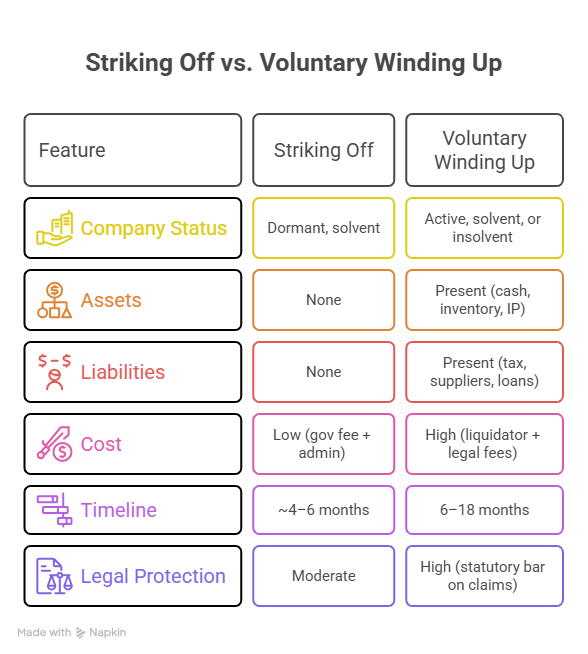
Close or Delist a Singapore Company with RadiantBiz
Closing a company well takes more than filling in forms, it takes oversight that catches hidden liabilities before ACRA does.
At RadiantBiz, our team runs the solvency assessment, secures IRAS tax clearance, manages liquidator appointments where needed, and files final resolutions with ACRA, whether you're striking off or winding up.
We make sure records are preserved, accounts are properly closed, and your exit is legally watertight. Talk to us before you file, not after a rejection.
FAQs
1. Can I close a Singapore company if I still owe money to the bank?
No, a company with outstanding debts can't be struck off. You'd need a Creditors' Voluntary Liquidation to settle debts legally.
2. How long does it take to delist a Singapore company?
A strike-off generally takes about 4–6 months, including the roughly 60-day Gazette objection period. A voluntary winding up runs 6 to 18 months, depending on asset realisation and creditor settlement.
3. Do I need to file taxes before closing my company?
Yes, under the Income Tax Act, all outstanding returns must be filed and liabilities settled with IRAS before dissolution.
Closing Your Singapore Company the Compliant Way
Delisting a Singapore company comes down to one thing: getting the route right for your company's actual financial position.
Striking off is fast and cheap for a clean, dormant entity, whereas winding up gives formal protection when assets or debts are in play.
The risks of doing it badly, penalties, personal liability, a forced strike-off you didn't choose, are too steep to gamble on. If your company has any assets, debts or history, a licensed liquidator isn't optional, it's the law.
For a clear assessment of your company's status and a tailored closure plan, seek our professional on-the-ground guidance, contact us via mail at info@radiantbiz.com, WhatsApp, or call us at +971521322895!

.webp)

.webp)
With over 15 years of experience in the banking and business consulting sector, Rizwan Ansari leads RadiantBiz with a vision to simplify business setup in the UAE.

.avif)


.svg)


.svg)
.svg)
.svg)